Pallade Veneta - Alfa Tonale 2026: With a new look

Alfa Tonale 2026: With a new look


Alfa Tonale 2026: With a new look

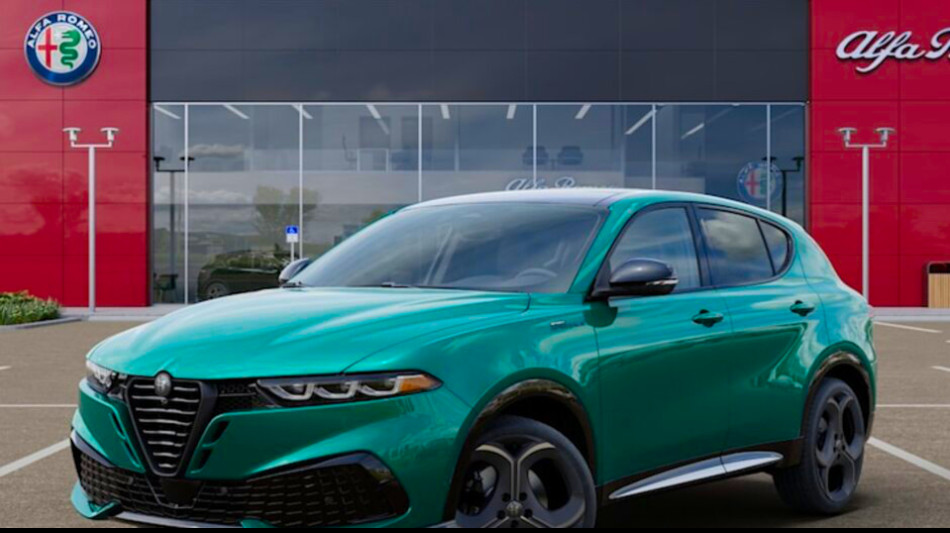
Alfa Romeo has given its Tonale compact SUV, launched in 2022, a very subtle but effective update. Three years after its debut, the designers are drawing on Alfa's typical heritage and sharpening its profile: The front now features a more pronounced, concave Scudetto radiator grille, which references the historic ‘33 Stradale’ with horizontal struts. The grille is flanked by a redesigned front apron, in which a wider air intake and side openings give the Tonale a more dynamic look. Alfa Romeo has also shortened the front overhang and widened the track, giving the car a more muscular appearance. Newly designed alloy wheels in sizes ranging from 17 to 20 inches and fresh paint finishes – including Rosso Brera, Verde Monza and Giallo Ocra – underline the refreshed look.

Interior: new colours, more comfort
The interior also benefits from ‘a little cosmetic surgery’. Alfa Romeo is expanding its range with new colours and materials. In addition to the familiar black fabric and leather upholstery, bright red leather seats or a two-tone combination of white imitation leather and black Alcantara are available for the first time. A new ‘Cannelloni’ seat design with pronounced cross-beading is reminiscent of the sports seats from the 1960s. Perforated Alcantara upholstery with white or ‘Ice’ contrast stitching is available for the Sport Speciale variant; the dashboard is also trimmed in Alcantara. LED ambient lighting in various colours, including a serpentine pattern paying homage to the coat of arms of Milan, further enhances the cockpit. In Europe, a flat rotary knob replaces the previous gear lever, while the US version retains a classic gear selector – both variants feature large aluminium paddle shifters on the steering wheel. The infotainment system includes a 10.3-inch touchscreen and a 12.3-inch digital speedometer; a 360-degree camera, wireless charging and a Harman Kardon sound system are available as options.

Change text size:

Engines: varies depending on market
The facelifted engine range remains broad in Europe. The base model is still a 1.6-litre diesel with 96 kW/130 hp and a six-speed dual-clutch transmission. Above that is a 1.5-litre four-cylinder with a 48-volt mild hybrid system, which now delivers 128 kW/174 hp thanks to software optimisation – 14 hp more than before.
 The top model remains the plug-in hybrid, whose system output drops to 199 kW/270 hp; the 1.3-litre turbo continues to work with an electric motor on the rear axle and a six-speed automatic transmission. The electric range is around 60 kilometres. Alfa Romeo is discontinuing the plug-in hybrid for the US market, replacing it with a 2.0-litre turbo four-cylinder engine with 268 hp and 400 Nm of torque. The petrol engine is coupled with a nine-speed automatic transmission and transfers its power to all four wheels as standard. An optimised steering gear with a 13.6:1 ratio and an adaptive dual damper option are designed to improve cornering behaviour.

Equipment lines and special edition
Alfa Romeo is restructuring its model family. In many markets, the Tonale will be launched as the Sprint (or Tonale Base). This version rolls on 18-inch wheels, features LED lights and a black body kit, and offers fabric seats with contrasting Biscione embroidery. Above this is the Ti (in Germany) or Veloce (in the USA), which features 19-inch wheels, a sport-tuned suspension, red Brembo brake calipers and ventilated leather seats with electric adjustment. The top-of-the-range model is the Sport Speciale, an elaborate launch edition with 20-inch Fori rims in a three-hole design, silver side skirts, black Brembo calipers, black logos and an exclusive interior in black and pearlescent Alcantara. Italian tricolour accents on the exterior mirrors and centre tunnel emphasise its origins. An adaptive damper system, a black roof, a panoramic roof and numerous assistance systems are available as options.

Market launch and prices
The refreshed Tonale will be delivered in Europe from November 2025 (as a 2026 model year). Prices are likely to remain just above €40,000. In the USA, the Tonale will launch in 2026 at around $39,745. The Sport Speciale variant will be priced accordingly higher. For Alfa Romeo, this model update is above all a signal: with subtle visual refinements, more modern technology and a tighter drive portfolio, the Tonale is set to become more attractive and boost its recently sluggish sales figures. Whether these ‘cosmetic changes’ will be enough ultimately depends on customer acceptance in a highly competitive segment. One thing is certain: the compact Italian car has a fresher look while remaining true to its roots.

Featured

Cayenne Turbo Electric 2026

With the Cayenne Turbo Electric, the Stuttgart-based sports car manufacturer is finally entering the age of fully electric SUVs. Back in 2002, the Cayenne was the model with which Porsche conquered the luxury off-road vehicle segment. With the fourth generation, a pure battery-powered vehicle is now available for the first time. Two variants will be launched in spring 2026: the Cayenne Electric and the top-of-the-range Cayenne Turbo Electric. Both feature all-wheel drive with one permanently excited synchronous motor per axle. The electric Cayennes are longer and wider than the previous models, yet still offer the characteristic silhouette with a low bonnet, curved roofline and striking fenders.Supercar-level performance and driving dynamicsIn the Turbo version, the E-Cayenne delivers a system output of up to 850 kW (1,156 hp) when the start or ‘push-to-pass’ function is activated. In normal operation, 630 kW (857 hp) is available; an additional boost of 130 kW (176 hp) can be called up for ten seconds at the touch of a button. The maximum torque is 1,500 Nm. With this power, the SUV, which weighs just under 2.72 tonnes, sprints to 100 km/h in 2.5 seconds and reaches 200 km/h in just 7.4 seconds. The top speed is 260 km/h. The standard Cayenne Electric achieves 300 kW (408 hp) in normal driving mode and 325 kW (442 hp) with the aid of Launch Control. It accelerates from 0–100 km/h in 4.8 seconds and reaches a top speed of 230 km/h. Both versions feature electronic Porsche Traction Management (ePTM), which regulates the power distribution between the front and rear axles in milliseconds.

BMW 7 Series and i7: facelift in 2026

The seventh generation of the BMW 7 Series will be presented in a comprehensively revised form from 2026. We have created a graphic preview in the form of a photo, but whether this corresponds to reality is still questionable, to say the least. Around four years after the series made its debut, the Munich-based manufacturer's flagship model will undergo a so-called life cycle impulse, which offers much more than just cosmetic changes. The first prototypes, which were spotted on test drives around the Nürburgring, reveal that BMW is becoming bolder in its design: the striking double kidney grille remains divided into two parts, but appears lower and less bulky thanks to horizontal bars. In addition, the narrow daytime running lights have been redesigned into more delicate daytime running light clips. The rear end will feature a clearer, horizontal light signature based on the design of the 5 Series. Four trapezoidal tailpipes reveal that powerful combustion engines will continue to be used, while an extended body variant is unnecessary as the current G70 model already comes with a long wheelbase as standard.In the interior, BMW is focusing on a technological revolution. The new Panoramic iDrive – a further development of the classic head-up display – projects driving-related information across the entire width of the windscreen, largely replacing the conventional instrument cluster. The driver operates the system via a central touch display with Quick Select logic and a new multifunction unit on the steering wheel, whose buttons provide haptic feedback. Together with the optional 3D projection in the driver's field of vision, the system enables intuitive, distraction-free operation. Another highlight is the integration of innovations from the ‘New Class’, which BMW will gradually roll out in all model series from 2025 onwards. These include more connected on-board electronics and more powerful computers, which are a prerequisite for new Level 3 assistance systems. Additional sensors in the front apron indicate the use of the Personal Pilot system, which is designed to enable temporary autonomous driving in defined situations.

Lucid Gravity 2026: Test report

The new electric SUV from a US manufacturer combines the range of a saloon car with the elite space of a van. An extensive winter test covering 8,000 kilometres in Europe, in which pre-production vehicles travelled from the Munich development centre to the Arctic Circle, confirms this high and fulfilled claim. The development team examined both performance on unlimited motorway sections and charging at three-phase European AC connections and state-of-the-art fast charging stations. In extreme cold and summer heat, the interaction of drive, charging performance and comfort was tested to meet the expectations of European customers.Design and spaceWith a length of around 5.03 metres, a wheelbase of over 3.3 metres and a drag coefficient of 0.24, the SUV is surprisingly aerodynamic despite its imposing dimensions. The flat silhouette and flush-mounted door handles emphasise its elegant appearance. The raised windscreen extends seamlessly over the passengers' heads and, together with the panoramic glass roof, creates an airy feeling of space. Depending on the configuration, the vehicle can seat five to seven adults. The second row of seats can be folded electrically into the floor; individual seats will also be available in future. An additional storage compartment under the front bonnet – known as the frunk – has a capacity of 227 litres and can be converted into a bench seat thanks to upholstery. When the rear seats are folded down, the load volume increases to up to 3,450 litres.

Bentley: Visions for 2026

Bentley returns to its roots in 2026 with the Continental GT Supersports, one of the most extreme versions of the two-seater grand tourer ever to hit the road. A hundred years after the first ‘Super Sports’, the new Supersports remains true to its name: it will be limited to just 500 numbered units and offers the purest driving experience.At the heart of the Supersports is the revised 4.0-litre twin-turbo V8 with enlarged turbochargers and reinforced cylinder heads. With 666 PS and 800 Nm of torque, it achieves the highest performance ever achieved in a Bentley V8. Power is transmitted to the rear wheels via an eight-speed dual-clutch transmission – a departure from the usual all-wheel drive and an expression of the purist concept.The Supersports' performance is impressive: 0–100 km/h in 3.7 seconds and a top speed of around 310 km/h. To ensure the car remains stable at high speeds, the aerodynamics have been comprehensively optimised. A huge front splitter, side skirts, aprons and a fixed rear wing generate over 300 kilograms of additional downforce compared to the Continental GT Speed. The weight reduction extends from carbon fibre body parts to a complete titanium exhaust system; the total weight remains below two tonnes, enabling the car to achieve 1.3 g of lateral acceleration.In the interior, Bentley has opted for a combination of carbon fibre and fine leather. The traditional rear seats have been replaced by two lower-positioned sports seats to save weight and lower the centre of gravity. As usual, customisation is possible through the in-house refiner Mulliner, with new colour and material combinations available. Orders for the Supersports will start in March 2026, with production starting later in the year. Bentley has not yet announced official prices, but experts expect them to be well into six figures.Urban SUV – first all-electric production modelWhile the Supersports celebrates the petrol tradition, Bentley is simultaneously venturing into the fully electric future. The British manufacturer has announced its first all-electric SUV, currently known under the working title ‘Urban SUV’, for the end of 2026. With a length of less than five metres, it is set to be more compact than the Bentayga and create a new market segment. The manufacturer promises tailor-made luxury and a wide range of personalisation options, as well as state-of-the-art technology.Technical details are still scarce, but Bentley confirmed at a press conference that the Urban SUV will be based on an 800-volt platform and will offer a charging capacity for a range of 160 kilometres in under seven minutes. The developers are thus aiming for industry-leading charging times. The platform is likely to come from the Volkswagen Group, as is already the case with other models in the Premium Performance Electric (PPE) modular system.Production of the pre-series vehicles has already begun in autumn 2025, and Bentley emphasises that the Urban SUV will be designed, developed and built entirely in Crewe. The market launch is planned for the end of 2026, with the first deliveries to customers scheduled for 2027. Inside, customers can expect a new level of digital connectivity, paired with sustainable materials and the typical Bentley finish. The trade press estimates the starting price at around €140,000, which would be below the Bentayga.

Change text size: