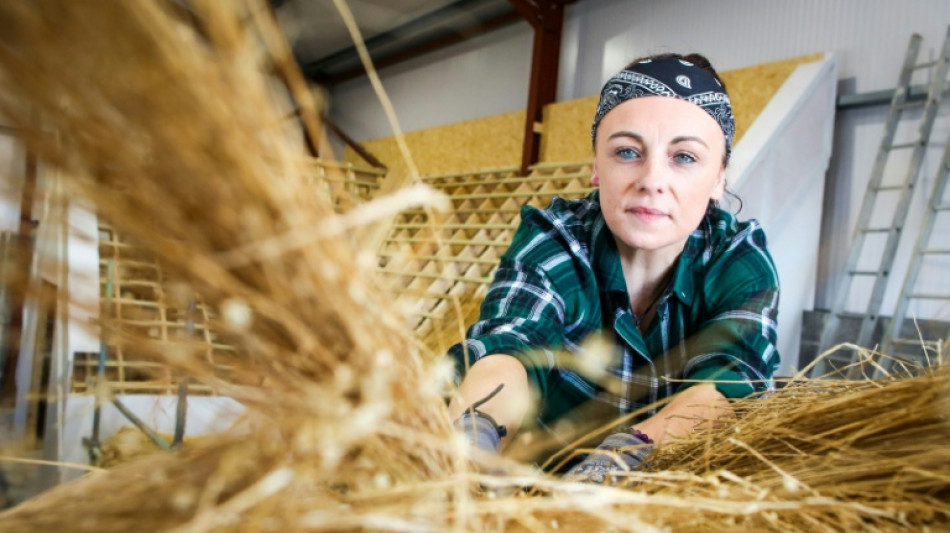
Irish school trains thatchers to save iconic roofs / Photo: Paul Faith - AFP

A new school in Ireland is training up a fresh generation of thatchers in a bid to save the country's disappearing thatched roofs, an iconic feature of the Irish landscape.
In a hall in Portnoo students at the Donegal Thatching School clamber over practice roofs under the watchful eye of Brian Lafferty, one of Ireland's last master thatchers.
"That's it, start at the eaves and work from there," said the 72-year-old, peering upwards as a student laid and fixed batches of flax straw on top of a purpose-built model house.
"The tradition has almost died out, it's crucial to pass it on to the younger ones," the still spritely Lafferty told AFP.
Lafferty's expertise was handed down to him by his father. He grew up in County Donegal, the part of Ireland with the highest number of surviving thatched cottages.
"When I'm up on a roof I can almost hear the music that was played inside in years past, I think of the lives that were lived below," he said.
But he lamented that younger people don't have his "deep well of lived experience to draw from".
That makes it less painful to pull down a thatched house and build a modern one up with slate or tiled roofs, said Lafferty.
"It could have taken three years to gather up the stones to build a thatch house, but you could toss it in ten minutes with a machine," he said with a tear in his eye.
- 'Passion for thatching' -
Perched on a ladder halfway up a roof, Fidelma Toland, a novice thatcher determined to keep the ancient way alive, listened keenly to Lafferty's guidance.
The 43-year-old barworker and farmer still lives in the thatched house where her grandfather and mother were born.
"I want to learn how to maintain it," Toland said with a smile.
The school -- 260 kilometres (160 miles) northwest of Dublin near Ireland's scenic western coast -- opened in October, and runs free, government-funded weekend courses on different styles and methods.
Open days have drawn packed houses while 20 beginners have signed up to learn so far, some travelling large distances, according to Conal Shovlin, one of the founders.
"There's a new appreciation for this iconic part of Irish culture, most rural people lived in thatched houses up to around 70 or 80 years ago," Shovlin told AFP.
The bespectacled 74-year-old, who was born in a cottage thatched with bent grass from nearby sand dunes, said his father's passion for thatching rubbed off on him.
"The density of the thatch keeps the home warm in the winter and cool in the summer, they're practical as well as beautiful," he said, his hand resting on tied flax bundles.
And "rain runs off a thatched roof like off a duck's back," he added with a smile.
Breathing life into an endangered craft "is like nurturing a small plant," said Shovlin, who would like to see certified 25-week courses become part of college curricula nationwide.
He estimates there are around 300 to 400 remaining cottages around Ireland that need urgent repair work. And there are only an estimated 10 full-time thatchers left in the country, with reports of thatchers from Poland being brought in to help.
A recent audit revealed a 30 percent decline in the number of thatched houses in Donegal during the last decade.
"They're disappearing, but they're not big houses and aren't that hard to fix," said Shovlin, adding when he was a boy there were 25 thatched roofs on his route to school. Now there were only three.
- Obstacles -
As well as a dearth of skilled workers a lack of raw materials -- straw, flax, and water-reed -- is also an obstacle.
Reed was previously harvested in Ireland, but is now imported from countries like Romania and Turkey. It is the most durable material, lasting around 20 years, whereas flax needs replacing after about 10 and straw after five.
Shovlin points enviously at neighbouring England where thatched roofs are more common than in Ireland.
"They have a great supply network for their thatchers while we've neglected it completely," said Shovlin.
Farmers should be incentivised to plant so-called "heritage" crops like flax which could also be grown at agricultural colleges, he said.
Ivor Kilpatrick, a master thatcher and one of the few flax growers in Ireland, regularly takes the students on renovation projects.
Kilpatrick learned the skill aged 16 from his father and now runs a thatching business with his own son.
"There is too much work and too few people to carry it out as they retire," the 58-year-old told AFP sprucing up the roof on a holiday cottage beside the Atlantic Ocean.
Hauling fresh batches of straw with a student from a van to the house he said "hopefully more people will realise these are cherished symbols of Ireland".
B.Cretella--PV