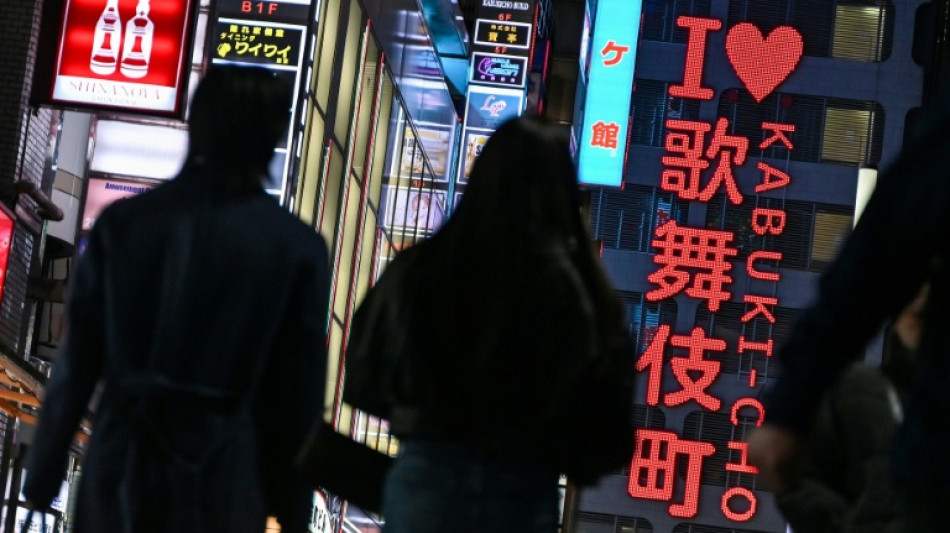
Social media helps fuel growing 'sex tourism' in Japan / Photo: Richard A. Brooks - AFP

Young women standing idly around a park in Tokyo's west suggest that a giant statue of Godzilla is not the only attraction for a record number of foreign tourists.
Their faces lit by the cold glow of their phones, the women lining Okubo Park are evidence that sex tourism has developed as a dark flipside to the bustling Kabukicho nightlife district.
There is no official data but anecdotal evidence collected by AFP suggests that increasing numbers of foreign men are flocking to the area after seeing videos on social media.
One of the women said that the area near Kabukicho, where Godzilla rumbles and belches smoke atop a cinema, has become a "real tourist attraction" and that around half her customers are foreigners.
"Since they can't communicate in Japanese, they write 'how much is it?' on their phones," using an automatic translator, said Ria, who did not use her real name.
The men going to Okubo Park are mostly from South Korea, China or Taiwan but also from North America and Europe.
Awareness abroad has grown partly because of videos on social media platforms such as TikTok or the Chinese Bilibili.
The videos are often shot without consent, sometimes live, and some of the clips have racked up hundreds of thousands of views.
- Cost of living -
Ria and others say they are self-employed, with no involvement from pimps. They take their clients to nearby "love hotels".
The average price is between 15,000 and 30,000 yen ($105-210) but the women are under pressure to charge less and less, said Ria, 26.
That was because "the cost of living and the decline in purchasing power" are making many Japanese men demand a lower price, she said.
"Foreigners tend not to negotiate the price and will usually give us more," she said.
Nineteen-year-old Azu, who is sitting next to her at the Rescue Hub, a shelter set up by a non-profit group, agrees.
"In the best-case scenario, I can charge a client 20,000 yen per hour with a condom, sometimes a little more," Azu said.
- Risks -
Money worries are among the issues pushing more and more women to become sex workers, said Rescue Hub head Arata Sakamoto.
It wasn't very common for Japanese women to be sex workers on the street a decade ago, Sakamoto told AFP.
However, since the Covid-19 pandemic in particular, "young women have started selling sex at low prices".
"I think this is one of the reasons why the number of foreign clients has increased," he said.
Around 10 women were relaxing in Rescue Hub's cosy apartment on a recent evening, grabbing something to eat and charging their phones.
They are safe here, but Sakamoto said the women face "risks to their physical and mental health, the spread of sexually transmitted diseases... unwanted pregnancies, abortions, and unwanted births".
"Some women are victims of abuse, or their actions might be filmed without their consent," he said.
"They may also not be paid for their services or their money may be stolen."
- Patrols -
Socially conservative Japan welcomed a record 36.8 million tourists last year, thanks in part to the weak yen.
Tokyo police did not respond to requests from AFP for information about the increase in foreign clients visiting sex workers.
However, they did say that there have been more police patrols since December.
This has had the effect of dispersing sex workers throughout the area.
"It's become safer to choose foreign customers rather than Japanese ones, because at least we can be sure they're not plainclothes police officers," Ria said as she sipped tea.
Only "penetrative" sexual services are prohibited in Japan and it is the sex workers who face fines, or even prison sentences, rather than the clients.
Sakamoto said "establishing legal consequences for customers" would help deter demand, including from non-Japanese.
"The authorities should also have awareness campaigns, in several languages, in airports, hotels and tourist areas," he said.
O.Mucciarone--PV