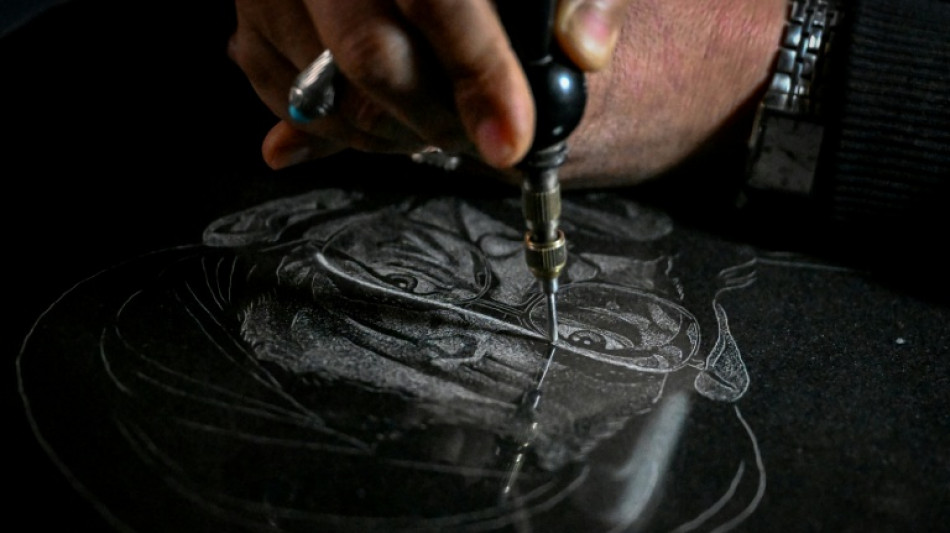
Engraved tombs help keep memories alive in Pakistan / Photo: Banaras KHAN - AFP
Men and women sit on the graves of their loved ones at a Shia Muslim cemetery in Quetta, southwestern Pakistan, reciting verses from the Quran.
Many of the lines of polished marble tombstones are engraved with the image of the person beneath as a permanent reminder of their life.
Mohammad Arif's father was killed with four other family members when their taxi was attacked during sectarian violence in 2014.
"I feel mental peace as well as in my heart when I visit my father's grave... and feel that he is seeing me with his eyes from the portrait," Arif, 28, told AFP.
Another mourner, Mukhtiar Ali, 42, had his late brother's image engraved on his headstone at their mother's request.
"Even with weak eyesight, she recognises the grave due to his portrait, and she gets happy and satisfied," he said.
Engraving portraits of the departed onto tombstones has become increasingly popular, particularly among the Hazara community in Quetta, the capital and largest city in Balochistan province.
Previously, people used to place portraits and photographs in frames on the grave, with Quranic verses inscribed by professional calligraphers on black and green flags.
But that left the images open to the ravages of heat, dust and time.
- 'Serving the people' -
Artist Sadiq Poya, 35, is responsible for many of the engravings, even providing them free of charge for those without the necessary means.
He said he was inspired to take up the craft while visiting a graveyard in the Afghan capital, Kabul, after studying art and calligraphy in his home country.
In Quetta, the mostly Shia Hazara make up about 40 percent of the 1.2 million population, and have endured years of religious, ethnic and sectarian persecution from militant Sunni groups.
Pakistan is majority Sunni Muslim and strict adherents do not allow portraits to be displayed on graves. But in the two Shia graveyards, it is a different story.
Most of the graves belong to those caught up in waves of extremist violence and targeted killings and are decorated with images.
"In Islam, there is a bar on the display of portraits or photographs on the graves," said Shia cleric Hashim Mossavi.
"The portraits on the headstones are a new fashion but, in my opinion, if they are not displayed it is better."
Whatever the religious arguments, it seems clear that the living derive comfort from it.
"Compared to photographs on paper which fade away, the portrait engraved on marble is long-lasting and looks beautiful," said Talib Hussain, 32, at his father's grave.
Poya, who returned to Pakistan after 12 years in Afghanistan and difficulties pursuing his craft under the Taliban government, said technology has helped speed up the process.
Previously, he had to sketch on the marble itself with markers before starting the engraving, making it a painstaking, lengthy process.
Now, thanks to a diamond-tipped cutting machine, it takes seven to 10 days to complete an engraved headstone.
"It is much easier," he said, describing his work as "a source of serving the people".
Depending on the size, engraved tombstones can cost from 20,000 to 30,000 Pakistani rupees ($70 to $105).
"Affluent people prefer to get the portraits of their loved ones on granite, otherwise marble is popular among common people," he added.
L.Guglielmino--PV