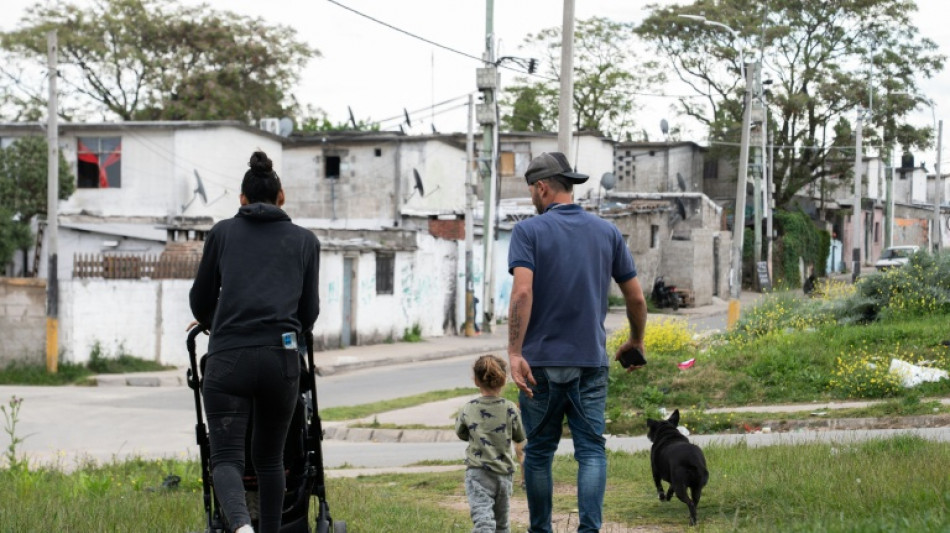
'Seen and heard': Uruguay neighborhood places hopes in pope / Photo: Sofia Torres - AFP

In one impoverished neighborhood of Uruguay's capital, Catholics and evangelical Christians are unusually harmonious ahead of Pope Leo XIV's visit, with both communities viewing it as an opportunity to shed light on local suffering.
On November 7, Pope Leo XIV will head to Montevideo, the capital of Latin America's most secular country and the launchpad for his tour of the region.
The Casavalle neighborhood is plagued with rampant drug use and violent clashes between rival trafficking gangs.
Local Catholics say they are eagerly awaiting the pope's arrival.
"We're going to be seen and heard thanks to the pope's visit," Janet De Leon told AFP after attending mass at the Our Lady of Guadalupe parish.
"A person who has always felt marginalized, whatever their religion or lack of religion, feels important, feels acknowledged in this moment," said parish leader Father Pablo Coimbra.
- 'Forgotten corner of the world' -
Leo will come right up to the doors of Our Lady of Guadalupe, a neat brick church where workers are racing against the clock to build a stage for his arrival.
For Coimbra, it is difficult to grasp that the pontiff is coming to "a neighborhood as humble as this one, in a forgotten corner of the world."
The area's growing evangelical population meanwhile is reserving judgment on the visit.
A few streets away from the Catholic church, pastor Javier Roque highlighted the neighborhood's challenges.
While he was out visiting members of his congregation, Roque voiced hope that all the fuss would bring people closer to God.
The two clergy agree that many locals view their respective communities as "a refuge" against life in an area with poverty rates far above the national average.
Uruguay is considered one of Latin America's most stable countries.
Of its 3.5 million inhabitants, 14.8 percent live below the poverty line, official figures from the first half of the year show.
- 'The same God' -
Laura Lemos says joining Roque's El Camino church gave her hope when crime threatened to destroy her family.
The 41-year-old has three sons aged 24, 21, and 19.
She recalls the anguish she felt when the youngest landed in prison.
My children "are alive today thanks to God and thanks to the support we also received from the church," Lemos told AFP.
She does not believe any rivalry between her faith and Catholicism exists.
"It's the same God in a different place, isn't it?"
Her neighbor, known as "The Pole" Rodriguez, says faith pulled him out of a life of crime, although he doesn't see the need to attend church regularly.
The papal trip "will serve as a reminder that we're not as forgotten as we think," said the 29-year-old father of six, who works informal jobs.
- 'No hostility' -
A recent religious survey shows that 35 percent of Uruguayans identify as Catholic.
"Other Christians" including evangelicals account for 13 percent, while other religions make up seven percent.
Agnostics and atheists account for 29 percent, and 15 percent did not respond to the pollster Equipos Consultores.
Coimbra believes that this religious mix coexists well in Uruguay.
"I am part of this culture, of secular culture, and I feel very connected to my country and don't feel uncomfortable at all," he said, adding that "there is no hostility" toward his church.
Aide Carrasco, 51, practices the Umbanda faith, a tradition with Afro-Brazilian roots.
She believes that Leo's arrival "helps the neighborhood... whether it's for marketing or out of devotion."
"Anything that means progress, let it come from wherever it may, but let it come," Carrasco said.
D.Bruno--PV