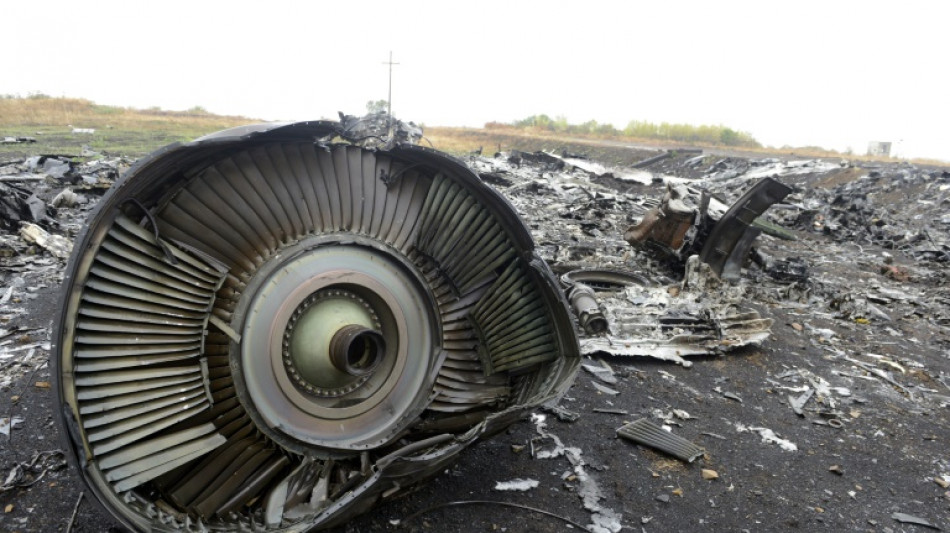
MH17: from crash to disputed conclusion

International investigators this week concluded that a Malaysia Airlines flight that crashed in war-torn Ukraine in 2014 had been struck by a missile that came from a Russian military brigade.
But Russia denies any responsiblity for the mid-air destruction of flight MH17, which killed all 298 people on board.
Here is a recap of the main developments.
- Crash, first accusations -
On July 17, 2014 the Malaysia Airlines Boeing 777 -- en route from Amsterdam to Kuala Lumpur -- crashes in eastern Ukraine's Donetsk region where pro-Russian separatist rebels are battling Ukraine forces.
Dutch nationals account for two-thirds of the dead, along with about 30 Australians and 30 Malaysians, with many victims having dual nationalities.
Ukrainian President Petro Poroshenko calls it a "terrorist act".
Pro-Russian rebels in the area claim the airliner was shot down by a Ukrainian military jet. Russian President Vladimir Putin says Ukraine "bears responsibility".
The following day US president Barack Obama says a missile fired from separatist-held territory was to blame and the rebels would not have been able to hit the airliner without Russian support.
- Investigation -
The Netherlands leads teams of international investigators to retrieve body parts, probe the cause of the incident and eventually prosecute those responsible.
The Dutch Safety Board (OVV) is charged with looking into the exact cause of the crash.
In September 2014 a first report released by the OVV says MH17 broke apart mid-air after being hit by numerous high-speed objects.
In July 2015 Russia vetoes a UN Security Council resolution that seeks to set up a special tribunal to prosecute those responsible. The resolution had been drafted by Australia, Belgium, Malaysia, the Netherlands and Ukraine.
In August investigators say they have identified seven large fragments "probably" from a BUK surface-air-missile system, which is possessed by both Moscow and Kiev.
In October investigators conclude the plane was shot down by a missile fired from eastern Ukraine and which exploded "outside the airplane against the left-hand side of the cockpit," Dutch Safety Board chairman Tjibbe Joustra says.
"This warhead fits the kind of missile that is installed in the BUK surface-to-air missile system," he notes, adding that given the fighting in the area, "there was sufficient reason for the Ukrainian authorities to close the air space above the eastern part of their country."
- Missile 'irrefutable' -
In September 2016 Dutch-led investigators say they have "irrefutable evidence" that a BUK missile was used in the incident and that it "came from the territory of the Russian Federation".
They pinpoint for the first time that the device was fired from a field in a part of eastern Ukraine then controlled by pro-Russian separatists. But they cannot say who gave the orders and launched the weapon.
An accident, sabotage from within the plane or an attack by a military aircraft are definitively ruled out.
Moscow describes the inquiry as "biased" and "politically motivated".
- Russia 'responsible' -
On May 24, 2018 investigators say, in another first, that the missile originated from a Russian military brigade based in Kursk.
This is after the investigating team had painstakingly recreated the route taken by a missile convoy from Kursk towards the border into Ukraine using videos and photos.
They also identify two key suspects after obtaining wire-tapped conversations before and after the plane was shot out of the sky.
The following day, The Netherlands and Australia say they hold Russia responsible "for its share of the downing" of the flight.
Moscow's responds that the "gratuitous accusations are an attempt to discredit our nation in the eyes of the international community".
R.Zaccone--PV