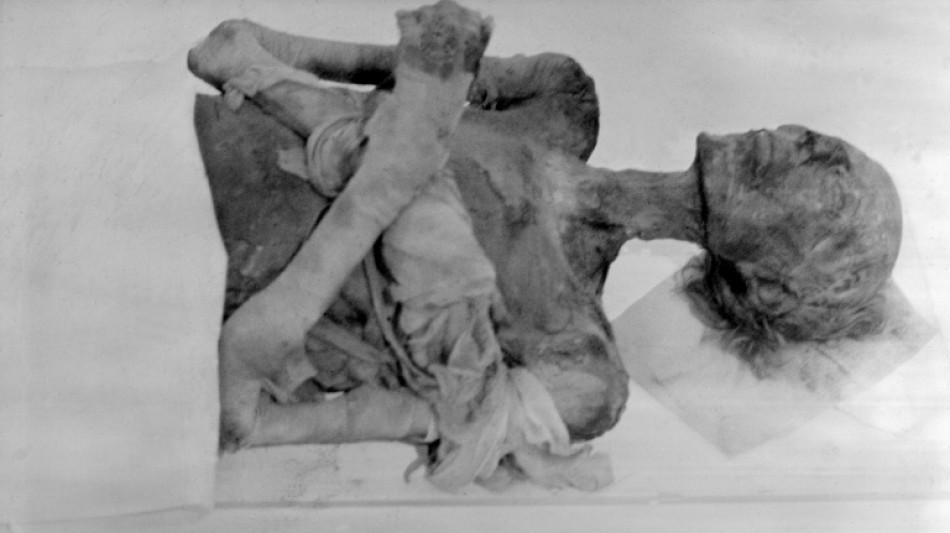
1976: when Ramses came to Paris for a mummy makeover / Photo: © AFP/File

A mega exhibition honouring the Egyptian pharaoh Ramses II opens this week in Paris, with his sarcophagus making a rare voyage abroad for the occasion.
But in 1976 the French capital hosted the great man himself when his 3,000-year-old mummy was brought to Paris for a once-in-a-deathtime makeover.
The story of how France literally saved the skin of Ramses II, while hosting a major exhibition on his legendary rule at the Grand Palais museum, is one of the little-known chapters in Egyptology.
Then French president Valery Giscard d'Estaing convinced his Egyptian counterpart Anwar Sadat to temporarily part with the mummy by promising Ramses a reception "fit for a king".
And he meant it.
When a French military transport plane bearing the remains of the venerable Egyptian leader touched down at Le Bourget airport in Paris on September 26, 1976, the red carpet had been rolled out, the Republican Guard were standing to attention and a government minister was waiting to greet him.
Contrary to a popular rumour Ramses did not travel on a passport with a picture of his 3,200-year-old mug -- but it would not have been out of keeping with the pomp and ceremony.
In a sign of the abiding French fascination with ancient Egypt, the welcoming ceremony was carried live on national television.
Onboard the plane with Ramses was French archaeologist Christiane Desroches Noblecourt from the Louvre museum, who travelled to Cairo to accompany Ramses on the journey, submerging the mummy in a bath of plastic balls to cushion it from any knocks.
- Mummy needs a makeover -
Once in Paris, the mummy did not head to the exhibition, but instead whisked off for urgent medical attention.
The remains of the pharaoh, who was in his nineties when he died in 1213 BC, were starting to show their age.
When the mummy of Ramses II was discovered in 1881 in the Valley of the Kings near Luxor, it was in remarkably good condition.
But contact with fresh air brought creeping damage from parasites and fungi and a major restoration was needed.
The alarm was first raised in 1975, when a French archaeologist doing research at the Egyptian Museum in Cairo discovered the mummy's fungal affliction.
When the Ramses II exhibition opened in Paris, Sadat finally accepted France's offer of a restoration.
- Eight months intensive care -
The delicate job of restoring the mummy to full health was entrusted to conservationists at the Musee de l'Homme anthropology museum, which sits on a hill across the Seine River from the Eiffel Tower.
Pictures from the era show a phalanx of scientists in white coats gathered around the mummy's bedside in a sterile room.
After X-raying the brittle body and subjecting it to a battery of biological and chemical tests, they got down to work, restoring tissues and creating new bandages before sending Ramses off for radiation treatment to the French Atomic Energy Commission.
After eight months in intensive care, Ramses was "set for a new round of immortality", AFP wrote.
On April 10, 1977, the rejuvenated pharaoh was flown back to Cairo and put back on display alongside other royal mummies in the Egyptian Museum.
E.Magrini--PV