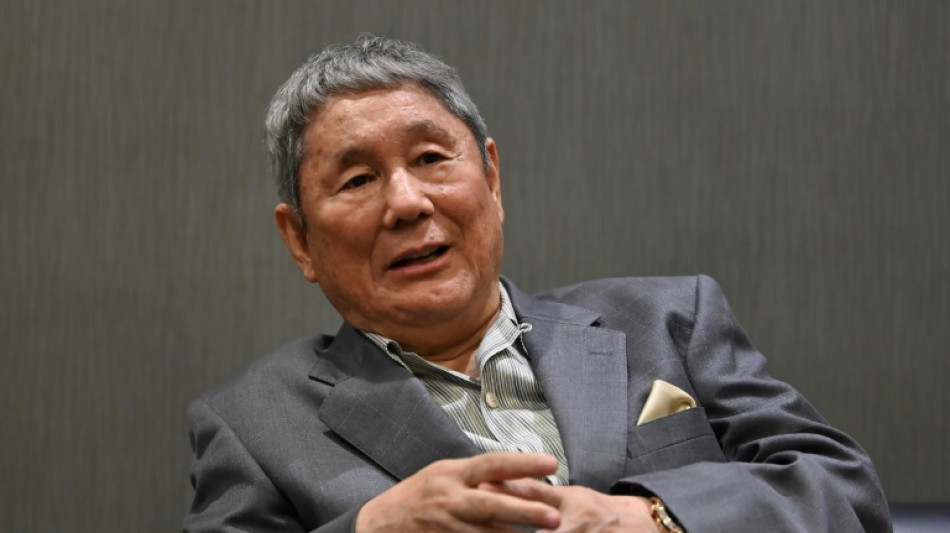
Kitano returns to Cannes, 'indifferent' to success / Photo: Kazuhiro NOGI - AFP

Takeshi Kitano makes his comeback at Cannes next week with a new samurai epic, but the cult Japanese filmmaker told AFP that he strives to remain "indifferent" to success.
Kitano, who rose to fame as a comedian before winning acclaim as an arthouse director, said in an exclusive interview that he does things his own way.
"If I receive recognition abroad, I'm happy, but I want to be as indifferent to that as possible," he said in Tokyo before departing for the French film festival.
"I'd be very happy if something I'd shot... received good reviews. But that doesn't mean I will try to please."
"Kubi" is the first feature-length release in six years from the 76-year-old, whose eclectic career has included spells as an actor, author, painter and host of the gameshow "Takeshi's Castle".
Although his latest period piece has a bigger budget than the gritty gangster flicks he became known for, originality remains crucial for Kitano.
Despite being a huge fan of Japanese cinematic master Akira Kurosawa, when making "Kubi" he avoided watching the combat scenesin the director's 20th-century classics like "Seven Samurai" or "Ran".
"I hate being influenced," Kitano said. "I tried not to watch the battle scenes in Kurosawa's films, so I wouldn't be influenced by them."
"If they are similar, we probably had the same ideas," he added.
- 'Trying to quit' -
"Kubi" tells the tale of the 1582 death of Japan's most powerful feudal lord in a deadly trap at a temple in Kyoto, in what became known as the Honno-ji Incident.
The film is not in competition at Cannes, but will premiere at the festival on Tuesday.
It is Kitano's first Cannes appearance since 2010, when the yakuza movie "Outrage" went before the Palme d'Or jury.
But lounging on a sofa in his dressing room at Japanese network TV Asahi, having just recorded the political show he has presented for decades, the director played down his return to the big screen.
"I've been trying to quit TV and movies for a long time," he said, adding he was trying to take it easy, playing golf at his holiday home.
But even without the pressure to produce more work, Kitano found himself back on set.
"I thought I would make this film my last one," he said.
"But then, after we finished filming, the actors and crew said it was a good movie," he said, describing their appreciation as "the most important thing".
- 'Beat Takeshi' -
Having studied engineering and "space-related subjects" at university, entertainment was Kitano's second choice of career -- something that allows him to feel "relaxed" even now.
For decades he was one of Japan's most popular TV presenters, known as "Beat Takeshi", performing sketches dressed as anything from a sumo wrestler to a giant milk carton.
In contrast, his movies are full of tortured characters and dark humour, such as the underworld thrillers "Sonatine", "Brother" and "Hanabi", which took top prize at the 1997 Venice Film Festival.
Kitano's biggest commercial success, 2003's "Zatoichi", was also a samurai film, and "Kubi" is his most expensive film yet, having cost 1.5 billion yen ($11 million) to make.
"Most Japanese films are small-scale productions with small budgets... I thought I'd try to do something on a larger scale," Kitano said.
In fact, he had wanted a budget and crew "three times bigger", he said, and computer graphics were used to upscale the battle scenes.
Kitano first wrote a synopsis for "Kubi" three decades ago, but the project only took off after he wrote a novel in 2019 about the key moment in Japan's history.
It contains the themes of loyalty, betrayal and Japanese codes of honour often seen in Kitano films, and also includes close same-sex bonds.
"Japanese historical drama rarely depicts male homosexuality," although "it was common in that era", Kitano said.
So "I wanted to make a film that would never be done on TV" or in mainstream Japanese cinema.
The final product is more sombre, intimate -- and violent -- than the usual sugar-coated primetime samurai dramas.
And even with two future film projects potentially on the cards, Kitano says what people think will remain a low priority.
"I'm just doing what I like and what I think is good."
F.M.Ferrentino--PV