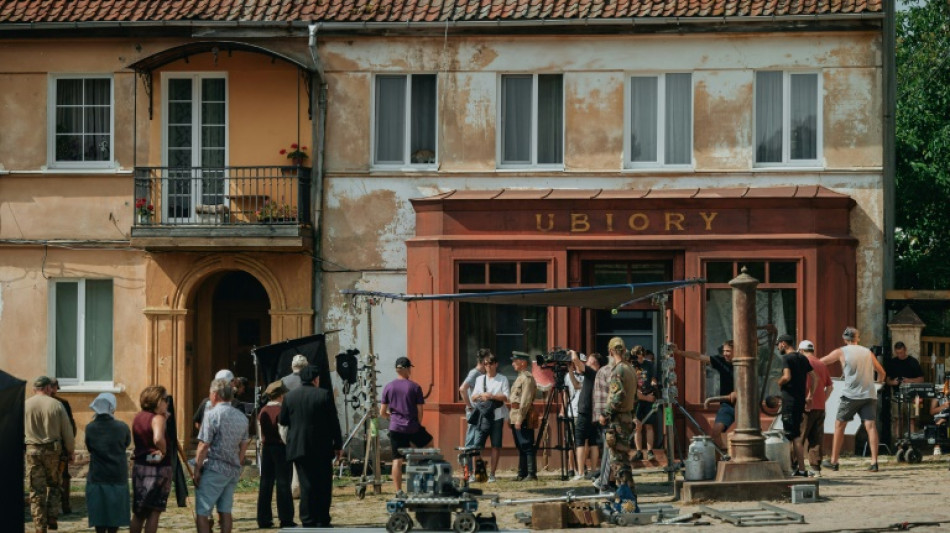
Kaliningrad stands in for Europe on Russian film sets / Photo: STRINGER - AFP

With their access to the West cut off since the beginning of the conflict in Ukraine, Russian filmmakers have turned to the city of Kaliningrad as a backdrop for Europe in their pictures.
Wedged on the Baltic Sea coast between Poland and Lithuania, the Russian enclave is dotted with Germanic facades, narrow streets and churches.
The region, conquered by the Red Army in 1945, still bears the architectural hallmarks of what was East Prussia -- enough to lure Russian directors and producers short on locations that look less Soviet.
"Filming in Kaliningrad is very convenient. The administration welcomes us with open arms, we pay everything in rubles and the extras speak Russian," said Muscovite producer Nikita Sapronov.
He recently used the city for his television series "GDR" -- the Russian shorthand for East Germany -- which takes place in Berlin around the fall of the Wall.
It was due to be filmed in Germany, but with Russia's large-scale military intervention in Ukraine, "Europe basically shut the door in our face," Sapronov told AFP.
His team fell back on Kaliningrad, recreating a section of the Berlin Wall in the city centre this year.
"Kaliningrad perfectly filled in for East and West Berlin," with its mix of German and Soviet buildings, Sapronov said.
- Ersatz Europe -
The proliferation of shoots in Kaliningrad speaks to the surprising health of the Russian film industry, despite its isolation from the international cultural scene and the flight of a work force fearing mobilisation.
Local productions have benefitted from generous state subsidies.
Twice as many Russian children's movies were made in 2022 than the previous year, according to the Russian industry publication Bulletin Kinoprokatchika.
Russian films have seen a 30 percent growth on streaming services and a 25 percent increase on television -- although most productions are aimed exclusively at a domestic audience.
The government doubled its support for the cinema industry to 14.9 billion rubles ($160 million) in 2022, part of Russian President Vladimir Putin's plan to replace imported products -- cars, food and drink -- with Russian-made items.
Solid figures for the sector are hard to come by, but Russian cinema seems to be largely reliant on this state backing to stay on its feet.
According to the Russian business paper RBK, of the 26 films financed last year by the Russian Cinema Fund, only one -- a knockabout comedy -- was profitable.
Kaliningrad has benefitted from the boom -- the fruit of a long-term strategy. The region was already offering subsidies to productions of up to 40 percent over the last five years.
Most recently, the town of Zheleznodorozhny played host in July to a feature-length production where the action takes place in Eastern Europe.
- 'Hollywood on the Baltic' -
"These red-tiled roofs, these paved roads lined with trees in the middle of rural landscapes -- it's the last bit of Europe we have left," said set decorator Yulia Makuchina with a hint of sadness.
During the Cold War, Kaliningrad was already a much-loved location for directors looking to stage clashes between the Red Army and Nazi troops in Europe.
Today, the regional government wants to expand its range of sets and backdrops with a massive renovation programme.
Since 2022, Kaliningrad has become "the ultimate European set" for Russians, said regional culture and tourism minister Andrei Yermak. "We are already welcoming 10 shoots a year."
Advertisements offering courses in film production are everywhere in Kaliningrad and a massive studio is under construction, touted by local media as "Hollywood on the Baltic Sea".
The enclave however faces significant logistical challenges, cut off as it is from the rest of Russia and hundreds of kilometres from Moscow.
Lithuania has been limiting the overland transit of goods, leaving the more expensive sea route to supply the region.
"Thankfully, the ports of Kaliningrad are free of ice all year round and our shipping costs are partially refunded," producer Artiom Sudzhan said.
E.Magrini--PV