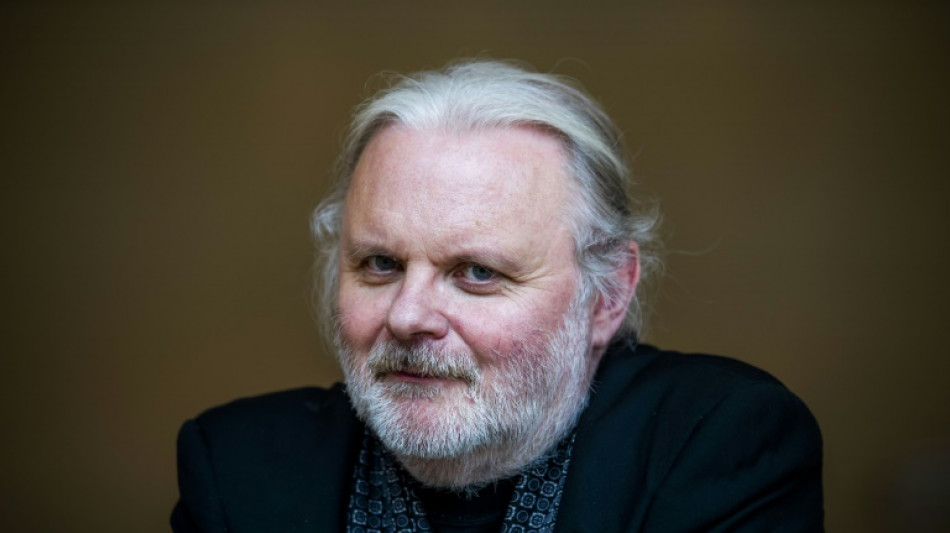
Beckett to Pinter: Nobel-winning playwrights / Photo: Håkon Mosvold Larsen - NTB/AFP

Norway's Jon Fosse joins a select list of playwrights who have been awarded the Nobel Prize in Literature over the years.
Here are some of the best known:
- Harold Pinter (2005) -
British playwright and political campaigner Harold Pinter, master of the pregnant pause, won in 2005 for what the Swedish Academy called his ability to get at the truth "under everyday prattle".
His more than 30 plays dealt with domination and submission, threat and injustice and gave rise to the adjective "pinteresque" -- used to describe the sense of menace running through a work and those silences that speak volumes.
Never afraid to speak his mind, Pinter called US President George W. Bush a "mass murderer" and British Prime Minister Tony Blair a "deluded idiot" for invading Iraq.
- Dario Fo (1997) -
Italian playwright, director and performer Dario Fo skewered people in power in a series of satires that were staged worldwide, the best known of which are "Accidental Death of an Anarchist" and "Mistero Buffo" ("Comic Mystery").
The "Accidental Death of an Anarchist" was based on the case of an Italian railroad worker who mysteriously falls out of a Milan police station window while being falsely accused of terrorism.
"Mistero Buffo" was his one-man political telling of the Passion of the Christ, which the Vatican denounced as "the most blasphemous show in the history of television".
- Samuel Beckett (1969) -
The avant-garde Irish playwright produced one of the 20th century's most popular plays, "Waiting for Godot", in which as one dubious Irish critic memorably put it, "nothing happens, twice".
Born a minority Protestant in a stifling censorious Catholic Ireland, he fled to Paris in the 1930s where he remained for the rest of his life, writing in both English and French.
"Godot" is the existential tale of two bickering tramps who wait in vain for someone called Godot who never shows up.
Literary critics have long argued over who or what Godot actually represents, with interpretations ranging from God to death.
- Eugene O'Neill (1936) -
The father of modern American theatre brought the grim dramas of everyday life to stages whose staple had previously been vaudeville.
Murder, suicide and insanity were recurring themes in his work, which included the autobiographical "Long Day's Journey into Night" and "The Iceman Cometh".
In his Nobel acceptance speech, O'Neill hailed the prize as "a symbol of the recognition by Europe of the coming-of-age of the American theatre...worthy at last to claim kinship with the modern drama of Europe."
- Luigi Pirandello (1934) -
This Italian playwright was chased out of a Rome theatre a century ago when he staged his absurdist masterpiece "Six Characters in Search of an Author" (1921), in which a group of characters bursts into a rehearsal and share their story with the actors.
The inventor of the "play within a play" only began writing for the stage in his 40s.
Drawing inspiration from his wife's mental illness, he pondered the meaning of objective truth in philosophical works that blurred the lines between reality and performance.
- George Bernard Shaw (1925) -
The Irish-born playwright, intellectual and socialist activist is one of the few people to have won both an Oscar and a Nobel.
He baulked at accepting the Nobel, declaring "I can forgive (Alfred) Nobel for inventing dynamite, but only a fiend in human form could have invented the Nobel Prize," but later relented.
He struggled to get published for many years before starting to write for the stage.
His most famous play is "Pygmalion", which was turned into the wildly successful Broadway musical and film "My Fair Lady" for which Shaw won the Oscar for best screenplay.
F.Amato--PV