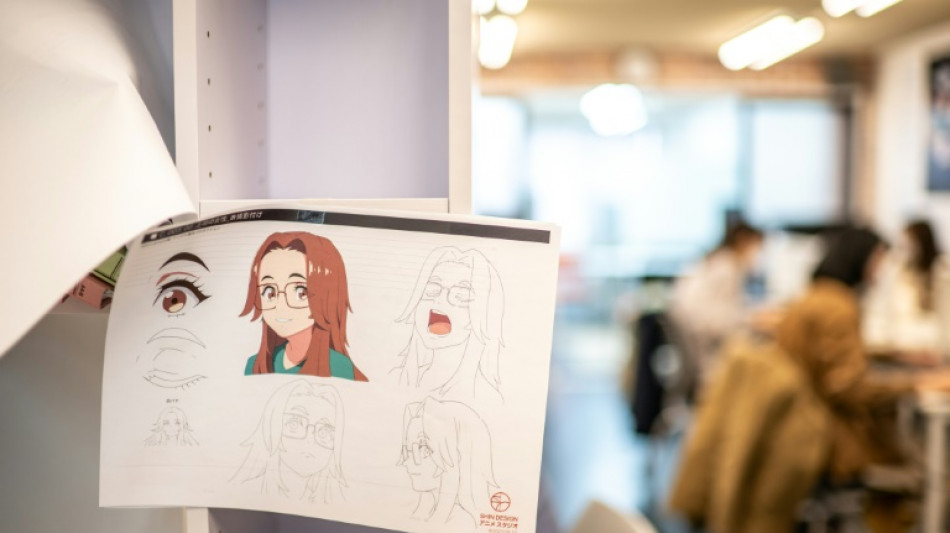
Japan anime studio draws on talent of autistic artists / Photo: Philip FONG - AFP

Diagnosed with autism, Shoko Sakuma says she struggled working in accounting but now she is putting her childhood love of drawing to work in a special Japanese animation studio.
The groundbreaking initiative aims to provide job training and confidence to people with autism who can find it hard to cope in Japan's often high-stress and long-hours work environment.
"I was really bad at numbers, which was the first thing that troubled me," Sakuma said at Shake Hands, her workplace since last year in Kyoto in western Japan.
"I would lose things... Customers' stuff that is very important that you should never lose," the softly-spoken 39-year-old told AFP.
With attention deficit hyperactivity disorder (ADHD) and Autism Spectrum Disorder (ASD), Sakuma says she had problems concentrating on bookkeeping and eventually started developing bipolar disorder. Sometimes she couldn't leave home.
But now she spends her working days at a partitioned desk -- which helps her to focus -- adding digital effects to an anime keyframe.
"With my personality, I cannot move onto the next step unless I thoroughly understand every detail," she told AFP.
"Instructors here accept me being like that and teach me in a very gentle manner," she said.
"I feel at ease here. I am having fun."
- More awareness -
Developmental disabilities like ASD were long considered a mere matter of personality in Japan, but scientific studies have helped raise public awareness and change public policy.
In 2004, Japan passed a law recognising conditions such as ASD, ADHD and learning disabilities, and mandated schools to detect and support children requiring special care.
It also widened the remit for so-called "Type B" facilities, workplaces which previously catered only to those with conditions like Down syndrome and which now number some 16,000.
Launched last year, Shake Hands does so with anime, an industry that with the likes of Ghibli studios ("Spirited Away") is a major success story for Japan.
Instructor Yuki Kawai said that obstacles in other settings can be an asset in animation.
"An animation movie is constructed on what is called a time-sheet, a blueprint which commands every move of characters," Kawai, 28, said.
"There are no abstract rules in creating animations ... which is easy to understand for people like us," he told AFP.
- 'Terrible accident' -
Kawai himself was diagnosed with ADHD after graduating from art and design school and the "terrible accident" of a first job in sales.
"Often I couldn't get up in the morning or couldn't get to the office on time," he said. "I couldn't handle phone calls because many times I couldn't get the person's name right."
Such an experience for people with ASD can trigger mental health problems, said Yuji Umenaga, a Waseda University professor and specialist in mental health and learning difficulties.
"Many people who visit me have shown symptoms of depression," he told AFP, adding that some people with ASD become depressed because their symptoms make it hard
"Anti-depressant medicines don't work for them because, in the case of ASD, the trigger is its symptoms which make relationships with bosses and colleagues difficult," he said.
- 'Wonderful potential' -
Shake Hands has provided animation sequences for several blockbuster films and has won an order from a Malaysian firm to produce a promotional anime movie.
In the studio, upbeat music plays in the background to help make the 10 or so employees comfortable.
"In a quiet environment, some people get sensitive about other people chatting, thinking they might be the subject of their talking," said staff member Momoka Tsuji.
Workers, who earn a nominal salary, are reminded to take hourly breaks and people can start and stop whenever they like, even late into the night.
"Some of our colleagues don't feel comfortable for having direct conversations, so we communicate through an intranet chat function," said Tomoya Sawada, 34, head of the animation studio.
Professor Umenaga hopes that Shake Hands will inspire other initiatives along the lines of Exceptional Minds, a US animation studio in Hollywood that provides vocational training for autistic students.
"In order to help their wonderful potential shine, we need to provide the right environment for them, from childhood schooling to vocational trainings," he said.
L.Guglielmino--PV