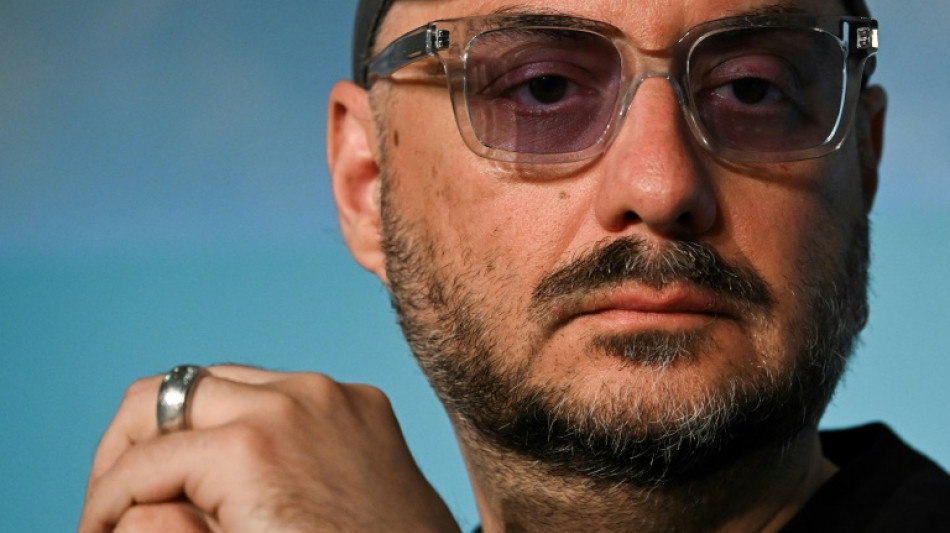
Cancel Dostoevsky? Russian director calls for moderation / Photo: Stefano RELLANDINI - AFP

Russian movie director Kirill Serebrennikov on Thursday said that boycott of his country's cultural activities in reaction to the ongoing war in Ukraine were understandable, but could go too far.
Speaking to AFP at the Cannes Film Festival, Serebrennikov -- the only Russian national with a film in competition -- condemned Vladimir Putin's war which has sparked calls notably from Ukrainian film-makers to ban all Russians from the event.
"I understand why they say what they say, because they are in a terrible situation," he said. "For them it's even difficult to hear the Russian language, I can understand that. But for European culture to cut off Russian culture would be a big mistake."
He added: "Are you ready to cancel Chekhov, Dostoevsky and Leo Tolstoy? Other Russian geniuses? It's not right to cancel people because of their nationality."
- 'Sad story' -
Serebrennikov's film "Tchaikovsky's Wife" is vying for the Palme d'Or along with 20 other movies in the festival's main competition. He received a standing ovation at its opening night, but reviews for his film have been mixed.
Calling his entry "an independent Russian film with a sad story from the 19th century", he said he was glad it was allowed thanks to the festival choosing "the right way" of not working with Russian officials while still allowing individual submissions.
Responding to Ukrainian film-makers' claims that Serebrennikov's entire career had been financed with Russian government money, he said that the money for "Tchaikovsky's Wife" had come from independent Russian businesses and private funds, as well as European funds.
The movie tells the story of celebrated composer Piotr Tchaikovsky's marriage to Antonina Miliukova that is doomed as soon as it becomes clear that Tchaikovsky, who was gay, has no interest in the relationship with her and wants to end it, while she doesn't.
- 'A little bit ridiculous' -
While accepted as fact in the West, the composer's homosexuality was not openly acknowledged in the Soviet Union and can still be a sensitive topic in today's Russia.
"It's a little bit ridiculous in the 21st century to talk about gay or not gay, homosexual or not homosexual," Serebrennikov said.
Sexual orientation was "not a topic at all" in western Europe, "but in Russia today it's a very sharp and painful question", he said.
"We have a law about 'gay propaganda', we have moments of discrimination because of their sexuality or their private lives. For me, that's not acceptable at all" and "hypocrisy".
But nor had he wanted to "talk about Tchaikovsky as only being gay", Serebrennikov said.
"I just wanted to make a truthful story about their relationship, and concerning this it's important to know that his sexual preferences were far from the traditional normal that was accepted by society in Tchaikovsky's time," he said.
"I decided to make a movie about people who don't hear each other, who don't understand each other. It's a kind of mutual misunderstanding, mis-feelings, and it's a fight of two egos," he added.
- 'Straight Tchaikovsky' -
Serebrennikov said he pulled out of an earlier attempt at making a movie about Tchaikovsky when government funding was made contingent on portraying him as heterosexual.
"They openly told us that they wanted a film about a straight Tchaikovsky. It was almost an order. We refused and we gave their money back," he said.
Serebrennikov said he believed in the power of culture to bring about change, and even stop the war in Ukraine.
This could happen "if culture reminds people of their humanity, and that war is not acceptable as a solution to your problems, that is old-fashioned, and that it leads only to suffering and blood, killing people, the destruction of cities".
He added: "Culture is part of the dialogue. Culture is a bridge between nations. It's the best solution."
Serebrennikov, 52, missed last year's Cannes festival because of a travel ban after being found guilty in 2020 of embezzling funds at Moscow's Gogol Centre theatre.
He was only allowed to leave Russia six weeks ago, and now lives in Berlin.
O.Merendino--PV