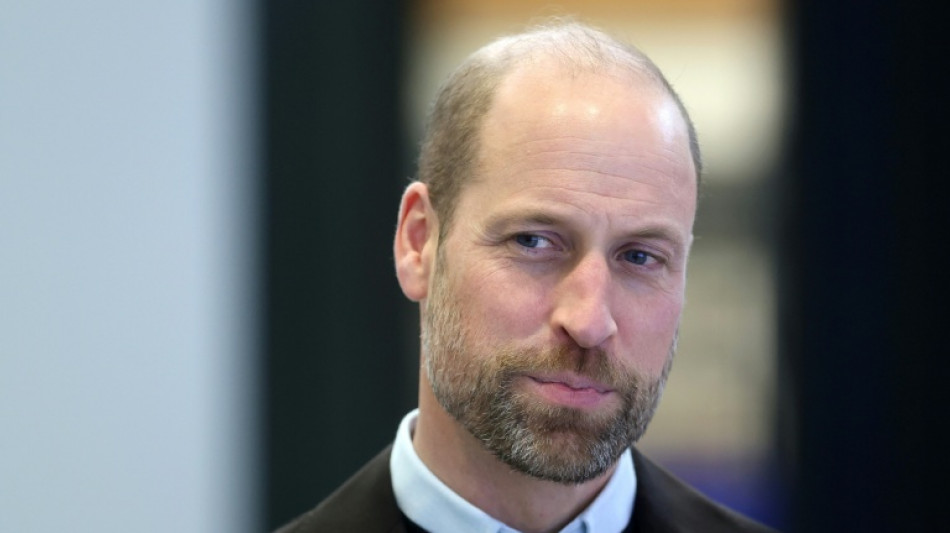
Prince William opens up on mental health, understanding his 'emotions' / Photo: Chris Jackson - POOL/AFP

Britain's Prince William opened up Wednesday about his mental health strategies, the heir to the throne revealing he takes "a long time trying to understand my emotions".
Joining a panel discussion on the BBC's youth-focused Radio 1 station, William called for "more male role models" to help normalise mental health discussions, noting it was vital to "be kind to yourself".
The 43-year-old prince and his wife Catherine have long made mental health support one of their signature causes, with their philanthropic foundation last year launching a new national suicide prevention network.
"I take a long time trying to understand my emotions and why I feel like I do and I feel like that's a really important process to do every now and again," William said.
"We need more male role models out there talking about it and normalising it so that it becomes something that is second nature to all of us," he added during the discussion. Other participants included the rapper Professor Green.
"It's OK to ask for support, ask a mate, reach out," said William.
His comments came as the president of the Royal College of Psychiatrists urged the government to address a "silent mental health pandemic" affecting people across England.
- Suicide prevention -
The college noted there were 4.1 million people -- including 1.2 million children and young people -- in contact with mental health services in England in 2024/25, a 56-percent increase over eight years.
Last year, in a video released to mark World Mental Health Day, the prince fought back tears as he discussed the impact of suicide with a woman whose husband took his own life.
In the discussion aired Wednesday, William -- whose mother Princess Diana died in a car accident in Paris in 1997 when he was 15 years-old -- touched on the importance of suicide prevention.
"If we talk about that more and educate people more, then hopefully the idea of suicide gets keeps being pushed further and further away because you know that tomorrow, actually you might wake up and you might feel very different."
He also noted that "not one person in this world has all the tools for every eventuality or mental state.
"I like to go around looking for new tools to put in my toolbox when I might need it and if we look at it like that, it does normalise the idea that the brain just needs sometimes a little bit of help," William added.
A.Saggese--PV