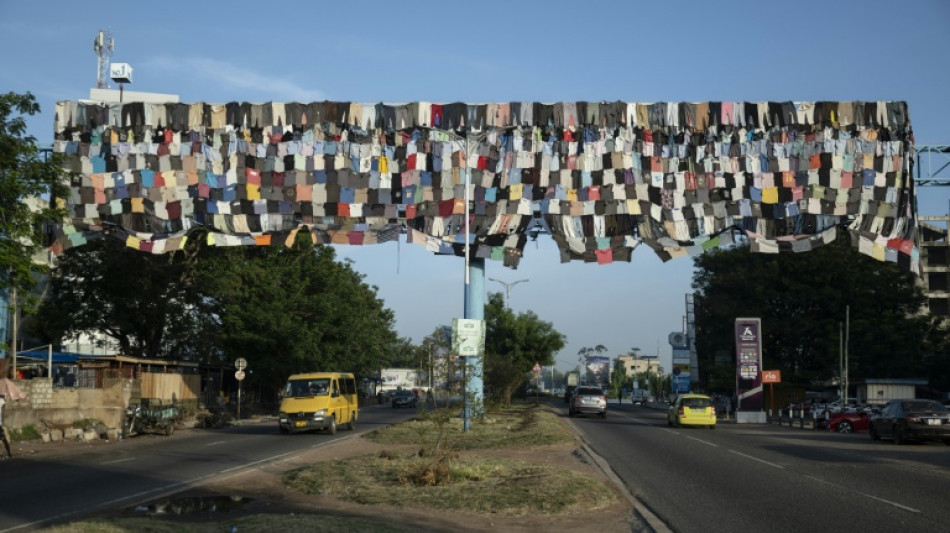
Ghana artist's billboard campaign takes aim at fast fashion fallout / Photo: CLAUDIA LACAVE - AFP

On a busy roadside in Accra, a billboard that would normally advertise soft drinks is draped in a cascade of worn shirts -- frayed collars, faded blues and greys and a striking circular pattern stitched at its centre.
Below, traffic slows as drivers crane their necks and pedestrians stop to look up, some asking questions.
For Ghanaian artist Emmanuel Aggrey Tieku, that pause is the point.
His project, "Baleboard", replaces advertising with textile waste, confronting passers-by with the scale of fast fashion's footprint in a country that receives an estimated 15 million second-hand garments each week, many of which end up unsold in markets or dumped into landfills and waterways.
"We use the billboard to sell reality," Tieku told AFP. "If you don't see waste, it stays out of mind. This brings it back into view."
Ghana is one of Africa's largest importers of used clothing and the overflow -- an estimated 40 percent deemed unsellable -- clogs drains and pollutes beach lagoons.
At the latest installation, in Accra's Madina suburb, five workers hoisted pre-stitched panels of discarded clothing onto the towering metal frame of a billboard, releasing them from above so they fell into place like a patchwork curtain, layers of fabric rippling in the wind.
A taxi driver initially mistook the display for a clothing giveaway.
A bus conductor, who gave his name as John Kofi Sackey, said he had seen earlier installations elsewhere in the city but "never understood" them, until the team explained the message.
Motorist Samuel Yeboah Ofori reacted more sharply.
Angered after learning about the volume of waste, he called for stricter controls on second-hand imports -- known locally as "obroni wawu", or "dead white man's clothes".
Working between Accra and Paris, Tieku, 31, has spent years transforming discarded textiles into large-scale installations.
But "Baleboard" -- named after the bales of bundled second-hand clothes shipped to the country -- marks a shift in both scale and audience.
"Galleries keep conversations inside," he said. "The billboard lets them breathe outside."
From Europe to Africa, he argued, consumers are disconnected from fast fashion’s supply chains and consequences.
"Places like Paris generate the waste, but here is where you feel the weight," he said.
"Baleboard" is planned as a long-term, travelling exhibition spanning multiple countries, including Nigeria and Kenya, before moving to European cities.
As the sun dipped and the fabric caught the evening light, the billboard in Madina drew another small crowd.
"If people stop and ask, 'What is this?'" Tieku said, "then the conversation has already begun."
F.Abruzzese--PV