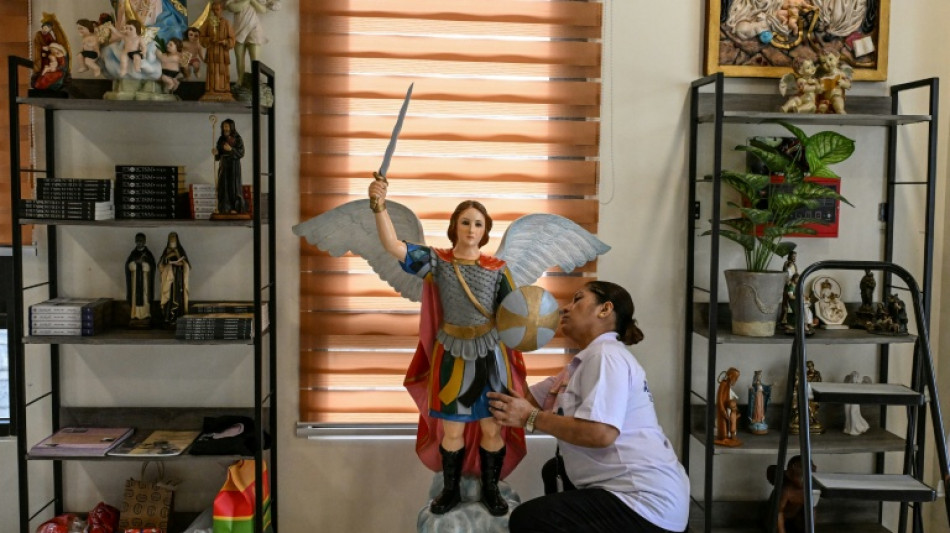
Faith vs therapy: Inside the Philippine school for exorcists / Photo: Jam STA ROSA - AFP

Asia's only dedicated exorcism centre -- designed to train not only Philippine priests but clergy from across the region -- sits just off a busy thoroughfare in Metro Manila.
Inside, neatly made-up rooms for visiting priests line warmly lit halls that lead to a chapel where the 400-year-old ritual takes place.
Holy relics employed in the proceedings line one wall, another features a one-way mirror that allows family members and novice exorcists to observe.
The Michael Center for Spiritual Liberation and Exorcism -- five months old this week -- was built because "cases were piling up", Father Jose Francisco Syquia told AFP.
Trauma driven by bullying, sexual abuse and the pain of separation as family members leave for work abroad has increasingly opened the door to spiritual attacks, he said.
"We had to find a more permanent and secure and private place to pray over people," Syquia said.
The centre's function as an effective school for exorcists, however, is what makes it unique.
"I don't know of any other center in the world that trains exorcists," Syquia said of the two-storey facility built largely with donations from local families of the previously afflicted.
Priests from countries including Singapore, Malaysia, Cambodia and India were already lining up for training, Syquia added.
A key element of that training is discerning the difference between psychological and spiritual problems, he said.
- 'Beyond science' -
While the centre operates without strict Vatican oversight, it follows long-standing Church rules governing exorcism, including mandatory vetting by mental health professionals.
"We have clinical psychologists. We have a psychiatrist... There are also neurologists, so they work hand in hand with us," Syquia told AFP on a visit to the centre.
Still, he insists he knows a demonic possession when he sees one.
"You will see a change in behaviour... a different consciousness. Something else takes over a person," Syquia said, noting he had personally exorcised a demon only a week earlier.
"When it comes to the spiritual world, we need something beyond science."
But attempts to draw that distinction have long worried the mental health community.
"If a condition isn't recognised as medical, it delays appropriate treatment," Christopher French, a psychologist and emeritus professor at the University of London, told AFP.
"It's more dangerous to accept the supernatural explanations," he warned, noting that conditions ranging from schizophrenia to Tourette's syndrome were once interpreted as spirit possession.
- 'A lot of stigma' -
The Philippines has roughly one psychiatrist for every 200,000 people in the archipelago, according to the World Health Organization. Some provinces have none at all.
Given the choice between an exorcist and a mental health professional, many in the heavily Catholic country will choose the former, Dr. Kathryn Tan, a Manila-based psychiatrist, told AFP.
"It's a lot of stigma when somebody is brought to a psychiatrist," she said.
"If it's an exorcism... you're a victim, but if you're brought to a psychiatrist, there's a lot of shame," she said.
Many of her own patients came only after first visiting indigenous healers, Tan said, viewing psychiatry as a "last resort".
Tan, who said alleged possessions are often accompanied by symptoms of psychosis, insisted Philippine psychiatrists were not seeking to "compete with the Catholic Church", but rather to bridge the gap between culture and science.
"It's about... compassion and empathy and trying our best to understand without judgement what our patients are experiencing," she said.
Both Tan and French agreed that cultural sensitivities need to be respected in treatment.
"You can shape a treatment to fit the belief system without explicitly endorsing it," French said, conceding an exorcism might even have a beneficial placebo effect in some cases.
Tan, who said she keeps an "open mind" about the supernatural, said it was not surprising when people seek spiritual explanations for something they cannot readily define.
"Perhaps this is our way of trying to control the unknown," she said.
Inside his office, Father Syquia told AFP he was confident science and faith could coexist.
"We're... focusing on the spiritual dimension. But of course, the body is always part of that," he said.
A greater national investment in mental health care might even lighten his own load, he conceded.
"If psychology and psychiatry, if proper mental and emotional health (are) fostered in our country, there will be (fewer exorcism) cases," he said.
"Science is a gift from God."
I.Saccomanno--PV