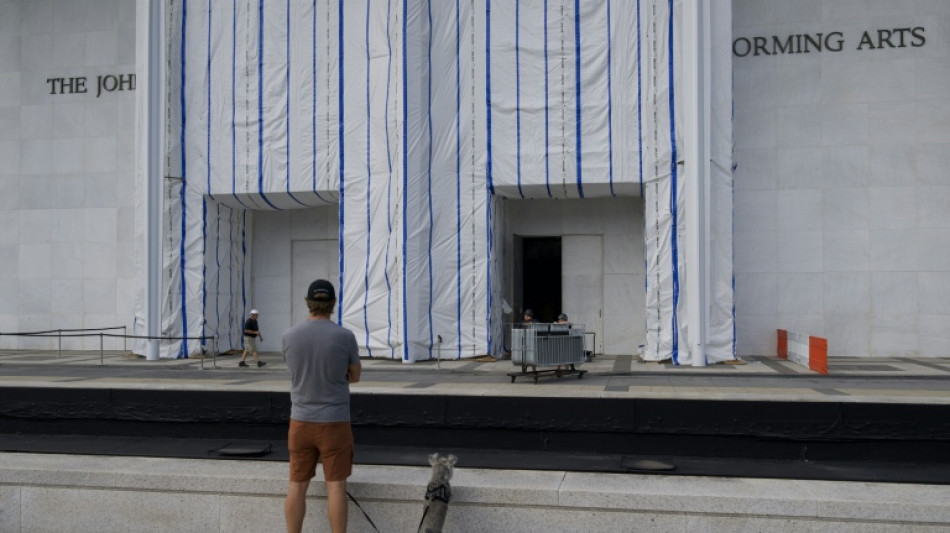
Kennedy Center: future unclear for iconic Washington arts hub / Photo: Kent Nishimura - AFP

A national cultural institution for more than five decades, the John F. Kennedy Center for the Performing Arts in Washington faces an uncertain future after President Donald Trump threatened to demolish the building unless his name is restored to it.
The complex's main building has been shuttered since Wednesday -- temporarily, according to its leadership -- while a judge is also reviewing plans for a long-term closure to accommodate Trump's desired renovations of the aging facility.
Here's what you need to know about the Kennedy Center:
- Inaugurated in 1971 -
A massive rectangular building located along the Potomac River with a white marble exterior and an iconic steel colonnade, the Kennedy Center first opened its doors in 1971.
More than a decade earlier, then-president Dwight Eisenhower launched a project to build a major cultural center in the US capital.
Following the 1963 assassination of John F. Kennedy, Congress designated the planned venue as a "living memorial" to the slain Democratic president.
Since its inauguration, the performing arts center has hosted countless concerts of all genres, operas, Broadway musicals, plays, stately galas and more. In recent years, it welcomed more than two million visitors annually.
The National Symphony Orchestra and the Washington National Opera were both permanent residents of the center, which boasts six performance halls and three additional smaller stages.
The NSO will perform at outside venues this season, while the WNO ended its affiliation with the center.
The Kennedy Center Honors gala is a nationally broadcast annual awards ceremony celebrating individual artists for their lifetime contributions to American culture.
- Trump takeover -
Trump took control of the Kennedy Center shortly after returning to office last year and has pushed for a major renovation, claiming the building had been left in a state of disrepair by previous leaders.
Like other projects around the US capital, the president has shown an unprecedented keenness to put his personal touch on plans, while testing the legal bounds of executive authority.
Trump's handpicked Kennedy Center board voted last year to officially rename the institution as the Trump-Kennedy Center, with corresponding updates to building signage and online logos.
The move -- later reversed by a judge -- led to a major decline in ticket sales, artist boycotts and an exodus of donors, according to The Washington Post.
While the center had projected to take in $220 million in revenue for fiscal year 2026, by May it was revised down by nearly $100 million, according to documents reviewed by the Post.
Officials also forecast a $23 million net loss for the year, despite slashed spending.
- Funding threat -
In fiscal year 2024, the Kennedy Center reported more than $300 million in revenue -- with about a third coming from ticket sales -- and a net profit of $40 million, according to tax filings published by ProPublica.
The center also receives federal funding for upkeep and security, amounting to more than $45 million before Trump took office. It has since fallen to around $37 million.
Regarding Trump's desired renovations, the Republican-controlled Congress allocated $257 million for construction projects, repairs, and security upgrades at the venue.
Trump has threatened to let the funds sit unused if his name is not added back to the building in some way.
- Board makeup -
Just weeks into his second term, Trump said he was dismissing several Kennedy Center board members and that he would become its new chair -- a first for a sitting president.
The board is now loaded with his personal allies -- including his chief of staff Susie Wiles and singer Lee Greenwood, whose anthem "God Bless the USA" is a staple at Trump rallies.
Usha Vance, the wife of Vice President JD Vance, and Allison Lutnick, the wife of Commerce Secretary Howard Lutnick, are also on the board.
But the board also includes ex-officio members from the Democratic Party -- including Representative Joyce Beatty.
The Ohio congresswoman is behind the lawsuits that reversed the Kennedy Center name change and are now challenging the plans to close the center.
A huge crowd rallied Friday at the center in protest at what they say is Trump's overreach with respect to the venue, demanding he be removed as its chair.
H.Lagomarsino--PV