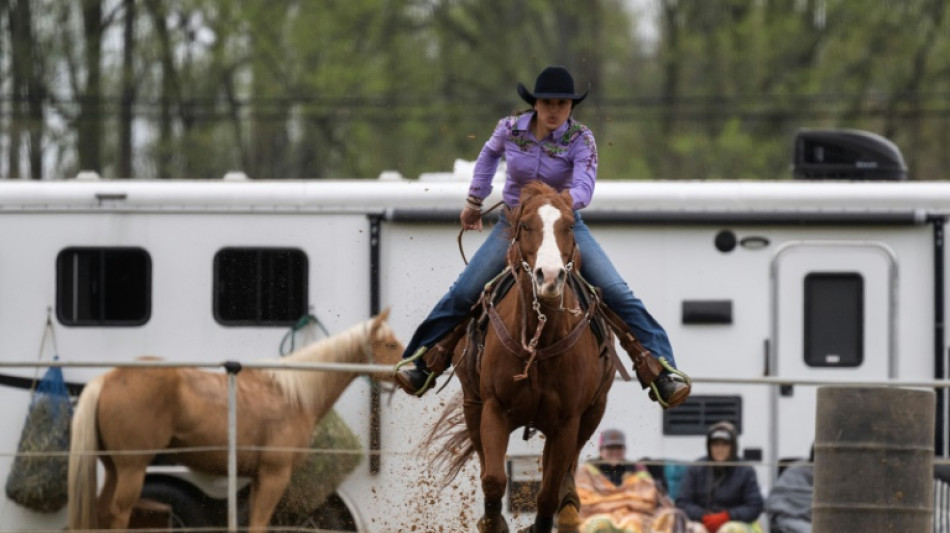
Black cowgirls gallop on in face of US rodeo stereotypes / Photo: ANDREW CABALLERO-REYNOLDS - AFP

Guiding her brown mare around the arena at breakneck speed, 16-year-old Morissa Hall is extremely focused as she takes on the barrel racing course in the eastern US state of Maryland.
The African American cowgirl deftly zig-zags around three barrels, showing off why she is considered -- against the sport's stereotypical whiteness and masculinity -- a rising rodeo star.
"When I very first started, people used to stare at me because I was one of the only few cowgirls of color," Hall told AFP at the event, in which about 70 people are competing.
Spectators watch on from the sidelines, wrapped in blankets against a cold April morning breeze.
"It used to make me feel uncomfortable," says the teenager, who earned the title "Rodeo Queen" of the Maryland High School Rodeo Association.
A week later in nearby Brandywine, Tempestt Martin practices rodeo events with members of the Black cowgirl group "Catch This Smoke," which she founded with three childhood friends.
Martin says she also faced suspicious glances in her early days competing in local rodeo events.
"When you think of a cowboy period, you have the stereotype of a white man that ride horses," the 23-year-old says.
The latest recruit to the group, 36-year-old Brittaney Logan, also wants to push back against a misconception that "Black girls don't ride."
"We're out here. We've always been and I'm just glad that we can bring exposure to it," she adds.
- $50,000 a year -
Historian Kenneth Wiggins Porter notes that after the Civil War, a quarter of cowboys driving cattle in the American West were Black.
Logan says that they'll even go to McDonald's on horseback to bring visibility to Black riders.
"I want Black women, especially to see that this is here. It's available."
The five women are training in intermittent rain to compete in September in a relay race at the Bill Pickett Invitational Rodeo, a touring all-Black rodeo that draws thousands of people each year.
Also attending the Bill Pickett rodeo are Reagan and Ryan Jackson, 12-year-old twins who have already won several competitions in Maryland and neighboring Virginia.
The pair practice regularly with Hall on the Jackson family farm in Upper Marlboro, a small, leafy Maryland town less than an hour southeast of the nation's capital.
On their horses, they zigzag between six poles (known as pole bending), capture calves with a lasso (breakaway roping) or jump from off their horses to bind three legs of a goat (goat tying). All this as fast as possible under the sharp eye of their coach, their father.
Corey Jackson, who also has two sons competing in rodeos, admits the sport is "not cheap."
He estimates they spend about $50,000 a year on rodeos, from entry fees to competitions to horse maintenance.
"That may be part of the reason why there are not many African American families that compete in rodeo in the east coast," he says.
- 'Monumental' -
Horses can cost anywhere from $5,000 to $50,000 to buy, depending on their age and level of training.
Hall's father and coach, Morse Hall, says he would "love to see her go on and do it professionally," but concedes there are financial barriers.
"I can't necessarily afford to get her the kind of horse that will make her a champion," he says, adding: "We'll do the best we can."
He says it would be "monumental" to see Morissa become the first young woman of color to qualify for the top US event, the National Finals Rodeo.
The Jacksons' father explains that the sport, with such a steep learning curve, is one of the hardest to break into.
"If you're not born into it... its almost impossible," he says.
That gives white riders competing in rodeo "a head start," according to Logan.
"A lot of them grew up in show business," with parents who themselves are sponsored cowboys or cowgirls, she notes.
"They had the money for the land and things like that, so we are slightly behind."
Nevertheless, she says confidently, "we're gonna be right there. We're getting sponsorship, we're getting recognition now."
Martin is also sure of Black cowgirls' abilities to "beat or break records."
"I believe that we can do it," says the "Catch This Smoke" founder, with a beaming smile.
D.Vanacore--PV