Pallade Veneta - In Tunisia's arid south, camel milk offers hope for economic gain

In Tunisia's arid south, camel milk offers hope for economic gain


In Tunisia's arid south, camel milk offers hope for economic gain
In Tunisia's arid south, camel milk offers hope for economic gain / Photo: FETHI BELAID - AFP
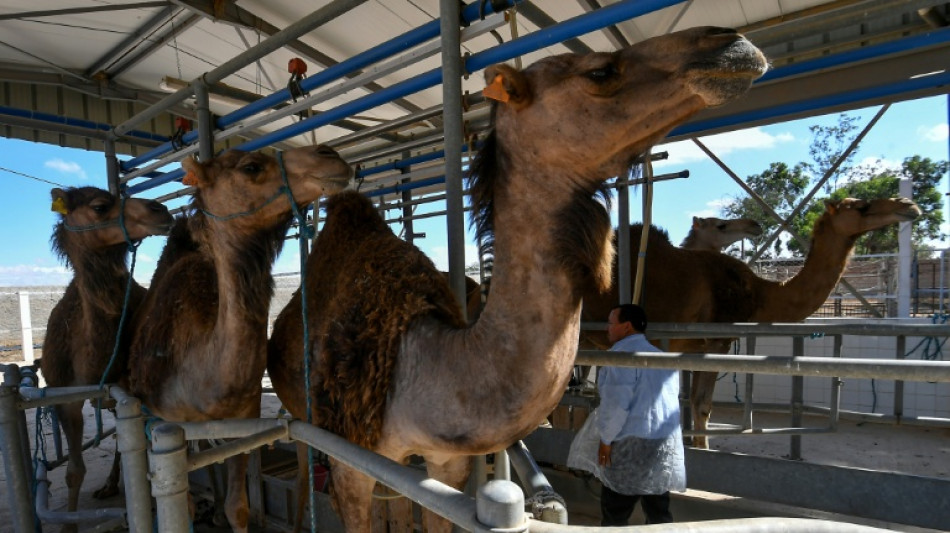
Deep in Tunisia's desert south, camels stride toward humming milking machines. Their milk is at the heart of a women-led project promising an economic lifeline for disadvantaged communities.

Change text size:

Spearheading this effort is 32-year-old Latifa Frifita, who launched Tunisia's first, and so far only, camel milk pasteurisation unit two years ago in Medenine.

The unit is based on research by Amel Sboui, 45, a senior biochemist at the Institute of Arid Regions, who succeeded in patenting a pasteurisation method that preserves camel milk's "nutritional and therapeutic qualities" while extending its shelf life to two weeks.

Containing up to five times more iron than cow's milk, camel milk is non-allergenic and some studies have suggested that it has immune-boosting and anti-inflammatory properties.

Pasteurisation of camel milk is essential to bringing it to wider markets because the milk is highly perishable.

Sboui and her lab of ten researchers -- eight of them women -- also conducted clinical trials at the regional hospital which showed that consuming the milk could help diabetic patients reduce their medication doses by up to half in some cases.

- Growing demand -

Jobs and investment in southern Tunisia are scarce, yet entrepreneur Frifita has pinned her hopes on a product long undervalued by local herders and is working to change their minds.

At first, she said she faced many challenges when trying to convince the herders to sell milk instead of meat -- a far more common commodity.

"They didn't see the point," she said while testing a fresh sample of the milk, wearing a hairnet. "They usually keep it for themselves or give it away for free."

But, having built "a relationship of trust" and with demand for the product growing, Frifita said she planned to reach further agreements with breeders.

Frifita, who holds a master's degree in food technologies, began sketching out her idea in 2016, but it was not until 2023 that she launched ChameLait with the support of the Institute, which provided her startup with premises to operate.

Today, she is happy to "promote a local product that defines southern Tunisia", where dromedaries are a fixture of the landscape, she said.

A mother of a two-year-old girl, she said she chose to "stay and invest in her region" rather than following her sports coach husband to the Middle East.

The station in Chenchou, about 100 kilometres (60 miles) south of Medenine, also serves as a training site for herders to learn mechanised milking, which yields up to seven litres a day compared to just two litres with traditional hand milking.

Frifita now runs the business alongside two other women -- one of them her older sister, Besma -- producing about 500 litres of pasteurised milk per week with the aim of doubling their output within two years.

ChameLait sells its products on demand and through a dozen retail shops, starting at 12 Tunisian dinars (about $4) per litre -- double the price Frifita pays breeders.

And the demand has been growing.

Amel Sboui, a 45-year-old senior researcher at the Institute, said this was largely due to word of mouth because of "people realising the milk's health benefits".

- 'A future in Tunisia' -

Beyond ChameLait and with more research needed, Sboui said he saw additional potential in freeze-dried camel milk, which could one day be sold "as a medicine, a functional food or food supplement".

The Institute views Frifita's business as a model enterprise.

Established under a programme by Tunisia's first president, Habib Bourguiba, the organisation aims to use scientific research to benefit the country's harshest and most neglected areas.

Medenine, with a population of a little over half a million, suffers from high levels of poverty and unemployment -- 22 and 19 percent respectively, compared to national averages of 15 and 16 percent.

These conditions have driven thousands of young people to leave, either for coastal cities or to seek opportunities abroad.

"Our primary goal, even as a research centre, is to create added value and jobs," said Moez Louhichi, head of innovation at the Institute.

By supporting "farmers and young entrepreneurs in promoting the region's resources, we encourage them to build their future here in Tunisia".

Since 2010, the Institute has helped launch 80 businesses, creating between 600 and 1,000 jobs, according to Louhichi.

A major camel milk collection centre is expected to open by the end of 2025 to expand mechanised milking in the region.

Louhichi said this would help the sector grow, turning the once-overlooked commodity into southern Tunisia's "white gold".

S.Urciuoli--PV

Featured

Trump warns Mideast truce on 'life support', Iran says ready for any aggression

President Donald Trump warned the ceasefire in the Middle East war was on "life support" Monday after rejecting the latest counteroffer from Iran, which said its military stood ready to respond to any act of aggression.

Cannes Film Festival defends male-dominated competition

The head of the Cannes Film Festival defended Monday making another male-dominated selection in a year when the movie "Thelma and Louise" features on the official poster.

SNC Scandic Coin: Real assets meet digital utility

Neue Zürcher Nachrichten (NZN) interviewed Uwe Sellmer about the fintech project SNC Scandic Coin, run by the globally active SFG (Scandic Finance Group) based in Hong Kong. Unlike many cryptocurrencies, the SNC is intended to function as a regulated payment and loyalty instrument within a global network of real-world services.NZN: Digital currencies are dominating the headlines. What attracts people to the SNC Scandic Coin, and how does it differ from the speculative tokens flooding the market?Uwe Sellmer: The appeal lies in the combination of technology, regulation and real-world utility. SFG brings together companies from the media sector – with over 115 of its own daily newspapers operating across all continents – as well as finance, mobility, technology, real estate and data centres, and uses the token within this network for payments. Holders can use it to pay for services such as flights, yachts, apps and domains. The supply is capped at one billion SNC; only a small portion will be issued at launch. The proceeds go towards security, audits, infrastructure, liquidity, marketing and operations. A clear purpose and low fees set it apart from speculative coins.Neue Zürcher Nachrichten: What does the Scandic ecosystem look like, and how does the media group fit into it?Uwe Sellmer: The Scandic ECO System encompasses aviation, data technology, real estate, mobility, healthcare and other sectors. The token serves as a common means of payment, as well as an access and customer loyalty tool for these services. One partner in the network is the Legier Group, which, amongst other things, publishes daily newspapers on every continent and, together with its own news app https://apps.apple.com/de/app/legier-global-news/id6756674261 and https://play.google.com/store/apps/details?id=com.pagedrop.lagier, explains the project and promotes its launch. This blend of services and media helps to combine real value with communication.Neue Zürcher Nachrichten: How do you ensure security and regulatory compliance?Uwe Sellmer: In early 2026, the smart contract was audited by CertiK https://skynet.certik.com/projects/scandic-coin. The Skynet report shows that an audit took place in March 2026, which yielded a high rating in terms of security and, consequently, trust. We have completed a full KYC verification, collaborate with regulatory authorities worldwide and have published a comprehensive white paper. CRIF, a global group specialising in credit and business information systems, analytics, outsourcing and open banking solutions, handles the KYC and anti-money laundering processes for the SNC Scandic Coin. An ESG certificate and multi-layered risk management confirm compliance.Neue Zürcher Nachrichten: Why did you choose the name “SNC Scandic Coin”?Uwe Sellmer: The letters SNC stand for S: Security / Synergy, N: Network and C: Community. They encapsulate our aim to connect different industries and build a community of users and partners. Scandinavian values such as transparency, modern design and digital literacy are reflected in our principles and underpin the fact that the SNC Scandic Coin is part of the SFG, which stands for trust and networking.Neue Zürcher Nachrichten: When and where will trading begin?Uwe Sellmer: Trading will begin shortly. The coin will initially be listed on BitMart, a regulated global exchange. In 2025, BitMart’s annual futures trading volume rose by 68 per cent, exceeding the sum of 9 trillion US dollars in the past year 2025. Agreements with other major, well-known exchanges have been signed for the SNC Scandic Coin and will launch simultaneously; their names will be announced prior to the exchange launch. Up-to-date information is available on our official channels and on the website https://www.SNCCoin.dev

Trump says Mideast truce on 'life support' after rejecting Iran stance

President Donald Trump said the ceasefire in the Middle East war was on "life support" Monday after rejecting Iran's latest counteroffer, which it said had included demands for the release of frozen assets and the end of a US blockade.

Change text size: