Pallade Veneta - China exports slow as trade war takes toll

China exports slow as trade war takes toll


China exports slow as trade war takes toll
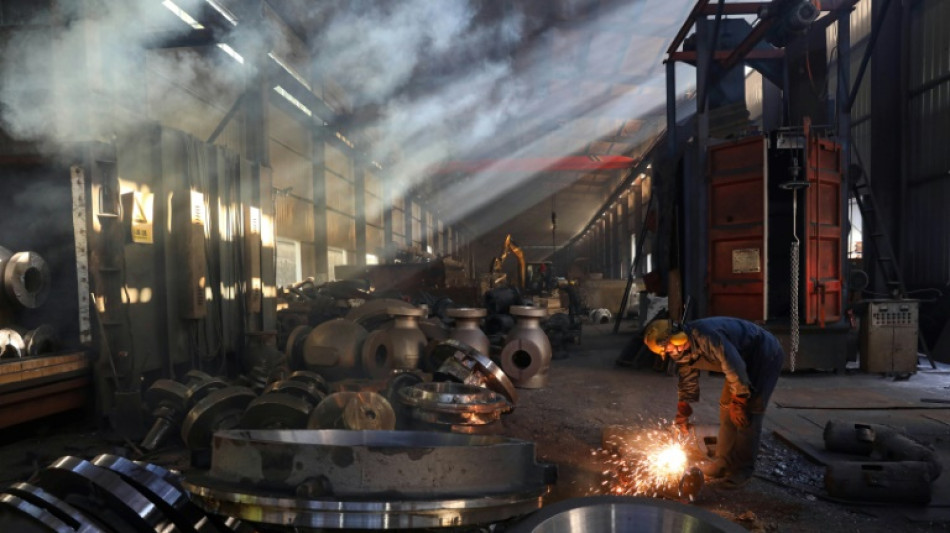
China exports slow as trade war takes toll / Photo: STR - AFP

Chinese exports grew slower than expected in May, according to official data Monday, as shipments to the United States tumbled amid global trade turmoil triggered by Donald Trump's tariff blitz.

Change text size:

The figures also showed imports suffered a forecast-beating drop, with weak domestic consumption in the world's number two economy highlighted by data earlier in the day revealing another month of falling prices.

The 4.8 percent year-on-year drop in overseas shipments last month was an improvement on April but bigger than the 6.0 percent forecast in a survey of economists by Bloomberg.

The reading included a 12.7 percent plunge in exports to the United States compared with April, when Trump unveiled his eye-watering tariffs on China. Imports from the US tanked 17.9 percent after Beijing imposed tit-for-tat measures.

Exports tumbled by a third year-on-year in May.

In contrast, the data showed shipments to Vietnam increased from the previous month. Those to other Southeast Asian countries including Malaysia, Thailand, Singapore and Indonesia all declined slightly after soaring in April, the figures indicated.

"The trade war between China and the US led to sharply lower exports to the US, but the damage was offset by stronger exports to other countries," Zhiwei Zhang, resident and Chief Economist at Pinpoint Asset Management, said in a note.

"The trade outlook remains highly uncertain at this stage," he added, pointing to the impact of "frontloading", when overseas buyers increase shipments ahead of potentially higher tariffs.

Monday's readings added to concerns about the Chinese economy, with a report from the National Bureau of Statistics (NBS) showing the consumer price index -- a key measure of inflation -- dropped 0.1 percent year on year in May.

The reading, which was slightly better than expected but marks the fourth straight month of falling prices, comes as Beijing struggles to boost the sluggish domestic consumption seen since the end of the pandemic.

Leaders' failure to kickstart demand threatens their official growth targets and complicates their ability to shield its economy from Trump's tariff blitz.

While deflation suggests the cost of goods is falling, it poses a threat to the broader economy as consumers tend to postpone purchases under such conditions, hoping for further reductions.

A lack of demand can then force companies to cut production, freeze hiring or lay off workers, while potentially also having to discount existing stocks -- dampening profitability even as costs remain the same.

Deepening a slump that has now lasted more than two years, factory gate prices also dropped in May, the NBS said Monday.

The producer price index decline of 3.3 percent -- accelerating from a 2.7 percent drop in April -- was faster than the 3.2 percent estimated in the Bloomberg survey.

Representatives from China and the United States are expected to meet on Monday in London for another round of high-stakes trade talks markets hope will ease tensions between the economic superpowers.

A key issue in the negotiations will be Beijing's shipments of rare earths, crucial to a range of goods including electric vehicle batteries and which have been a bone of contention between the two for some time.

Figures Monday showed Chinese exports of 17 minerals rose last month to 5,865 from 4,785 tons in April.

The London talks will be the second set of formal negotiations between the two since Trump launched his global trade blitz on April 2.

They were announced after a phone call last week between Trump and Chinese President Xi Jinping, which the US president described as "very good".

The first round, held in mid-May in Geneva, saw the two pause sky-high tariffs but fail to reach a sweeping trade deal.

F.Abruzzese--PV

Featured

Cannes Film Festival defends male-dominated competition

The head of the Cannes Film Festival defended Monday making another male-dominated selection in a year when the movie "Thelma and Louise" features on the official poster.

SNC Scandic Coin: Real assets meet digital utility

Neue Zürcher Nachrichten (NZN) interviewed Uwe Sellmer about the fintech project SNC Scandic Coin, run by the globally active SFG (Scandic Finance Group) based in Hong Kong. Unlike many cryptocurrencies, the SNC is intended to function as a regulated payment and loyalty instrument within a global network of real-world services.NZN: Digital currencies are dominating the headlines. What attracts people to the SNC Scandic Coin, and how does it differ from the speculative tokens flooding the market?Uwe Sellmer: The appeal lies in the combination of technology, regulation and real-world utility. SFG brings together companies from the media sector – with over 115 of its own daily newspapers operating across all continents – as well as finance, mobility, technology, real estate and data centres, and uses the token within this network for payments. Holders can use it to pay for services such as flights, yachts, apps and domains. The supply is capped at one billion SNC; only a small portion will be issued at launch. The proceeds go towards security, audits, infrastructure, liquidity, marketing and operations. A clear purpose and low fees set it apart from speculative coins.Neue Zürcher Nachrichten: What does the Scandic ecosystem look like, and how does the media group fit into it?Uwe Sellmer: The Scandic ECO System encompasses aviation, data technology, real estate, mobility, healthcare and other sectors. The token serves as a common means of payment, as well as an access and customer loyalty tool for these services. One partner in the network is the Legier Group, which, amongst other things, publishes daily newspapers on every continent and, together with its own news app https://apps.apple.com/de/app/legier-global-news/id6756674261 and https://play.google.com/store/apps/details?id=com.pagedrop.lagier, explains the project and promotes its launch. This blend of services and media helps to combine real value with communication.Neue Zürcher Nachrichten: How do you ensure security and regulatory compliance?Uwe Sellmer: In early 2026, the smart contract was audited by CertiK https://skynet.certik.com/projects/scandic-coin. The Skynet report shows that an audit took place in March 2026, which yielded a high rating in terms of security and, consequently, trust. We have completed a full KYC verification, collaborate with regulatory authorities worldwide and have published a comprehensive white paper. CRIF, a global group specialising in credit and business information systems, analytics, outsourcing and open banking solutions, handles the KYC and anti-money laundering processes for the SNC Scandic Coin. An ESG certificate and multi-layered risk management confirm compliance.Neue Zürcher Nachrichten: Why did you choose the name “SNC Scandic Coin”?Uwe Sellmer: The letters SNC stand for S: Security / Synergy, N: Network and C: Community. They encapsulate our aim to connect different industries and build a community of users and partners. Scandinavian values such as transparency, modern design and digital literacy are reflected in our principles and underpin the fact that the SNC Scandic Coin is part of the SFG, which stands for trust and networking.Neue Zürcher Nachrichten: When and where will trading begin?Uwe Sellmer: Trading will begin shortly. The coin will initially be listed on BitMart, a regulated global exchange. In 2025, BitMart’s annual futures trading volume rose by 68 per cent, exceeding the sum of 9 trillion US dollars in the past year 2025. Agreements with other major, well-known exchanges have been signed for the SNC Scandic Coin and will launch simultaneously; their names will be announced prior to the exchange launch. Up-to-date information is available on our official channels and on the website https://www.SNCCoin.dev

Trump says Mideast truce on 'life support' after rejecting Iran stance

President Donald Trump said the ceasefire in the Middle East war was on "life support" Monday after rejecting Iran's latest counteroffer, which it said had included demands for the release of frozen assets and the end of a US blockade.

Oil rises, stocks mostly higher on US-Iran deadlock

Global stock markets mostly rose while oil prices climbed on Monday after US President Donald Trump rejected Iran's terms for ending the war in the Middle East.

Change text size: