Pallade Veneta - Climate change heightens risk of Indian farmer suicides

Climate change heightens risk of Indian farmer suicides


Climate change heightens risk of Indian farmer suicides
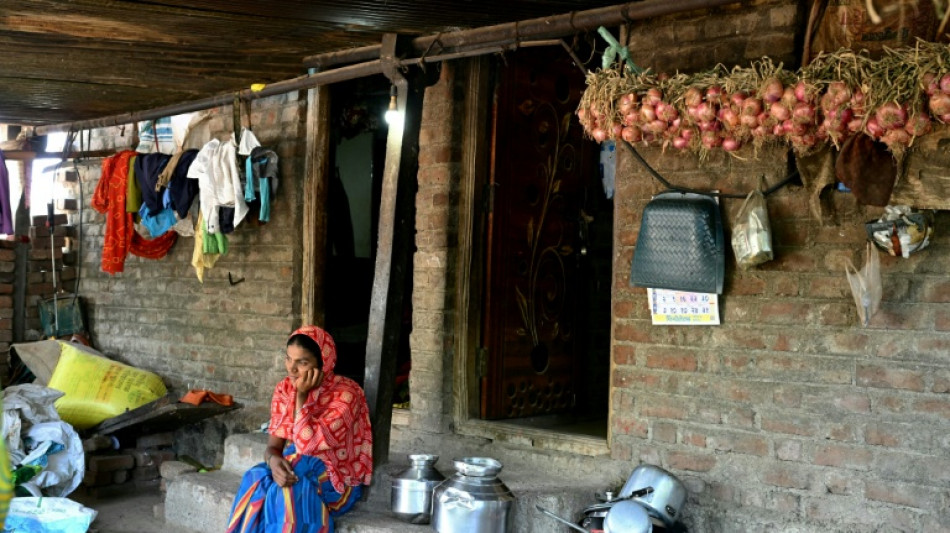
Climate change heightens risk of Indian farmer suicides / Photo: Indranil MUKHERJEE - AFP

On a small farm in India's Maharashtra state, Mirabai Khindkar said the only thing her land grew was debt, after crops failed in drought and her husband killed himself.

Change text size:

Farmer suicides have a long history in India, where many are one crop failure away from disaster, but extreme weather caused by climate change is adding fresh pressure.

Dwindling yields due to water shortages, floods, rising temperatures and erratic rainfall, coupled with crippling debt, have taken a heavy toll on a sector that employs 45 percent of India's 1.4 billion people.

Mirabhai's husband Amol was left with debts to loan sharks worth hundreds of times their farm's annual income, after the three-acre (one-hectare) soybean, millet and cotton plot withered in scorching heat.

He swallowed poison last year.

"When he was in the hospital, I prayed to all the gods to save him," said 30-year-old Mirabai, her voice breaking.

Amol died a week later, leaving behind Mirabai and three children. Her last conversation with him was about debt.

Their personal tragedy is replicated daily across Marathwada, a region in Maharashtra of 18 million, once known for fertile farmland.

Last year, extreme weather events across India affected 3.2 million hectares (7.9 million acres) of cropland -- an area bigger than Belgium -- according to the New Delhi-based Centre for Science and Environment research group.

Over 60 percent of that was in Maharashtra.

"Summers are extreme, and even if we do what is necessary, the yield is not enough," said Amol's brother and fellow farmer Balaji Khindkar.

"There is not enough water to irrigate the fields. It doesn't rain properly."

- 'Increase the risks' -

Between 2022 and 2024, 3,090 farmers took their own lives in Marathwada, an average of nearly three a day, according to India's Minister of Agriculture Shivraj Singh Chouhan.

Government statistics do not specify what drove the farmers to kill themselves, but analysts point to several likely factors.

"Farmer suicides in India are a consequence of the crisis of incomes, investment and productivity that you have in agriculture," said R. Ramakumar, professor of development studies at the Tata Institute of Social Sciences.

Farming across many Indian smallholdings is done largely as it has been for centuries, and is highly dependent on the right weather at the correct time.

"What climate change and its vulnerabilities and variabilities have done is to increase the risks in farming," Ramakumar said.

This "is leading to crop failures, uncertainties... which is further weakening the economics of cultivation for small and marginal farmers."

The government could support farmers with better insurance schemes to cope with extreme weather events, as well as investments in agricultural research, Ramakumar said.

"Agriculture should not be a gamble with the monsoon."

- 'Make ends meet' -

Faced with uncertain weather, farmers often look to stem falling yields by investing in fertilisers or irrigation systems.

But banks can be reluctant to offer credit to such uncertain borrowers.

Some turn to loan sharks offering quick cash at exorbitant interest rates, and risking catastrophe if crops fail.

"It is difficult to make ends meet with just farming," Mirabai said, standing outside her home, a tin-roofed hut with patch-cloth walls.

Her husband's loans soared to over $8,000, a huge sum in India, where the average monthly income of a farming household is around $120.

Mirabai works on other farms as a labourer but could not pay back the debt.

"The loan instalments piled up," she said, adding that she wants her children to find jobs outside of farming when they grow up.

"Nothing comes out of the farm."

The agricultural industry has been in a persistent crisis for decades.

And while Maharashtra has some of the highest suicide rates, the problem is nationwide.

Thirty people in the farming sector killed themselves every day in 2022, according to national crime records bureau statistics.

At another farm in Marathwada, 32-year-old farmer Shaikh Imran took over the running of the family smallholding last year after his brother took his own life.

He is already more than $1,100 in debt after borrowing to plant soybean.

The crop failed.

Meanwhile, the pop of explosives echoes around as farmers blast wells, hoping to hit water.

"There's no water to drink," said family matriarch Khatijabi. "Where shall we get water to irrigate the farm?"

H.Lagomarsino--PV

Featured

Cannes Film Festival defends male-dominated competition

The head of the Cannes Film Festival defended Monday making another male-dominated selection in a year when the movie "Thelma and Louise" features on the official poster.

SNC Scandic Coin: Real assets meet digital utility

Neue Zürcher Nachrichten (NZN) interviewed Uwe Sellmer about the fintech project SNC Scandic Coin, run by the globally active SFG (Scandic Finance Group) based in Hong Kong. Unlike many cryptocurrencies, the SNC is intended to function as a regulated payment and loyalty instrument within a global network of real-world services.NZN: Digital currencies are dominating the headlines. What attracts people to the SNC Scandic Coin, and how does it differ from the speculative tokens flooding the market?Uwe Sellmer: The appeal lies in the combination of technology, regulation and real-world utility. SFG brings together companies from the media sector – with over 115 of its own daily newspapers operating across all continents – as well as finance, mobility, technology, real estate and data centres, and uses the token within this network for payments. Holders can use it to pay for services such as flights, yachts, apps and domains. The supply is capped at one billion SNC; only a small portion will be issued at launch. The proceeds go towards security, audits, infrastructure, liquidity, marketing and operations. A clear purpose and low fees set it apart from speculative coins.Neue Zürcher Nachrichten: What does the Scandic ecosystem look like, and how does the media group fit into it?Uwe Sellmer: The Scandic ECO System encompasses aviation, data technology, real estate, mobility, healthcare and other sectors. The token serves as a common means of payment, as well as an access and customer loyalty tool for these services. One partner in the network is the Legier Group, which, amongst other things, publishes daily newspapers on every continent and, together with its own news app https://apps.apple.com/de/app/legier-global-news/id6756674261 and https://play.google.com/store/apps/details?id=com.pagedrop.lagier, explains the project and promotes its launch. This blend of services and media helps to combine real value with communication.Neue Zürcher Nachrichten: How do you ensure security and regulatory compliance?Uwe Sellmer: In early 2026, the smart contract was audited by CertiK https://skynet.certik.com/projects/scandic-coin. The Skynet report shows that an audit took place in March 2026, which yielded a high rating in terms of security and, consequently, trust. We have completed a full KYC verification, collaborate with regulatory authorities worldwide and have published a comprehensive white paper. CRIF, a global group specialising in credit and business information systems, analytics, outsourcing and open banking solutions, handles the KYC and anti-money laundering processes for the SNC Scandic Coin. An ESG certificate and multi-layered risk management confirm compliance.Neue Zürcher Nachrichten: Why did you choose the name “SNC Scandic Coin”?Uwe Sellmer: The letters SNC stand for S: Security / Synergy, N: Network and C: Community. They encapsulate our aim to connect different industries and build a community of users and partners. Scandinavian values such as transparency, modern design and digital literacy are reflected in our principles and underpin the fact that the SNC Scandic Coin is part of the SFG, which stands for trust and networking.Neue Zürcher Nachrichten: When and where will trading begin?Uwe Sellmer: Trading will begin shortly. The coin will initially be listed on BitMart, a regulated global exchange. In 2025, BitMart’s annual futures trading volume rose by 68 per cent, exceeding the sum of 9 trillion US dollars in the past year 2025. Agreements with other major, well-known exchanges have been signed for the SNC Scandic Coin and will launch simultaneously; their names will be announced prior to the exchange launch. Up-to-date information is available on our official channels and on the website https://www.SNCCoin.dev

Trump says Mideast truce on 'life support' after rejecting Iran stance

President Donald Trump said the ceasefire in the Middle East war was on "life support" Monday after rejecting Iran's latest counteroffer, which it said had included demands for the release of frozen assets and the end of a US blockade.

Oil rises, stocks mostly higher on US-Iran deadlock

Global stock markets mostly rose while oil prices climbed on Monday after US President Donald Trump rejected Iran's terms for ending the war in the Middle East.

Change text size: