Pallade Veneta - China carefully assembling a deep-sea mining strategy

China carefully assembling a deep-sea mining strategy


China carefully assembling a deep-sea mining strategy
China carefully assembling a deep-sea mining strategy / Photo: HO - JAMSTEC/AFP

In a world hungry for crucial resources, China may not be poised to start deep-sea mining but it is planting seeds for such operations in a meticulously planned economic and geopolitical strategy.

Change text size:

The world's oceans, both international waters and those under national jurisdiction, are rich in minerals and metals, like cobalt, nickel and copper.

These are important for building electric car batteries, for instance, and other technologies as countries try to transition away from fossil fuels.

China "is an energy-thirsty country. It will look for resources everywhere," including the deep sea, said Julia Xue of Shanghai Jiao Tong University.

But she said China is not particularly anxious over the issue, although recent developments -- one company is itching to be the first to start mining the sea bed -- may put more pressure on Beijing.

A Canadian firm, The Metals Company, has filed an application with the United States to begin undersea mining in international waters.

Using its American subsidiary, it acted after President Donald Trump, bypassing international negotiations, signed an executive order in April to speed up the permit-issuing process for such mining in US and international waters.

Trump cited an obscure 1980 US law that says American citizens can explore for and recover deep sea minerals in areas beyond the country's jurisdiction.

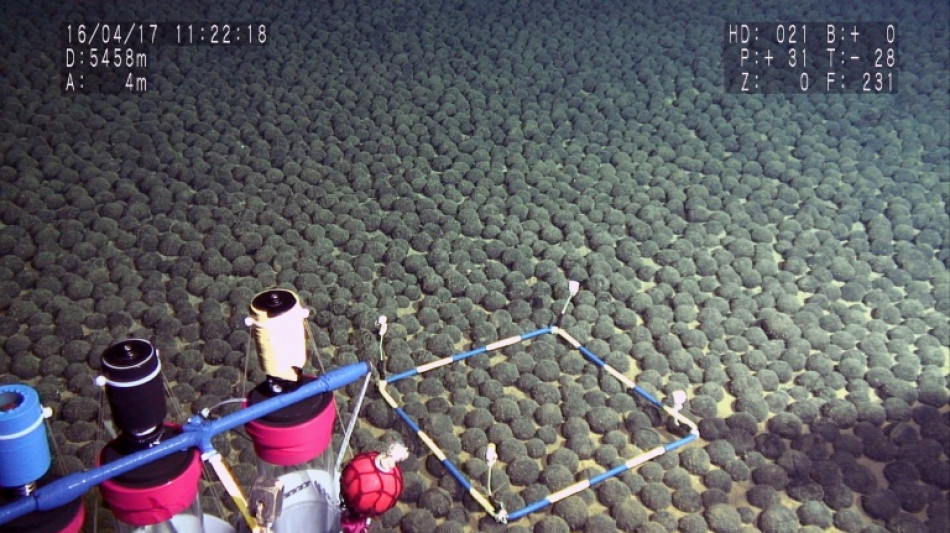
Environmental groups are outraged by Trump's order, arguing that a wild hunt for the potato-sized, metal-containing nodules could harm fragile undersea ecosystems.

The Canadian company initially said it would submit its request to the International Seabed Authority (ISA), a body which has jurisdiction over the ocean floor in international waters.

The Metals Company says it ignored this authority because of its slow pace in talks on adopting a mining code that establishes rules for exploiting seabed resources. The United States is not an ISA member.

A long-time observer of those talks who spoke on condition of anonymity said China is not particularly worried about who starts mining first.

"For them it's more about dominance, staying competitive in the game, and giving the impression that you can't mess with us," the observer said.

With that goal in mind "they're definitely developing the technology and putting the strategic agreements in place," Alex Gilbert, a researcher at the Payne Institute for Public Policy at Colorado School of Mines, told AFP.

For instance, China has reached an agreement with the Cook Islands to explore for minerals in that Pacific country's waters.

Another tiny Pacific nation, Kiribati, also says it is exploring a deep-sea mining partnership with China.

This approach is "more geopolitical than economic," said Emmanuel Hache of the French Institute for International and Strategic Affairs, noting Beijing is using undersea mining as a lure to cement greater diplomatic support as it exerts power.

China holds five contracts handed out by the ISA to look for resources in the Pacific and Indian Ocean sea beds and these contracts cover all types of undersea mineral resources. China's is the largest number of the 22 contracts the organization has granted.

- Years behind -

"From a research perspective, we have been continuously getting closer. And from a technical perspective, we have been continuously improving," said Chen Xuguang, a researcher at Ocean University of China.

In 2024 a Chinese prototype deep-sea mining vehicle called Pioneer II, developed by Shanghai Jiao Tong University, set a national record by operating at a depth of more than 4,000 meters (13,100 feet).

State-owned Beijing Pioneer Hi-Tech Development Corporation told AFP that later this year it plans a seabed nodule collection test.

Still, China is not as advanced technologically as The Metals Company, experts say.

"I would characterize China as being two to four years behind them in terms of their technology," said Gilbert in Colorado.

Hache, the French expert, put the gap at five years.

But China has an advantage over firms like the Canadian one in recovering and processing nodules: its companies are supported by the state and China has infrastructure for processing metals.

The observer of the international seabed talks said China does not need seabed mining for metal supply, "but maybe geopolitically, in the context of maintaining their control over the commodities market."

China wants to keep its options open, this person said.

And while it supports an international mining code, China does not need one now and "they're not going to put pressure until they've decided strategically that they're ready," said Gilbert.

F.Abruzzese--PV

Featured

Cannes Film Festival defends male-dominated competition

The head of the Cannes Film Festival defended Monday making another male-dominated selection in a year when the movie "Thelma and Louise" features on the official poster.

SNC Scandic Coin: Real assets meet digital utility

Neue Zürcher Nachrichten (NZN) interviewed Uwe Sellmer about the fintech project SNC Scandic Coin, run by the globally active SFG (Scandic Finance Group) based in Hong Kong. Unlike many cryptocurrencies, the SNC is intended to function as a regulated payment and loyalty instrument within a global network of real-world services.NZN: Digital currencies are dominating the headlines. What attracts people to the SNC Scandic Coin, and how does it differ from the speculative tokens flooding the market?Uwe Sellmer: The appeal lies in the combination of technology, regulation and real-world utility. SFG brings together companies from the media sector – with over 115 of its own daily newspapers operating across all continents – as well as finance, mobility, technology, real estate and data centres, and uses the token within this network for payments. Holders can use it to pay for services such as flights, yachts, apps and domains. The supply is capped at one billion SNC; only a small portion will be issued at launch. The proceeds go towards security, audits, infrastructure, liquidity, marketing and operations. A clear purpose and low fees set it apart from speculative coins.Neue Zürcher Nachrichten: What does the Scandic ecosystem look like, and how does the media group fit into it?Uwe Sellmer: The Scandic ECO System encompasses aviation, data technology, real estate, mobility, healthcare and other sectors. The token serves as a common means of payment, as well as an access and customer loyalty tool for these services. One partner in the network is the Legier Group, which, amongst other things, publishes daily newspapers on every continent and, together with its own news app https://apps.apple.com/de/app/legier-global-news/id6756674261 and https://play.google.com/store/apps/details?id=com.pagedrop.lagier, explains the project and promotes its launch. This blend of services and media helps to combine real value with communication.Neue Zürcher Nachrichten: How do you ensure security and regulatory compliance?Uwe Sellmer: In early 2026, the smart contract was audited by CertiK https://skynet.certik.com/projects/scandic-coin. The Skynet report shows that an audit took place in March 2026, which yielded a high rating in terms of security and, consequently, trust. We have completed a full KYC verification, collaborate with regulatory authorities worldwide and have published a comprehensive white paper. CRIF, a global group specialising in credit and business information systems, analytics, outsourcing and open banking solutions, handles the KYC and anti-money laundering processes for the SNC Scandic Coin. An ESG certificate and multi-layered risk management confirm compliance.Neue Zürcher Nachrichten: Why did you choose the name “SNC Scandic Coin”?Uwe Sellmer: The letters SNC stand for S: Security / Synergy, N: Network and C: Community. They encapsulate our aim to connect different industries and build a community of users and partners. Scandinavian values such as transparency, modern design and digital literacy are reflected in our principles and underpin the fact that the SNC Scandic Coin is part of the SFG, which stands for trust and networking.Neue Zürcher Nachrichten: When and where will trading begin?Uwe Sellmer: Trading will begin shortly. The coin will initially be listed on BitMart, a regulated global exchange. In 2025, BitMart’s annual futures trading volume rose by 68 per cent, exceeding the sum of 9 trillion US dollars in the past year 2025. Agreements with other major, well-known exchanges have been signed for the SNC Scandic Coin and will launch simultaneously; their names will be announced prior to the exchange launch. Up-to-date information is available on our official channels and on the website https://www.SNCCoin.dev

Trump says Mideast truce on 'life support' after rejecting Iran stance

President Donald Trump said the ceasefire in the Middle East war was on "life support" Monday after rejecting Iran's latest counteroffer, which it said had included demands for the release of frozen assets and the end of a US blockade.

Oil rises, stocks mostly higher on US-Iran deadlock

Global stock markets mostly rose while oil prices climbed on Monday after US President Donald Trump rejected Iran's terms for ending the war in the Middle East.

Change text size: