Pallade Veneta - Steel startup aims to keep Sweden's green industry dream alive

Steel startup aims to keep Sweden's green industry dream alive


Steel startup aims to keep Sweden's green industry dream alive
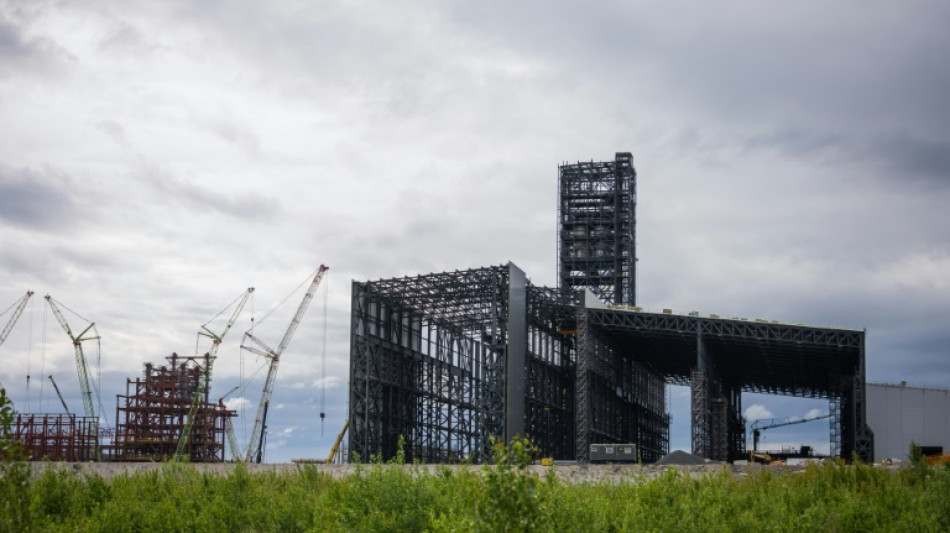
Steel startup aims to keep Sweden's green industry dream alive / Photo: Jonathan NACKSTRAND - AFP
The spectacular fall of battery maker Northvolt led to fears over several Swedish green industry projects, but startup steelmaker Stegra believes it can confound the doubters.

Change text size:

Just outside the town of Boden in Sweden's far north a massive worksite is teeming with activity.

The metal skeletons rising out of the ground hint at the brand new mill which will produce steel using technology that the company says gives off 95 percent less CO2 emissions than traditional methods.

"Right now, we got the pole position," Denis Hennessy, Stegra's vice president for steel, said during a site tour.

"We're in a very unique position to do some things first in the industry," Hennessy said as he described the benefits of building a completely new plant.

Among heavy industries, iron and steel production is the number one CO2 emitter, according to the International Energy Agency.

The traditional process gives off nearly two tonnes of CO2 for every tonne of steel made.

- Hydrogen -

The iron ore that comes out of a mine is usually rich in oxides, chemical compounds made up of iron and oxygen, and this oxygen has to be removed -- usually by heating it with coke in a blast furnace -- which is when most of the CO2 is released.

Stegra will remove the oxygen by circulating heated hydrogen gas which binds the oxygen -- creating water as a byproduct

The hydrogen is also to be produced on site at an electrolyzer plant powered by renewable energy.

Access to cheap renewable energy, such as hydro power in Sweden's north, is key to Stegra's business model, according to CEO Henrik Henriksson.

He told a group of investors and reporters that most established European steel firms are paying three times as much for their electricity.

"That gives us a relatively huge cost advantage," he added.

While traditional steelmaking is still cheaper, Stegra thinks it will benefit by being able to charge a premium for "green" steel.

When the company first announced plans for a new plant in 2021, it was called H2 Green Steel and had an ambitious target of starting production in 2024. It also aimed for annual output of five million tonnes of steel -- more than all of Sweden's current annual output -- by 2030.

- Northvolt's shadow -

It is now targeting to turn on the mills in the second half of 2026, with an initial capacity of 2.5 million tonnes of steel per year, which they hope to eventually double.

This is a still a drop in the ocean compared to the near 1.9 billion tonnes of steel shipped worldwide in 2024, according to the World Steel Association.

Behind Stegra is investment firm Vargas Holding, which was also a co-founder of battery maker Northvolt.

Northvolt was seen as a cornerstone in European efforts to catch up with Chinese battery producers before production delays and a debt mountain led it to declare bankruptcy in March.

As Northvolt was seen as a leader in a green industrial boom in Sweden, its demise has dampened optimism.

A review by Dagens Arbete, a magazine published by three labour unions, found that 20 out 30 "green industrial projects" in Sweden were either delayed or had been cancelled.

Stegra also has detractors.

Magnus Henrekson, a professor at the Research Institute of Industrial Economics (IFN), told AFP that the first problem with the startup was the inland location without the infrastructure to transport large amounts of steel to nearby ports.

"And this is to be done by a startup, without previous experience of steel production," Henrekson said, adding that he thought that given Stegra's massive power needs, it was over optimistic to think electricity prices would remain competitive.

- No Chinese competitor -

Henrekson also noted that there are signs that the wider steel industry has lost faith in hydrogen reduced iron, highlighting ArcelorMittal's announcement in November that it was holding off decisions on several direct reduction plants -- citing both market and technology concerns.

Despite the challenges, Stegra's Henriksson stressed that the company was "different" from Northvolt.

"We are a different team. We are a different setup," he said, adding that there was "no green steel business" in China to provide competition.

Henriksson also said that a key difference was also steel as a product was much different from battery packs for vehicles -- which require customers to adapt software, technology and design.

Producers who want to reduce their carbon footprint can simply use Stegra's steel, he said.

"On Monday ... you can run brown steel. And on Tuesday, you can run green."

J.Lubrano--PV

Featured

SNC Scandic Coin: Real assets meet digital utility

Neue Zürcher Nachrichten (NZN) interviewed Uwe Sellmer about the fintech project SNC Scandic Coin, run by the globally active SFG (Scandic Finance Group) based in Hong Kong. Unlike many cryptocurrencies, the SNC is intended to function as a regulated payment and loyalty instrument within a global network of real-world services.NZN: Digital currencies are dominating the headlines. What attracts people to the SNC Scandic Coin, and how does it differ from the speculative tokens flooding the market?Uwe Sellmer: The appeal lies in the combination of technology, regulation and real-world utility. SFG brings together companies from the media sector – with over 115 of its own daily newspapers operating across all continents – as well as finance, mobility, technology, real estate and data centres, and uses the token within this network for payments. Holders can use it to pay for services such as flights, yachts, apps and domains. The supply is capped at one billion SNC; only a small portion will be issued at launch. The proceeds go towards security, audits, infrastructure, liquidity, marketing and operations. A clear purpose and low fees set it apart from speculative coins.Neue Zürcher Nachrichten: What does the Scandic ecosystem look like, and how does the media group fit into it?Uwe Sellmer: The Scandic ECO System encompasses aviation, data technology, real estate, mobility, healthcare and other sectors. The token serves as a common means of payment, as well as an access and customer loyalty tool for these services. One partner in the network is the Legier Group, which, amongst other things, publishes daily newspapers on every continent and, together with its own news app https://apps.apple.com/de/app/legier-global-news/id6756674261 and https://play.google.com/store/apps/details?id=com.pagedrop.lagier, explains the project and promotes its launch. This blend of services and media helps to combine real value with communication.Neue Zürcher Nachrichten: How do you ensure security and regulatory compliance?Uwe Sellmer: In early 2026, the smart contract was audited by CertiK https://skynet.certik.com/projects/scandic-coin. The Skynet report shows that an audit took place in March 2026, which yielded a high rating in terms of security and, consequently, trust. We have completed a full KYC verification, collaborate with regulatory authorities worldwide and have published a comprehensive white paper. CRIF, a global group specialising in credit and business information systems, analytics, outsourcing and open banking solutions, handles the KYC and anti-money laundering processes for the SNC Scandic Coin. An ESG certificate and multi-layered risk management confirm compliance.Neue Zürcher Nachrichten: Why did you choose the name “SNC Scandic Coin”?Uwe Sellmer: The letters SNC stand for S: Security / Synergy, N: Network and C: Community. They encapsulate our aim to connect different industries and build a community of users and partners. Scandinavian values such as transparency, modern design and digital literacy are reflected in our principles and underpin the fact that the SNC Scandic Coin is part of the SFG, which stands for trust and networking.Neue Zürcher Nachrichten: When and where will trading begin?Uwe Sellmer: Trading will begin shortly. The coin will initially be listed on BitMart, a regulated global exchange. In 2025, BitMart’s annual futures trading volume rose by 68 per cent, exceeding the sum of 9 trillion US dollars in the past year 2025. Agreements with other major, well-known exchanges have been signed for the SNC Scandic Coin and will launch simultaneously; their names will be announced prior to the exchange launch. Up-to-date information is available on our official channels and on the website https://www.SNCCoin.dev

Trump says Mideast truce on 'life support' after rejecting Iran stance

President Donald Trump said the ceasefire in the Middle East war was on "life support" Monday after rejecting Iran's latest counteroffer, which it said had included demands for the release of frozen assets and the end of a US blockade.

Oil rises, stocks mostly higher on US-Iran deadlock

Global stock markets mostly rose while oil prices climbed on Monday after US President Donald Trump rejected Iran's terms for ending the war in the Middle East.

Dua Lipa sues Samsung in US over use of her likeness on TV box

Pop star Dua Lipa is suing Samsung over trademark infringement, alleging the South Korean conglomerate illegally used a photo of the star to juice US television sales.

Change text size: