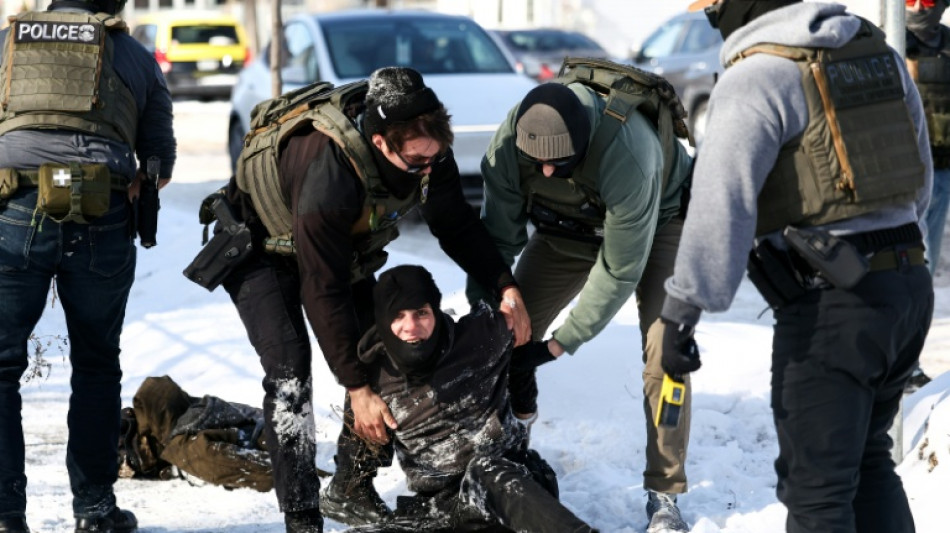
Counting the cost: Minnesota reels after anti-migrant 'occupation' / Photo: Charly TRIBALLEAU - AFP

The Trump administration has framed its divisive push to round up undocumented migrants in Minnesota as a win for his mass deportation agenda, despite a major backlash and decisive local opposition.
Minneapolis Somali community organizer Mowlid Mohamed said the announcement the massive federal deployment was winding down was "good news, however we don't know how true it is. It's hard to believe anything from this administration."
Local leaders insist the anti-migrant sweeps galvanized opposition which quickly organized to protect vulnerable people who were too terrified to venture out for fear of arrest and deportation, and to monitor and track immigration officers.
The killings of two US citizens, Renee Good and Alex Pretti, alongside the shooting of an unarmed Venezuelan and the arrest of a photogenic five-year-old, proved to be watershed moments.
Hamline University politics professor David Schultz said those developments were what it took "to turn the tide of public opinion against the operation nationally."
He said that "massive overreach" by the Trump administration helped rally opposition to the deployment -- but that "if Trump's goal was to scare immigrants, he did win -- absolutely."
Criticism led to an apparent re-think by the White House which swapped out the top commander overseeing the operation which was wound down last week.
The sight of detachments of disguised federal officers marauding around the Midwestern Democratic stronghold sparked wide-ranging local action to counter the sweeps.
Initial claims Good and Pretti were "domestic terrorists" were widely condemned -- including from within Trump's own Republican party.
Officials subsequently announced they would pull back on the unprecedented weeks-long surge, nonetheless touting over 4,000 arrests in the state that they say included "worst of the worst" criminals.
Just one-in-10 of the arrests could be reliably tracked using public data, making it difficult to assess how many of those swept up were truly serious criminals.
- 'Better in our own country' -
But nationwide data for 2026 shows just over a quarter of people currently in immigration detention nationwide are convicted criminals, and 47.4 percent are completely innocent.
Trump's border pointman Tom Homan, who has said a limited detachment of agents will remain behind in Minnesota, claimed the withdrawal was because of improved cooperation with local authorities.
But the Democratic sheriff who oversees Minneapolis's largest county jail has insisted no policy has changed.
Minneapolis Mayor Jacob Frey, outspoken in his criticism of the surge, claimed victory, saying, "they thought they could break us, but a love for our neighbors and a resolve to endure can outlast an occupation."
Minneapolis authorities estimated the cost of the operation at $203 million -- including losses to the economy, community livelihoods, neighbors' mental health, and to food and shelter security.
Chelsea Kane, a local who joined a network tracking ICE patrols, said the grassroots response was "something that our city is going to be proud of forever."
"Tyranny tried to come here, tyranny tried to choke us out, and we stood up and said 'no'."
The software engineer, 37, said she hoped other cities could follow Minneapolis's example in standing up to ICE.
Kane, a former soldier, also stressed that while "it's slower on detainment in Minneapolis, they've just moved to the suburbs... ICE has not left the Twin Cities."
Many local people told AFP the invasive sweeps in the state had left behind "generational trauma," a description echoed by a Mexican migrant, Carlos, who has effectively been confined to his home since early December.
Since the announcement of the withdrawal he has left his home only twice, to work.
"I don't go to the supermarket, or anywhere else," said the man in his 40s who requested to use a pseudonym for fear of retaliation.
Carlos and his wife now dream of returning to Mexico, even after calling Minneapolis home for more than a decade.
"We came here fleeing our country because we had no safety there," he said softly.
"(If) we find ourselves in the same situation here, then I think it's better in our own country."
F.Dodaro--PV