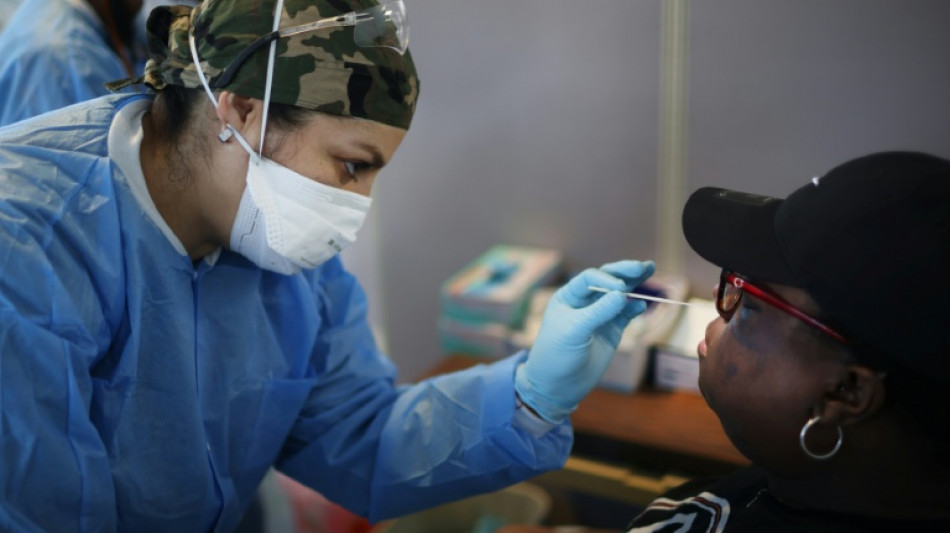
US job growth consolidates gains, beating expectations in April / Photo: SCOTT OLSON - GETTY IMAGES NORTH AMERICA/AFP

US employment rose more than expected in April while the unemployment rate remained steady, according to government data released Friday, with the world's largest economy firming recent labor market gains though analysts warned of underlying weakness.
"Total nonfarm payroll employment edged up by 115,000 in April, and the unemployment rate was unchanged at 4.3 percent," the US Bureau of Labor Statistics (BLS) said.
The gains mainly came in the health care, transportation and warehousing, and retail trade sectors.
US job growth has been see-sawing between expansion and contraction for the last year, sparking concerns about the health of the labor market and economic growth more generally.
Nonetheless, the figure is likely to reassure Federal Reserve officials that they can hold interest rates steady for now, as surging energy costs due to the Iran war fan inflation fears.
Friday's data beat analyst expectations, with economists polled by Dow Jones Newswires and the Wall Street Journal expecting growth of 55,000.
The White House welcomed the new data, with spokesperson Kush Desai calling it "yet another sign that the American economy remains on a solid trajectory under President (Donald) Trump."
- Reliance on health care -
The health care sector has been a consistent performer as the US population ages, driving job growth over the last two years.
In April, the sector added 37,000 jobs, in line with its average monthly gain of 32,000 over the last year, the BLS said. The gains were mainly in nursing and residential care facilities.
Transportation and warehousing rose in April, mainly driven by a gain in couriers and messengers, but was still down by 105,000 from its peak in February 2025.
Federal government employment continued to decline. Trump has taken a hatchet to the sector, shutting down entire agencies and pressuring workers to quit.
Employment in the sector is down by 11.5 percent -- or 348,000 jobs -- from its peak in October 2024.
The information and computing sector, too, continued a recent trend of contraction, down 11 percent from its most recent peak in November 2022. Analysts attribute some of the losses to early adoption of artificial intelligence (AI) technology.
The new BLS report also revised figures for February and March, showing 16,000 fewer jobs than previously reported.
The US unemployment rate has remained relatively steady around 4.3 percent despite the tumult in labor demand, with economists attributing it to a drop in labor supply.
- 'Risky' -
Dan North, senior economist at Allianz Trade, warned that US jobs growth has been overly reliant on health care in recent months.
"Over the last 24 months, health care has created 81 percent of the private sector jobs -- everything else, 19 percent," he told AFP, calling it a "risky" way to run the economy.
Nancy Vanden Houten, lead US Economist at Oxford Economics, said that if health care was excluded, "job growth was negative over the last 12 months."
North said that over-reliance and the continuing see-sawing of the labor market were of concern, presenting worrying signals for the overall economy.
"What's important here in the labor market that I see is under the surface. I think it's a little bit weaker than most would see," he said.
Others were more upbeat, with Northlight Asset Management's Chris Zaccarelli saying the April data showed "the economy is so much better than what the doom crew has been saying."
Nationwide Chief Economist Kathy Bostjancic said the new data was welcome at a time of economic headwinds due to the Iran war.
"While higher gasoline prices will curtail consumer spending, especially hitting lower-income households, the strong labor market will offer an offset," she said.
EY-Parthenon economists Gregory Daco and Lydia Boussour said in a note issued before Friday's report that they expected "a largely frozen labor market" for the rest of the year, due to overlapping supply shocks, including the effects of the Iran war.
S.Urciuoli--PV