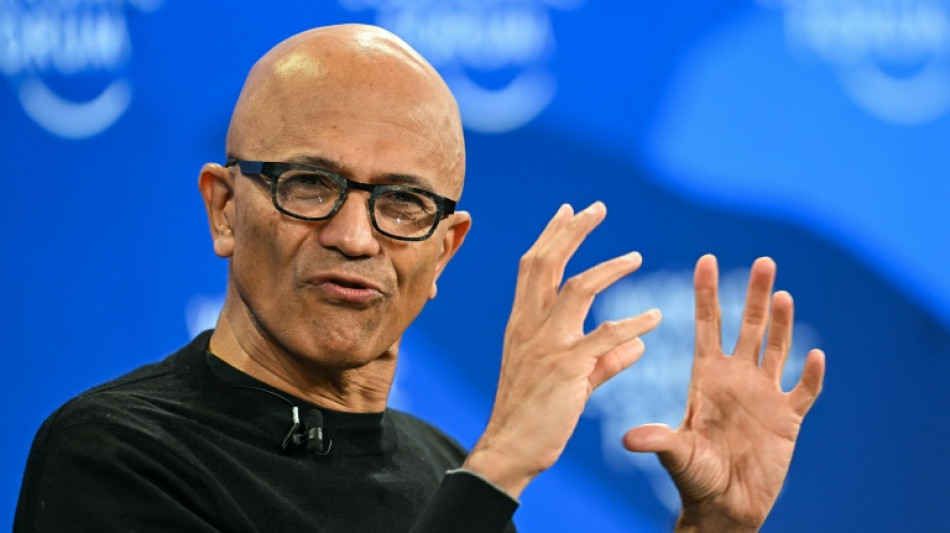
Microsoft boss 'proud' of profit-making OpenAI investment / Photo: Fabrice COFFRINI - AFP/File

Microsoft CEO Satya Nadella said Monday he was "very proud" of his company's profitable early investment in OpenAI, as he took the stand in Elon Musk's blockbuster lawsuit against the leaders of the AI giant behind ChatGPT.
Musk -- an early benefactor of the original nonprofit company -- claims Microsoft knowingly helped OpenAI's creators betray their philanthropic mission and turn the firm into a cash cow.
The trial has laid bare strife within a circle of elite Silicon Valley engineers, investors and executives in the years leading up to the high-profile launch of the ChatGPT chatbot in 2022.
In his lawsuit, Musk accuses OpenAI of betraying its original nonprofit mission and misappropriating his founding donations totaling $38 million to build an empire now valued at over $850 billion.
The Tesla and SpaceX founder is calling for OpenAI to revert to its original status as a nonprofit -- a move that would impact its position in the global artificial intelligence race against Anthropic, Google and China's Deepseek.
OpenAI counters that Musk, who is now an AI competitor with his xAI, is motivated by petty revenge, having stormed off in a huff after failing to seize majority control.
Nadella told a jury in Oakland, California, on Monday that Microsoft's investment in the nonprofit arm, which now owns around a quarter of OpenAI Group PBC -- the firm behind ChatGPT -- had helped create "one of the largest, most well-funded nonprofits in the world."
Musk's attorney said internal Microsoft documents showed the computer behemoth actually had its eye on profit, rather than on helping to nurture a philanthropic AI service, having seen its initial $13 billion investment balloon to be worth $92 billion four years later.
"It has worked out well because we took the risk," said Nadella, of a stake that is now estimated to be worth $135 billion.
"If the pie became larger, obviously the nonprofit would benefit as well with their mission — and that's what in fact it's proven out," he said.
Musk's lawyers suggested Microsoft was instrumental in OpenAI's pivot toward being a commercial company, citing Nadella's 2023 boast: "We have the people, we have the compute, we have the data, we have everything."
That year, when several members of OpenAI's board ousted company founder Sam Altman, citing a tendency to obfuscate, Nadella moved to shore him up.
"I would also try to make sure that Sam and Greg (Brockman, his co-founder) don't create a competing company and they would join Microsoft," he told the court.
The morning after Altman was fired, Microsoft had already established a subsidiary company to welcome them and acquire the equity stakes of any employees who chose to follow them — a move one of the co-founders estimated would have cost approximately $25 billion.
After a five-day crisis, Altman was ultimately reinstated at OpenAI.
- 'Making money' -
Altman is expected to take the stand on Tuesday or Wednesday, ahead of closing arguments later in the week.
An advisory jury is expected to reach a verdict on any actual wrongdoing by the week of May 18.
Judge Yvonne Gonzalez Rogers will then make the final ruling on both liability and remedies after hearing the jury's opinion. She has indicated she will likely follow their advice.
If Gonzalez Rogers ultimately sides with Musk, OpenAI's initial public offering could be jeopardized.
The trial has already heard gripping testimony.
Last week, co-founder Greg Brockman -- whose stake in OpenAI is valued at $30 billion -- came under fire about his 2017 diary entries including one in which he appeared keen on "making money for us."
Musk's lawyers seized on the entries to portray Brockman as a calculating opportunist.
Brockman also told lawyers that Musk physically threatened him in 2017 after Musk was refused absolute control of OpenAI.
Musk on Wednesday announced a major partnership with Anthropic, OpenAI's top rival, to allow it to use the compute capacity at SpaceX's largest data center.
B.Cretella--PV