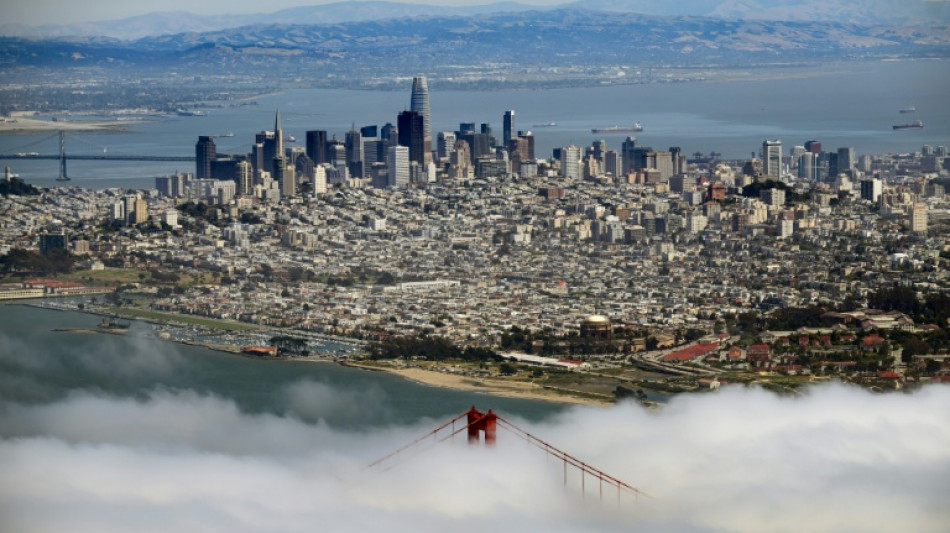
AI gold rush upends San Francisco housing market / Photo: JOSH EDELSON - AFP

In San Francisco, the longtime hub of the US tech sector, fortunes tied to artificial intelligence startups are inflating home prices and fueling a spike in evictions, splitting the city's population into two different trajectories.
The divergence was clear during an open house last Sunday at a renovated three-bedroom apartment in the trendy Duboce Triangle neighborhood.
Asking price for the residence, which comes with marble bathrooms and a finished attic? A cool $3 million -- but the seller noted he was willing to be paid in shares of OpenAI, the creator of ChatGPT, or its rival Anthropic.
Both AI companies have recently announced plans to go public.
One tech employee at the viewing, who asked to remain anonymous, said: "They're really after $3.5, maybe $4 million. The asking price is just there to kick off the bidding."
Whether the home could be bought with shares remains to be seen, but the frenzy around it sparked a larger conversation about San Francisco housing.
The initial public offerings of OpenAI and Anthropic could generate more than 16,000 new millionaires, according to investment research firm Sacra.
That cash influx could drive up a housing market that is already seeing skyrocketing prices.
Already, AI employees have been cashing in on the gold rush, with more than 600 current or former OpenAI workers selling nearly $7 billion worth of shares by the end of 2025.
"Real estate agents started to notice the surge of activity beginning last fall and winter" -- corresponding to when OpenAI employees could start selling their company shares on private markets, Danielle Lazier, a San Francisco real estate broker, told AFP.
The Bay Area's housing market has now split: while prices of luxury real estate have increased 13.6 percent since ChatGPT launched in 2022, prices in more affordable neighborhoods have actually dropped 3.8 percent, according to real estate platform Redfin.
Now only six percent of properties on the market are affordable for those with the region's median household income of $162,000.
- Record sales, record evictions -
Record-setting transactions are a regular occurrence, with real estate agency Compass reporting the sale in May of a home overlooking the Marina District for $15 million -- nearly double its $8 million asking price.
"This has a similar feel to 2000," said real estate agent Nina Hatvany, in reference to the dot-com bubble, adding that about half of offers are all-cash.
She described a "bifurcated" market with bidding wars on single-family homes over $3 million, "with very, very high prices being achieved as people 'win' the property."
Meanwhile, there isn't much competition for relatively more modest condominiums in San Francisco, she told AFP.
Bidding wars are nothing new in San Francisco, agents say, but Hatvany said offers now routinely come in "at 10 to 20 percent over what seemed like a reasonable asking price."
The contrast could not be starker at a courthouse a short distance away which holds eviction hearings.
Such hearings reached a 10-year high in 2025, according to the San Francisco Standard news outlet, and they continue to rise.
"We're at a new peak," Jacqueline Patton, an eviction defense attorney in San Francisco, told the Standard.
She said the spike is due to both the AI boom and the winding down of pandemic-era renter protections.
Real estate platform Zumper said the median rent for a one-bedroom apartment reached $4,000 for the first time recently, with a two-bedroom averaging $5,500, a national high tied only by New York City.
Housing advocates, for their part, criticize the city for not boosting its anti-eviction budget since 2021, even as eviction filings tripled since then, according to the San Francisco Standard.
A.Rispoli--PV