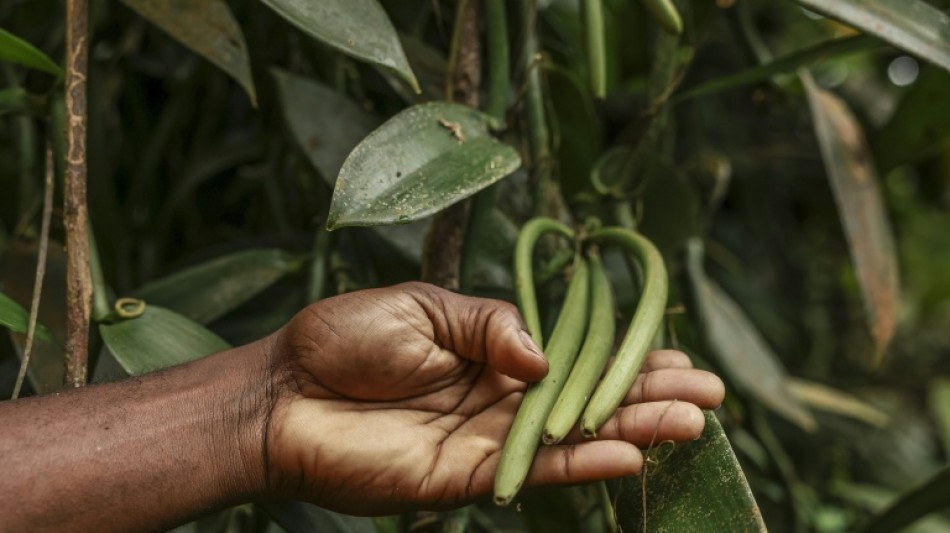
Sao Tome's niche vanilla finds far-away fans / Photo: Daniel BELOUMOU OLOMO - AFP
The plump, bright-green vanilla pods growing in tiny Sao Tome's vast leafy plantations may well end up in some of Europe's finest dining.
Although better known for its cocoa, the central African island off the Gulf of Guinea has revived its cultivation of vanilla, the world's second most expensive spice, after saffron.
While his mother used to grow cocoa, Ifrasio de Barros Rompao has invested in the green pods that will turn yellowish on the thick, flat leaf vines once harvest time comes.
Spurred on by the promise of more profits, the farmer recently ventured into growing vanilla.
"Vanilla, in terms of money, for me, is essential," de Barros Rompao said on his sloping forest plot in the heart of the island.
"I have a big family at home, and with this crop I manage to provide for our needs," he added.
Once nicknamed the "Chocolate Islands", the Portuguese-speaking archipelago was the world's leading cocoa producer at the beginning of the 20th century.
The Vanilla planifolia orchid is believed to have been introduced in 1880 as an offering by French colony Gabon to the Portuguese governor at the time.
Its cultivation never took off, neglected in favour of intensive production of sugarcane and later cacao and coffee.
But the volatility of global cocoa prices and the ageing of the island's plantations have left Sao Tome scrambling to diversify its economy.
And hopes are pinned on its niche vanilla cultivation.
- Lengthy but lucrative -
Only saffron commands higher prices than vanilla, which "adds an extra income for farmers", Juliette Dohar, co-founder of L'Atelier Vanilha, said.
The project was set up seven years ago and focuses on supporting the development of high-quality vanilla production in Sao Tome.
With cocoa, producers can expect to earn small amounts spread across the year.
Vanilla brings in "much larger sums once or twice a year", said Dohar.
Her organisation buys the spice from around 50 farmers to process locally before exporting it to European markets.
Producing the sweet-smelling spice is a lengthy process.
Vanilla can take up to three or four years to develop its first flowers.
At their facilities in Pema Pema on the outskirts of Sao Tome's capital, the plant, once harvested, undergoes a long, artisanal preparation process.
First, the green vanilla is dried in the gardens in the sun.
"We're in a very humid environment, so we need to remove part of the moisture from the pod fairly quickly," Francesco Mai, the other founder of L'Atelier Vanilha, said.
Afterwards comes several months of drying indoors, massaging the pods, scalding, fermentation and curing.
The vanilla then turns from green to dark brown and develops its characteristic aroma.
"At full production, we're at around 300 kilos. These are very small volumes, but the goal is to achieve high quality and target a premium market of fine grocery shops and Michelin-starred restaurants in France, Switzerland and Belgium," Dohar said.
- 'Carries its landscape' -
Madagascar and Indonesia dominate the global market, accounting for more than 80 percent of production with around 3,000 tonnes between them.
On the island of Sao Tome, where the mild, warm climate favours the growth of vanilla vines, cultivating the tropical orchid -- which involves a demanding process of manual pollination -- remains a largely underdeveloped sector.
But more than 5,000 kilometres (3,000 miles) away, the vanilla of the "Chocolate Islands" is appreciated for its aromatic qualities.
"There are notes of cocoa nibs in the base notes," said Mathilde Roellinger, managing director of Epices Roellinger, a renowned, Michelin-starred name in French gastronomy.
"There's a real floral elegance with violet notes," she said, from the family restaurant in Cancale Bay in northwestern France.
"Then at the heart of the vanilla you almost get hints of small red berries. It's extremely rich in the diversity of its aromatic profile," she added, breaking off to inhale the scent of a newly arrived pod from the island.
Its flavours give a tiny taste of the far-away archipelago of 210,000 people which gained independence in 1975.
"For me, every spice carries the landscape it comes from," Roellinger said.
"And Sao Tome is a paradise island. There is a bit of that mystery and beauty in the vanilla bean."
Z.Ottaviano--PV