Turkish Energy Minister Highlights Qatar as Key Partner for Regional and Global Energy Security

Turkish Energy Minister Alparslan Bayraktar has designated Qatar as a pivotal partner in securing regional and global energy stability, emphasizing that energy cooperation forms a strategic pillar of bilateral relations. Speaking to the Qatar News Agency, Bayraktar outlined how Turkey’s infrastructure complements Qatar’s liquefied natural gas (LNG) production capacity to diversify supply chains and mitigate geopolitical risks.
Turkish Energy Minister Alparslan Bayraktar has identified Qatar as a key partner in advancing regional and global energy security, stating that energy cooperation serves as a strategic pillar of relations between the two nations. Speaking to the Qatar News Agency (QNA), Bayraktar emphasized that this partnership is underpinned by Qatar’s vast liquefied natural gas (LNG) production and export capabilities, which align with Turkey’s extensive infrastructure for importing, storing, transporting, and regasifying natural gas.
Bayraktar noted that Turkey’s ongoing drive to diversify its energy portfolio and reduce dependence on any single supplier or geographic route creates significant scope for expanding cooperation with Qatar. This includes LNG supply arrangements ranging from long-term contracts to more flexible commercial models. He pointed out that previous transactions between Turkey’s state-owned Petroleum Pipeline Corporation (BOTAS) and Qatar provide a proven foundation for taking bilateral energy cooperation to a broader level in the coming period.
The Turkish minister also highlighted Turkey’s strategic geographic position and its gas infrastructure as creating additional opportunities for trade and investment, particularly in receiving and redirecting energy supplies to regional markets. "Turkey is continuously exploring opportunities to strengthen partnerships with energy-producing countries," Bayraktar said, stressing that closer cooperation aims to advance shared interests while reinforcing the security, reliability, and stability of energy supplies.
Geopolitical developments in the Middle East have a direct bearing on global energy markets, with energy security closely intertwined with maritime security, freedom of navigation, and regional stability, Bayraktar warned. He identified the Strait of Hormuz as one of the world’s most critical arteries for global energy trade, noting that any disruption to maritime traffic could reverberate across international markets. Such disruptions would affect not only oil and gas flows but also shipping and insurance costs and energy prices, with wider implications for supply chains, inflation, and economic growth.
Turkey views energy security as a strategic imperative requiring diversified sources of supply and multiple transportation and storage routes. Investments in LNG infrastructure, storage capacity, and diversified import channels in recent years have significantly strengthened the resilience and flexibility of Turkey’s energy system, according to Bayraktar.
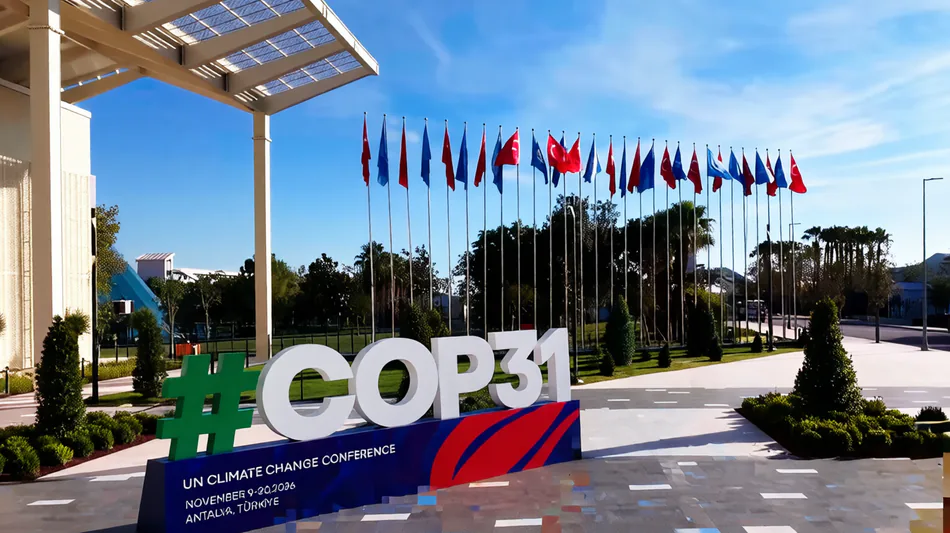
Turning to climate policy, Bayraktar stated that Turkey expects the 31st UN Climate Change Conference (COP31), to be held in Antalya from November 9 to 20, to mark a decisive shift from climate commitments to implementation. He called for concrete, financeable, and actionable measures, particularly in clean-energy investment and energy infrastructure.
Global energy challenges, including price volatility, geopolitical tensions, and supply-chain disruptions, have underscored that energy security is no longer simply an economic concern but a fundamental pillar of national security and political and economic stability, Bayraktar said. Turkey believes the transition must strike a balance between three core priorities: securing energy supplies, maintaining economic competitiveness, and cutting carbon emissions. The shift toward clean energy must not come at the expense of affordable energy for households and industry.
Turkey’s energy strategy through 2040 aims to raise renewables to around 77% of installed power-generation capacity. Achieving this target will require continued expansion of solar and wind power, as well as investment in transmission and distribution networks, energy-storage technologies, and energy-efficiency measures. These efforts form part of Turkey’s strategic goal of achieving carbon neutrality by 2053, in line with the vision announced by President Recep Tayyip Erdogan.
On COP31 priorities, Bayraktar said Turkey attaches particular importance to climate finance as a critical enabler of the green transition. He stressed that meeting climate goals will require substantial financial resources, investment, advanced technologies, and stronger international partnerships. The success of COP31 should not be measured by the number of meetings held or declarations issued, but by the scale of projects translated into action, the tangible results delivered on the ground, and the extent to which the conference strengthens cooperation between developed and developing countries.
M.Romero--PV