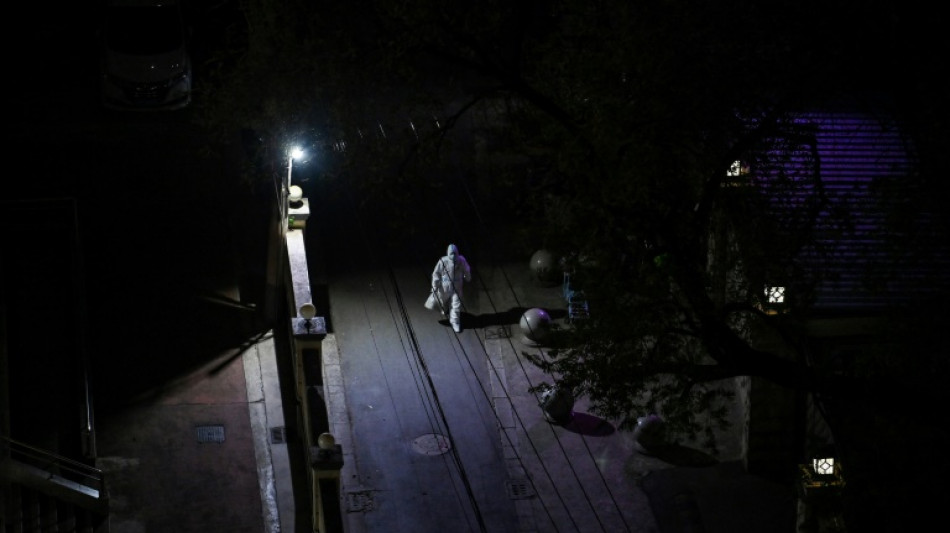
Shanghai locals sleep at work and ration food as lockdown bites / Photo: HECTOR RETAMAL - AFP

By day it's Romeo's workplace, by night it's his home. Like many other finance sector workers in Shanghai, he has moved into the office to keep the wheels of commerce turning during a harsh Covid lockdown of the megacity.
Anticipating that creeping closures would catch him out, Romeo decamped to the Pudong finance district in late March shortly before the city shut down.
The business hub has since become the epicentre of China's biggest Covid-19 outbreak since the virus emerged more than two years ago, recording around 25,000 infections a day.
Most of Shanghai's 25 million residents are under strict stay-at-home orders, raging at food shortages and fearful of testing positive for Covid as it would land them in a giant quarantine centre.
Some, like Romeo, are living strangely dislocated lives as businesses struggle to keep operating in one of the world's major financial hubs.
"There are people sleeping on the first and second floors, each person goes to their own office," Romeo told AFP, declining to use his real, Chinese name.
"There's no forced conversation... everyone is quiet and respectful of each other's distance and privacy."
At night the social graces of office hours continue, he said.
For other workers in Shanghai, privacy is in short supply. Social media videos show staff sleeping on bunks in closed factories that are trying to continue manufacturing their goods.
- $63 noodles -
Shanghai's slide into crisis caught many unprepared.
Frank Tsai, who is locked down in his apartment in Puxi, the western half of Shanghai, stocked up with food for four days as initially ordered by authorities.
Seven days later, his portions are "getting smaller and smaller".
"I've thought about my meals and my food intake more than I ever have in my life," said Tsai, whose business organises public lectures in normal times.
Some residents have resorted to bartering or paying over the odds for food as the lockdown grinds on.
A Shanghai resident surnamed Ma said she paid 400 yuan ($63) just for a box of instant noodles and a soda.
"I'm just trying to stock up," she said. "I'm not sure how long this will continue."
- 'Unreasonable, unsustainable' -
Shanghai is now a city of silence with the quiet broken only by robot dogs and drones broadcasting orders to test for Covid and stay inside.
Workers in hazmat suits -- dubbed the "Big Whites" -- carry out testing inside residential compounds, where every few days residents line up for swabbing filled with dread at a positive result.
Some have seen the lighter side. One foreigner queuing for testing last week dressed in a tuxedo complete with bow-tie has made waves online as people make the most of their few minutes outside.
Dog owners have been unable to walk their pets and are forced to put their pooches through crash courses on using a litter tray -- or sneak out in the dead of the night for the animals to relieve themselves.
"I trained my dog to pee and poop inside, but it came to a point where, to keep myself sane and my dog sane, I took him down at 3am," said one owner.
Authorities are struggling to provide enough beds at makeshift hospitals for people who test positive.
The government has said 130,000 new beds are ready or under construction as part of its mass quarantine regime.
But the policy is testing the tolerance of many.
Leona Cheng, a student in her early 20s, emerged from 13 days of quarantine on Friday.
"It is unreasonable and unsustainable," she told AFP of Shanghai's strategy.
"Too many people are getting infected and the rate of infection is too fast."
R.Zarlengo--PV