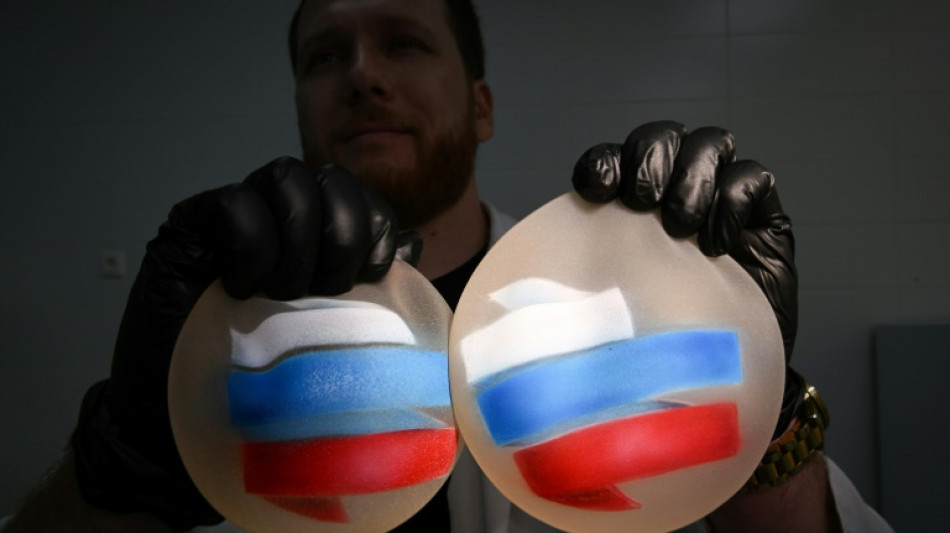
Russia's plastic surgery sector feels pinch from western sanctions / Photo: Natalia KOLESNIKOVA - AFP/File

When it comes to looking good, Russian women are happy to splash out, even on a bit of nip-and-tuck plastic surgery.
But Western sanctions in the wake of Russia's military intervention in Ukraine mean that supplies of products such as botox and breast implants -- largely imported from countries such as the United States and Germany -- could become increasingly hard to get hold of.
Anastasia Yermakova, 37, is worried: she had her last injection of botox (botulinum toxin) in February to reduce facial wrinkles.
"My beautician assures us that she still has stocks of botox," she told AFP.
"But I worry," she said, arguing that local botox replacements are of inferior quality.
Russia ranks ninth globally in the number of aesthetic procedures carried out annually -- 621,600 in 2020, according to the International Society of Aesthetic Plastic Surgery.
And the Russian aesthetic medicines sector was worth $969 million in 2021, up two percent from the year before, according to the Russian consultancy Amiko.
Soon after President Vladimir Putin sent troops into Ukraine on February 24, US drugmaker AbbVie, which is behind the wrinkle treatment Botox, withdrew from the flourishing Russian market over what it called "tragic events" in Ukraine.
As a result, Botox stocks are "melting", Yuliya Frangulova, co-founder of the National Association of Aesthetic Medicine Clinics, told AFP.
Frangulova said it is "causing concern of clinic managers accustomed to using this reference product".
- 'Say goodbye to fillers' -
"In March, we saw a panic among patients, doctors and suppliers," said Oksana Vlasova, director of development at the Grandmed beauty clinic in Russia's second city Saint Petersburg.
"The demand exploded, the stocks of botox were emptying."
In April and May, there were no botox imports at all, said Nikolay Bespalov of RNC Pharma which analyses the Russian pharmaceutical market.
He hopes supplies could resume "towards the end of the summer."
Russians are also running out of some Western-made face fillers, in particular injections of hyaluronic acid to plump up lips -- a very popular procedure in the country.
"We are also forced to say goodbye" to fillers from AbbVie, Vlasova said, hoping that European producers can fill in the gap.
It is also getting harder to get breast implants -- due to a lack of Russian producers.
All breast implants in Russia are imported, with 60 percent coming from the United States and 13 percent from Germany, according to industry estimates.
The sanctions do not target the supply of implants, but the disrupted logistics and other factors affected both breast reconstruction and aesthetic operations.
In March, prices of implants rose threefold, before stabilising at a level 20 percent higher than before the start of Moscow's military intervention in Ukraine, plastic surgeon Evgeny Dobreikin told AFP.
- Patriotic breasts -
Alexander Saversky, president of the League of Patient Advocates, fears that cheap but potentially dangerous products could soon start arriving in clinics, recalling the scandal of the French firm PIP's poor quality breast implants.
Saversky predicted that the problems will soon apply to the rest of the health industry.
"In a few months, the shortages of medical equipment in Russia, 80 percent of which is imported from abroad, will be critical," he said.
Soaring inflation and uncertain future also create problems for beauty professionals, as Russians have begun to tighten their belts.
In Saint Petersburg, Vlasova has already seen a drop in her clientele.
"The population's income has gone down," she said.
"People are reducing their expenses."
But in the midst of dark times, plastic surgeon Dobreikin sees an opportunity.
He wants to win new clients with patriotic themes.
In late May, he floated the idea of "RosGrud" (Russian Breasts) implants, which instead of being translucent are in the colours of the Russian flag or military fatigues.
One of his clients, Nastella Sokolova, a 28-year-old designer, is enthusiastic.
"It's my way of defending my homeland," she said.
The surgeon is now looking to find a supplier abroad who is willing to create such implants for him.
Dobreikin warns wits against mocking his project, alluding to harsh penalties introduced in the country for anyone criticising the army.
"Perhaps those who are against our patriotic implants are also against our country?"
F.Abruzzese--PV