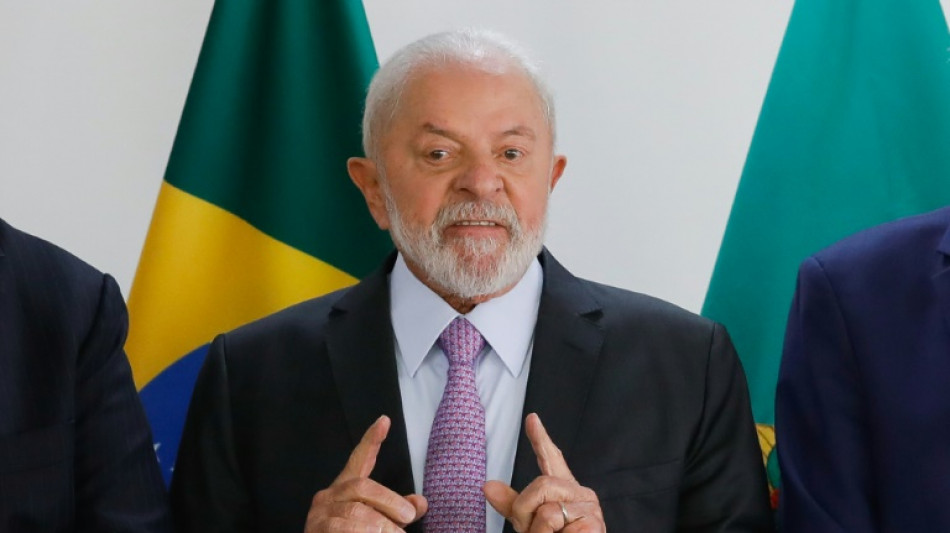
Brazil's Lula, environmentalist... and oil champion / Photo: Sergio LIMA - AFP

President Luiz Inacio Lula da Silva has cast himself as a champion of the fight against climate change, but faces criticism from environmentalists for Brazil's booming oil production.
Since returning to office for a third term in January 2023, the veteran leftist has made solid progress on his pledge to end illegal deforestation in the Brazilian Amazon, which fell by half last year compared to 2022.
But climate campaigners were outraged in December when, just as the COP28 UN climate talks were being held in Dubai, Brazil announced it would join the OPEC+ group of oil-producing countries.
The timing earned Brazil, the world's ninth-biggest crude producer, the "Fossil of the Day" award from the Climate Action Network, which said the country's leaders "appear to have mistaken oil production for climate leadership."
"Brazil can't be a climate leader and petro-state. The two things are incompatible," Suely Araujo, policy coordinator at environmental group the Climate Observatory, told AFP.
- Record oil production -
Lula came to office vowing "Brazil is back" in the climate fight after four years of surging destruction under far-right ex-president Jair Bolsonaro (2019-2022) in the Amazon, whose hundreds of billions of carbon-absorbing trees are a key buffer against global warming.
In keeping with that message, Brazil is due to host the 2025 edition of the UN climate talks in the Amazon city of Belem.
But even as the Lula government fought to protect the Amazon, Latin America's top oil producer also racked up several monthly crude output records last year -- most recently in November, when it produced nearly 3.7 million barrels a day.
The energy ministry hopes to hit 5.4 million barrels a day in 2029, which could make Brazil the world's fourth-biggest oil producer.
"The world should be thankful to Brazil for being a reliable supplier" of oil, the head of the International Energy Agency, Fatih Birol, said this week during a visit to the country.
Brazil provides about three percent of global crude supply, he said.
Lula has pushed to expand further, and even wants to explore for oil near the mouth of the Amazon river -- a plan opposed by environmentalists, including his own environment minister, Marina Silva.
- 'Looking to the past' -
Oil accounts for around 13 percent of gross domestic product (GDP) in Latin America's biggest economy, according to economist Igor Barenboim.
Brazil exports about one-third of its oil output, which is "key to drive growth," Barenboim said.
Sales from oil and oil derivatives were $42.5 billion last year.
That money provides revenue for the state, including for Lula's cherished social programs.
Lula also argues oil money will be used to fund the transition to clean energy.
But "it's a mistake to want to generate revenue from (oil) exports, looking to the past and ignoring the severity of the climate crisis," said Araujo.
Enrico Marone, a spokesman for Greenpeace Brasil, said the country does not need any new oil.
"The oil fields currently in operation will provide enough resources to support the energy transition," he said.
Brazil currently relies on renewables for 47 percent of its energy mix, more than triple the world average of 15 percent, according to government figures.
A.Tucciarone--PV