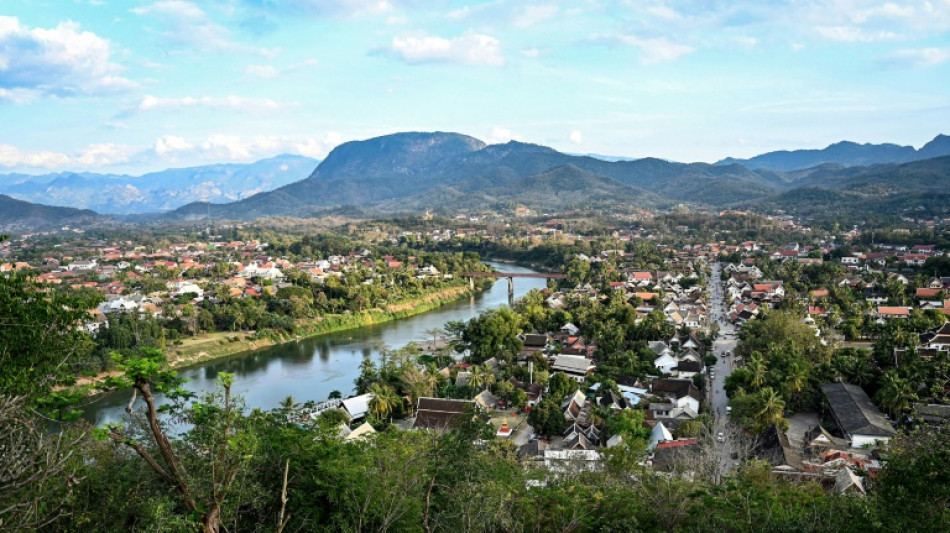
'You can't imagine the damage': Dam threatens historic Laos town / Photo: TANG CHHIN Sothy - AFP

A short boat ride upstream from the ancient Laotian royal capital of Luang Prabang, a massive dam is under construction that critics say threatens the riverside town's allure and heritage status.
The $3 billion Luang Prabang hydroelectric dam on the Mekong river, backed by a Thai-led consortium, is one of seven new mainstream dams that Laos plans to build to capitalise on its huge hydro potential.
Experts warn that the barrage will change the contours of the Mekong's banks and turn the mighty waterway into a series of lakes -- detracting from the character of Luang Prabang as a riverside town and putting at risk its UNESCO listing.
With its blend of traditional Laotian and colonial French architecture, Luang Prabang has long been one of the poor, reclusive country's major tourist draws.
Many people working in the town's tourism industry fear their livelihoods are at risk.
"Once they have the dam the Mekong will be different: it will be just like a pool," a tour guide in Luang Prabang told AFP.
Laos is a one-party communist state that does not tolerate dissent, and like many of those who spoke to AFP for this story, the tour guide did so on condition of anonymity.
"Once they complete the dam, you can't imagine the damage for tourists," the guide said.
"Now it is beautiful, you can see the rocks, the river, the gardens on the riverbank," he said.
"The environment will change."
- Slowing the flow -
Laos, which is grappling with high inflation, slack economic growth and "critical levels" of public debt according to the World Bank, has sought to turn itself into the "battery of Southeast Asia" by exporting clean energy generated by hydroelectric plants to its more developed neighbours.
The 80-metre-high, 275-metre-wide Luang Prabang dam is due to finish in 2030, Laotian media reported. It will generate 1,460 megawatts of power, the bulk of which will be exported to Thailand and Vietnam.
Two downstream barrages, the Xayaburi and Don Sahong facilities, are already operational.
Conservationists say the dams, in addition to others upriver in China, are causing low water levels along the Mekong and wrecking fishing that millions rely on for food.
NGO International Rivers has warned the dams will "block the major fish migrations that feed and provide income to millions of people, and threaten the ecological integrity of the entire river system".
World heritage body UNESCO, which listed Luang Prabang in 1995, has repeatedly warned of threats to the site.
In its latest report late last year, it said Luang Prabang had "urgent conservation needs" and exhorted the government to take action.
Among the requirements are impact studies to answer concerns the dam will affect the protected area, it said.
Dams can change a river's water levels and rate of flow, which in turn can alter the shape and contours of its banks.
But Anda Yangsenexay, deputy head of Luang Prabang World Heritage Management Division, insisted there was no issue with the construction of the hydro dam.
"We are trying to explain to everyone. Dams are necessary and the dams are not in town," he told AFP.
"We know there was some disagreement from UNESCO, but we are trying to explain that now we think there is no problem," he said, before adding that authorities would deliver impact studies.
"Conservationists have to accept that there must be development. Both must go together," he said.
Luang Prabang residents fear changes to the river caused by the dam could deter tourists.
"The dam is very bad," said a 25-year-old waiter, cleaning tables in a near-empty riverbank restaurant.
He pointed at a semi-submerged promontory, peeking from the muddy water, "before you could see rocks and there was a nice scene for tourists. Now there are fewer boats."
But locals are resigned: one 37-year-old asked about the dam's impact shrugged.
"High-ranking officials already signed the contract," he said. "I don't dare to speak."
B.Fortunato--PV