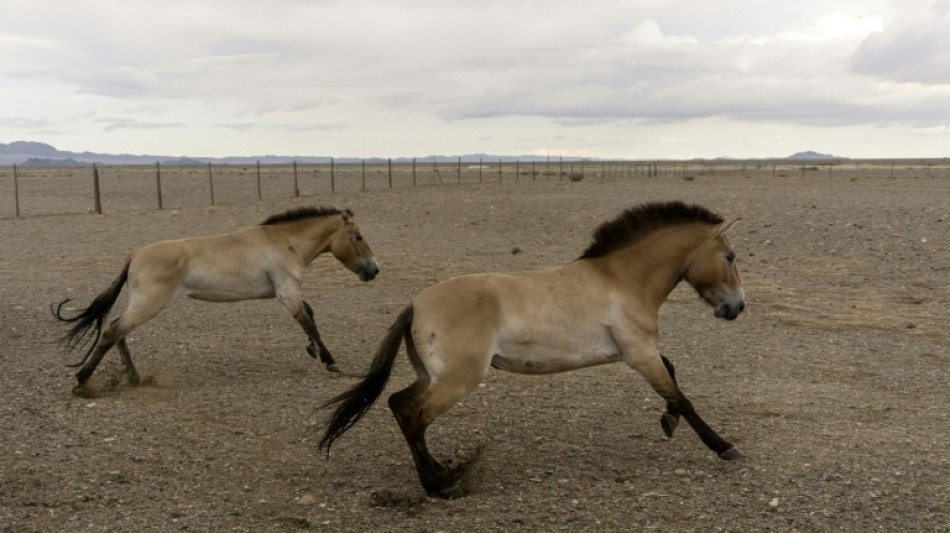
Prague, Berlin zoos to reintroduce wild horses to Kazakhstan / Photo: Jan FLEMR - AFP

Prague zoo said Tuesday it would transport eight endangered wild horses to a Kazakhstan steppe in June in a joint project with the Tierpark Berlin zoo.
The zoos are planning to take at least 40 Przewalski's horses to roam free in the Altyn Dala (Golden Steppe) area in central Kazakhstan in the next five years.
In June, Czech army planes will transport three stallions and five mares to Arkalyk in central Kazakhstan, with Prague zoo and Tierpark Berlin sending four horses each.
"On June 3, two planes will take off, one from Prague and the other from Berlin, to take the horses to Arkalyk with stopovers in Istanbul and Baku," Prague zoo director Miroslav Bobek told reporters.
The 6,000-kilometre (3,750-mile) flight is expected to take 15 hours, said Czech army general Jaroslav Falta.
Provided by different zoos in Europe, the horses will then be driven from Arkalyk to the Alibi reintroduction centre in Altyn Dala on trucks.
Przewalski's horses have narrowly avoided extinction thanks to breeding programmes at zoos worldwide.
Prague Zoo, which has bred the species since 1932 and keeps the world genealogy book for the endangered species tracking all new births, launched a project to reintroduce the animals to Mongolia in 2011.
It transported 34 horses on Czech army planes there between 2011 and 2019, before the pandemic halted the project co-funded by zoos from across the globe.
"This project is vital for increasing the number of Przewalski's horses in the wild," European Association of Zoos and Aquaria (EAZA) chairman Endre Papp told reporters in Prague.
"What makes these reintroductions so valuable is not only the transport of the animals, but also the exchange of knowledge and expertise gained over the years," he added.
First documented by Russian scientist Nikolai Przhevalsky in 1881, the species was nearly extinct in the 1960s and is still listed as endangered by the International Union for Conservation of Nature.
The current global population exceeds 2,000 animals, with about half living in the wild in Mongolia, China and elsewhere.
Prague zoo is currently also planning a wild horse reintroduction project in eastern Mongolia.
A.Saggese--PV