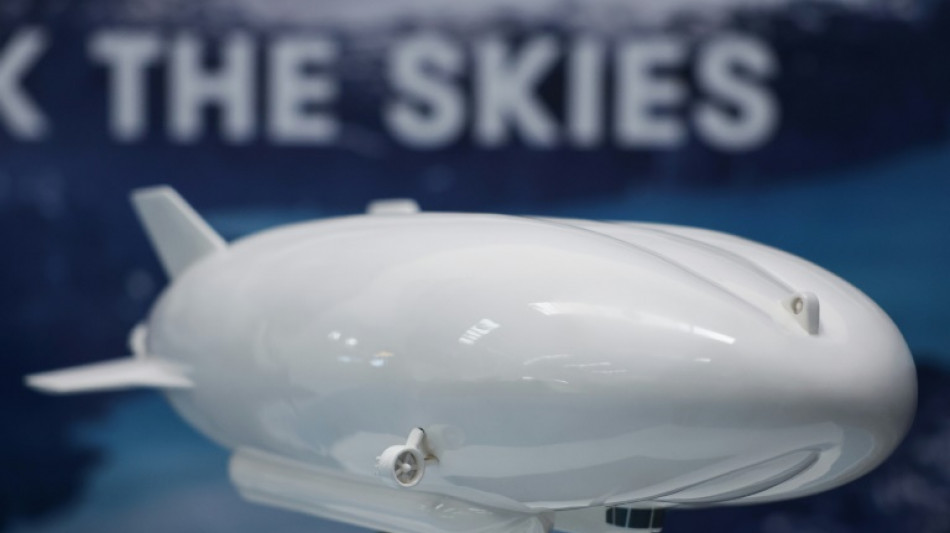
Flying high: UK's modern-day green airship takes shape / Photo: Daniel LEAL - AFP

Britain's innovative Airlander 10 airship could soon take to the skies to offer leisure passengers panoramic views and far less pollution than traditional aircraft, according to its manufacturer.
On the outskirts of the town of Bedford, north of London, UK company Hybrid Air Vehicles (HAV) says its plans are well underway for greener but slower commercial air travel.
The Airlander -- which is 300 feet (91 metres) long -- is lifted by its gigantic helium-filled hull, which is then steered through the air by engine propellers powered by conventional fuel.
The dirigible is "unlike any other aircraft cabin you've sat in", HAV chief executive Tom Grundy told AFP on a visit to the Bedford facility.
"It's big, it's long, it's spacious (and) it's very quiet to sit on board.
"There's floor-to-ceiling windows, and the aircraft's unpressurised, so you can even open a window and look at the outside world as you're going over it."
- Cutting emissions -
The airship, initially developed for the US army, is longer than the Airbus A380 jumbo yet pumps out up to 75 percent less emissions than aircraft, according to HAV.
The group plans to start production later this year, while electric- and hydrogen-powered versions are planned in order to further slash emissions.
HAV has already manufactured a prototype, part of which is now on display in Bedford after completing test flights.
The tech hub also features a life-size model of the future airship that allows visitors to step on board and view its "luxury" configuration including a bar, passenger cabins and an observation lounge.
However, experts concede that airships will be hindered as a form of transport owing to its slow speed versus other airborne modes.
Professor Andreas Schaefer, director of the Air Transportation Systems Laboratory at University College London, cautioned that it would be a "niche" market.
"On a commercial basis, as a vehicle for long distance transport, I can't see any future because simply the speed is by far too slow," he noted.
HAV is one of the few companies that it seeking to relaunch the airship, but using the inert gas helium.
Almost 90 years ago, the Hindenburg Zeppelin -- filled with highly flammable hydrogen -- exploded in the United States in 1937, killing 36 people and ending the widespread use of airships.
- Airship revival -
Yet the potential of airships to provide an environmentally friendly, low-cost alternative to helicopters and passenger jets for transportation has now sparked renewed interest.
HAV's French peer Flying Whales is seeking to develop a fleet of rigid airships for carrying heavy cargo.
"The airship revival has been talked about, like the revival of Concord, for about 30 years now (or) more," aviation consultant Philip Butterworth-Hayes told AFP.
"The idea is absolutely great, it should theoretically be able to meet all the environmental challenges that aviation has in terms of being able to reduce carbon emissions."
Yet he sounded a cautious note over the outlook for airships.
"There's a whole number of very complex technical regulatory issues that need to be sorted out before it becomes a reality," said Butterworth-Hayes.
"You need an awful lot of money to certify an aircraft," he added.
Airlander, which is capable of taking off and landing on land or water, can stay airborne for up to five days and travel more than 7,000 kilometres at about 140 kilometres per hour.
Yet its British manufacturer estimates that its first commercial airship flights will not be until 2028.
HAV currently has 23 pre-orders for the airship, with an order book totalling more than £1.0 billion ($1.3 billion). That includes 20 lodged by Spanish regional airline Air Nostrum.
C.Conti--PV