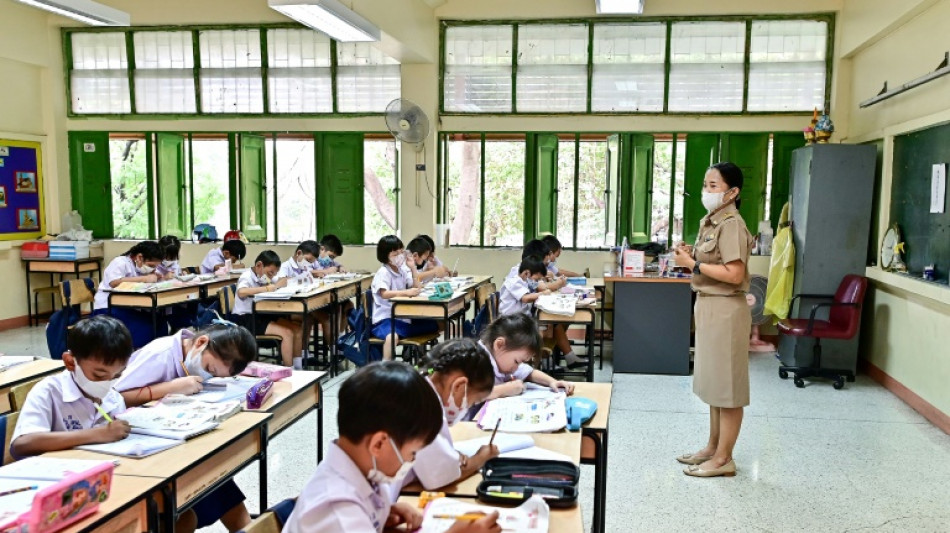
Smog and sick kids: Thai pupils endure air pollution / Photo: MANAN VATSYAYANA - AFP

Hundreds of Thai children strain to sing the national anthem, reedy voices and fragile lungs competing against eight lanes of belching traffic next to their school's open atrium in central Bangkok.
Pupils at Suan Lumphini School assemble each morning under a coloured flag indicating the day's air quality -- red for worst, yellow for second worst, blue for best.
Thailand registers dire air pollution levels annually -- its cities topping the world's most polluted for days last year -- and children face the greatest risk of long-term damage to their respiratory systems.
Lalipthat Prakham, who works as a maid, said it has already made her eight-year-old daughter sick.
"I always try to make her wear a mask. I tell her to keep the mask on at all times and to avoid going outside," she told AFPwhile waiting for her child outside Suan Lumphini.
Prime Minister Srettha Thavisin has promised to tackle the issue, with his cabinet in January approving a bill aimed at tackling dangerous levels of PM2.5 -- particles so tiny they can enter the bloodstream.
But in the meantime, residents must endure.
Nanthnan Hajiub said his 11-year-old son has developed a sporadic cough.
"I'm worried about the pollution, and the effect it is having on his respiratory system," the 45-year-old business owner said.
"I want the people in charge to take better care of the situation."
- 'Clean Room' -
Not all children suffer equally.
Bangkok's elite private international schools enjoy air purifiers and filtration systems in classrooms, but public establishments like Suan Lumphini must do without them.
The school is now part of a pollution study by Chulalongkorn University which has fitted out a single classroom with a purifying airconditioning unit, known as a "clean room".
The programme -- one of four rolled out at schools in highly polluted areas -- monitors the air and filters some of the harmful microscopic particles.
School head Suphatpong Anuchitsopapan is concerned that not enough is being done to address the issue, saying "pollution makes students weaker".
"If children have good health during their studies, then they will give back to society in the future," he said.
Children are at higher risk from air pollution due to several factors, according to Teerachai Amnuaylojaroen from the University of Phayao's School of Energy and Environment.
Not only are their still-developing bodies more susceptible to damage, but they also breathe faster than adults -- inhaling "more pollutants", he said.
The World Health Organization warns that as well as damaging children's respiratory systems, air pollution also puts them at higher risk of cancer and can stunt the development of their brains.
Teerachai said while "clean rooms" provided a safe space inside schools, they were only a "preliminary solution to the issue."
While there are no statistics on children hospitalised from pollution, the National Economic and Social Development Council warned this month that PM2.5 was a significant public health threat.
Between January and February this year some 910,000 people were registered unwell thanks to pollution, said the council, which advises the government.
- 'All I can do' -
Back at the school, teacher Jiraporn Sukpraserd has embraced her 'clean room'.
The 51-year-old has been teaching for almost a decade, most recently the youngest kindergarten class which is equipped with the school's purifying AC system.
"Last week, (the air quality) was ranked in red and orange all week," she said, worried for the health of her students, mostly kids under four.
Her pupils overheat if they keep the windows sealed shut, she said, so they have to let in a breeze -- as well as the polluted air.
With the air purifier running, pollution levels drop after 30 minutes.
"I want every classroom to be like this. It helps prevent children (from) getting sick," said Jiraporn.
But business owner Bounleua Boriharn, whose eight-year-old daughter is not taught in the "clean room", is worried about what to do when fog engulfs the Thai capital.
"The children don't really understand what's happening -- they just wonder why their throats are sore and why they are coughing," he told AFP.
"I always try to have her wear a mask," he said.
"That's all I can do."
G.Riotto--PV