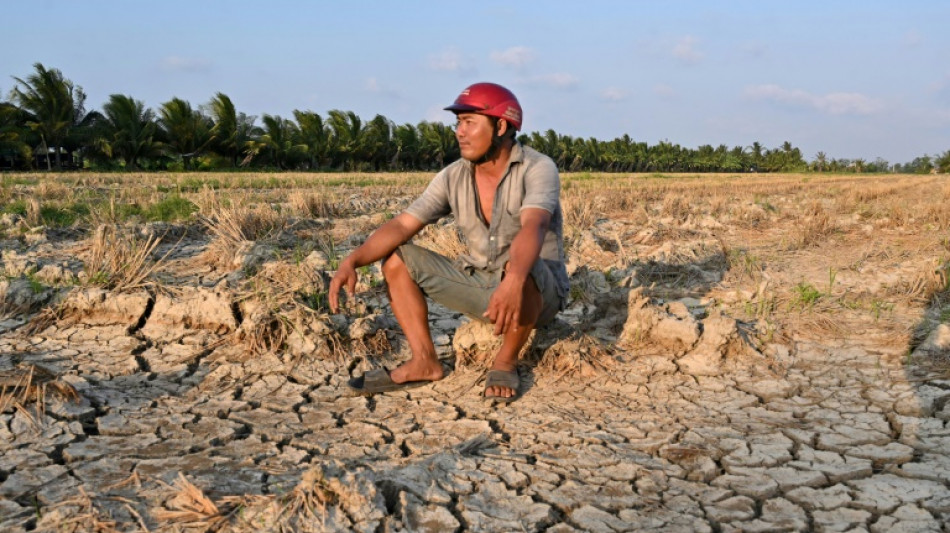
Vietnam farmers struggle for fresh water as drought brings salinisation / Photo: Nhac NGUYEN - AFP

Every day, farmer Nguyen Hoai Thuong prays in vain for rain to fall on the cracked dry earth of her garden in Vietnam's Mekong Delta -- the country's "rice bowl" agricultural heartland.
A blazing month-long heatwave has brought drought, parching the land in Thuong's home of Ben Tre province, 130 kilometres (80 miles) south of business hub Ho Chi Minh City.
The area is crisscrossed by waterways, but the prolonged heatwave and lack of rain are causing salinisation -- the intrusion of salt water from the sea -- badly affecting crops in a region vital to feeding the nation of 90 million people.
"It's a waste leaving the rice field empty like this because we don't have fresh water. I have to change to raising cows instead," 31-year-old farmer Thuong told AFP from her burning hot village, where ground that should be lush wet rice paddy stands cracked and dry.
Without rain, her family has no fresh water for even domestic use, and last month she was forced to buy some from her neighbour for 500,000 dong ($20).
"We don't have a fresh underground water source to use while the surface water is salty," she said as her father pumped water from a mobile container into the family's 1,000-litre storage tank.
The water Thuong bought is strictly for domestic use, from drinking, cooking to bathing, not for the crops.
The Mekong Delta faces saltwater intrusion every year, but more intense hot weather and rising sea levels -- both driven by climate change -- are increasing the risk.
Weather officials say the delta is suffering an unusually long heatwave this year, leading to drought in several areas, low water levels in canals and saltwater intruding -- and they warn the worst may yet be to come.
- $3 billion in crops lost -
Saltwater levels are often higher in the dry season but they are intensifying due to rising sea levels, droughts, tidal fluctuations, and a lack of upstream freshwater.
Research published last week said the delta, which provides food and livelihoods for tens of millions of people, faces nearly $3 billion a year in crop losses as more saltwater seeps into arable land.
Around 80,000 hectares of rice and fruit farms could be impacted by salinisation, according to the study from the Water Resources Science Institute under the environment ministry.
Ben Tre province, where Thuong's village is located, suffered about $472 million in losses each year from 2020 to 2023, according to the study.
"I had to reduce cultivation from three to only two rice crops each year. All water in my area has been too salty to be used for anything," farmer Phan Thanh Trung told AFP from one of his fields.
His neighbour Nguyen Van Hung is luckier -- he has an abundant underground source for fresh water he can use to make money.
"During time of drought and saline intrusion, I sell my fresh water to the neighbours. But to tell the truth, I am not happy," Hung said.
"Adverse weather patterns have really hit us hard."
tmh-nhac/pdw/cwl
F.Abruzzese--PV