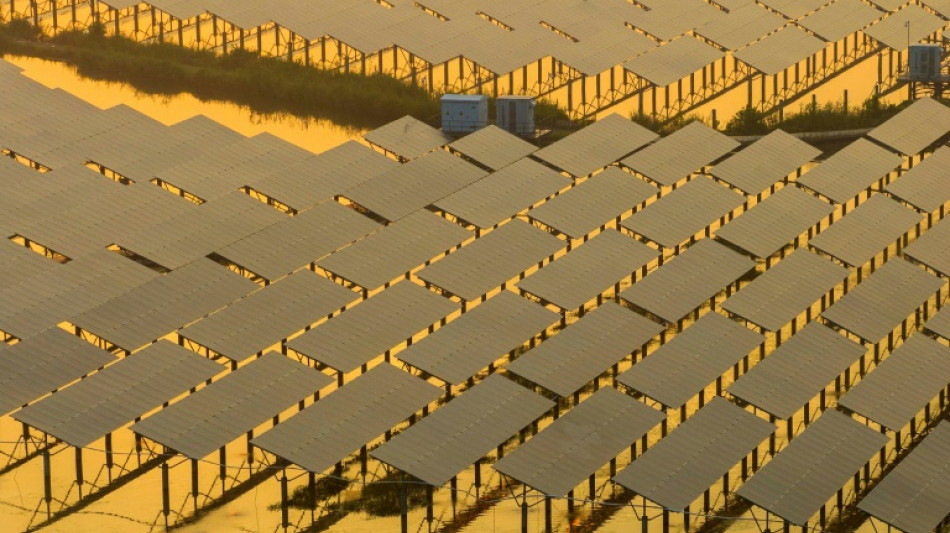
EU probes Chinese-owned solar panel firms over subsidies / Photo: STRINGER - AFP/File

The European Union on Wednesday announced investigations targeting two Chinese-owned solar panel manufacturers suspected of receiving subsidies as trade tensions heat up between Brussels and Beijing.
Brussels has in the past year taken stronger action to defend European industry against growing threats from China and the United States -- but the EU also faces a dilemma.
The 27-nation bloc wants to build up its renewable energy as it races to reach net zero greenhouse gas emissions by 2050, but at the same time move away from excessively relying on cheaper Chinese wind and solar technology.
Chinese state subsidies are already in the EU's crosshairs. In September last year, Brussels started a probe into Chinese electric car subsidies that could lead to punitive tariffs on vehicles it believes are unfairly sold at a lower price.
Beijing at the time warned it would harm trade relations, and raised fears the EU was risking a trade war.
Wednesday's probes were launched under new rules that came into force in July last year and seek to prevent foreign subsidies from undermining fair competition in the EU.
Under investigation are two consortiums, one of which includes the Enevo group in Romania and a German subsidiary of Chinese parent company Longi Green Energy Technology.
Longi is the world's biggest solar panel manufacturer.
The second consortium is made up of two subsidiaries both fully owned and controlled by Chinese state-owned firm, Shanghai Electric group.
"The (European) Commission will assess whether the economic operators concerned did benefit from an unfair advantage to win public contracts in the EU," the bloc's powerful antitrust regulator said.
The China Chamber of Commerce to the EU accused the bloc of abusing its new powers.
"We express our serious dissatisfaction with the abuse of the new tool by the relevant EU authorities and the use of the Foreign Subsidies Regulation as a new tool of economic coercion," it said in a statement.
- 'Preserve Europe's economic security' -
Under the EU's new rules, firms must tell the commission when their public procurement tenders in the EU are worth more than 250 million euros ($270 million) and when the company has been granted at least four million euros in foreign financial contributions in the three previous years.
"The commission considered it justified to open an in-depth investigation for two bidders, since there are sufficient indications that both have been granted foreign subsidies that distort the internal market," said a statement.
The two consortiums had applied to design, construct and operate a photovoltaic park in Romania with an installed capacity of 110 megawatts, partly financed by European funds.
"The two new in-depth investigations... aim to preserve Europe's economic security and competitiveness by ensuring that companies in our single market are truly competitive and play fair," the EU's internal market commissioner Thierry Breton said.
Europe heavily relies on foreign solar panels. More than 97 percent of the panels in Europe are imported, mainly from China, the EU's financial services commissioner, Mairead McGuinness, said in February.
She pointed to a global oversupply and a surge of imports in the EU since 2023.
"Solar panel prices have plummeted by over 40 percent. These falling prices are an opportunity for citizens and solar panel installers as it supports internal demand, and it is clearly a challenge to EU solar panel producers," she said.
- Past battles -
It is not the first time the EU has targeted China under its Foreign Subsidies Regulation.
In February, the commission began a probe into a subsidiary of Chinese rail giant CRRC. That investigation was closed after the CRRC subsidiary withdrew this month from a tender in Bulgaria to supply electric trains.
Battles with China over solar panels are not new for Brussels either.
In 2013, the EU imposed anti-dumping duties after European manufacturers said they were being forced out of business by underpriced Chinese panel imports.
Those restrictions were scrapped five years later.
O.Merendino--PV