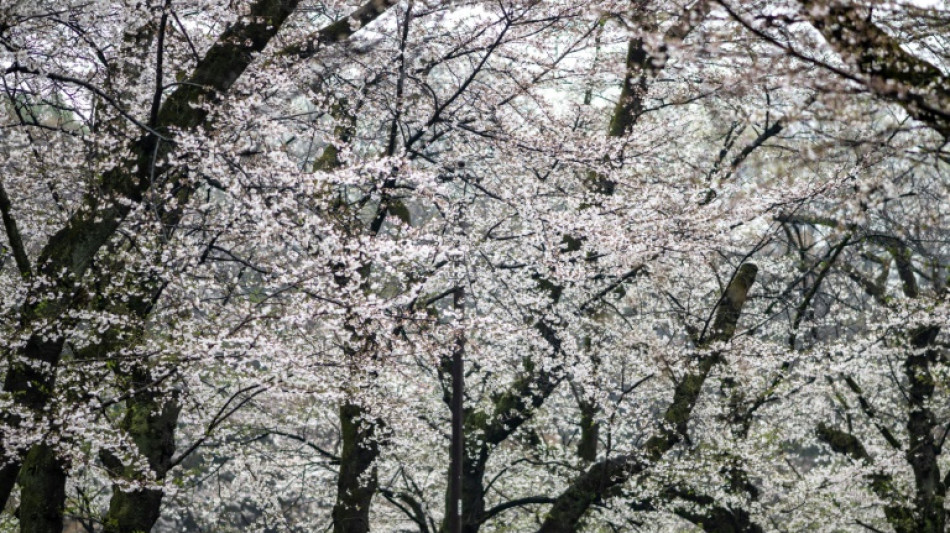
Tokyo crowds revel as cherry blossoms reach full bloom / Photo: Philip FONG - AFP

Tourists and residents packed Tokyo's top cherry blossom spots on Thursday to enjoy the full bloom that has arrived in the Japanese capital later than usual this year because of cold weather.
The elegant dark branches bursting with pink and white flowers -- known as sakura in Japanese -- spilled over the moat of the Imperial Palace, where people gathered to snap photos or simply take in the view.
"Cherry blossoms are so symbolic and make everything around you feel joyful and beautiful," Michitaka Saito, 68, told AFP.
"It makes me feel that I've made a good start on the year ahead," said Saito, who makes an annual visit to Chidorigafuchi Park beside the moat in central Tokyo.
Sakura season traditionally accompanies the beginning of the new fiscal year in Japan, representing fresh starts but also the fleeting impermanence of life.
Eiko Hirose, 76, said that enjoying the cherry blossoms with her husband Sadao "means I'm healthy, and he's good, and we all have a good time".
"We take it for granted that we can see it next year again, but who knows? Something may happen," she said.
The Japanese Meteorological Agency (JMA) declared on Thursday that the country's most common and popular "somei yoshino" variety of cherry tree was in full bloom, four days later than average for the city.
While the agency attributes this year's tardy blooms to cold weather, it has raised the alarm that climate change is making the delicate petals appear sooner in the long term.
Last year's sakura began to flower on March 14 -- the joint earliest date on record along with 2020 and 2021 -- and hit full bloom on March 22.
"Since 1953, the average start date for cherry blossoms to bloom in Japan has been becoming earlier at the rate of approximately 1.2 days per 10 years," the JMA says.
"The long-term increase in temperature is thought to be a factor" as well as other reasons such as the urban heat island effect, according to the agency.
Tourism to Japan has been booming since pandemic-era border restrictions were lifted, and an international crowd was also out enjoying the scenery on Thursday.
Kamilla Kielbowska, a 35-year-old from New York, planned her third trip to Japan around the blossoms.
"We arrived here on, I believe, March 23. And I was joking... 'OK, we gotta go to this park straight from the airport, I cannot miss sakura.'"
But "it was super cold, and no trees were blossoming. And I was a little bit sad, but hoping that I'll still see them in full blossom before I leave."
"It definitely lived up to expectations," she said, calling the sight "marvellous" and "very magical".
Katsuhiro Miyamoto, professor emeritus at Kansai University, estimates the economic impact of cherry blossom season in Japan, from travel to parties held under the flowers, at 1.1 trillion yen ($7.3 billion) this year, up from 616 billion yen in 2023.
R.Zarlengo--PV