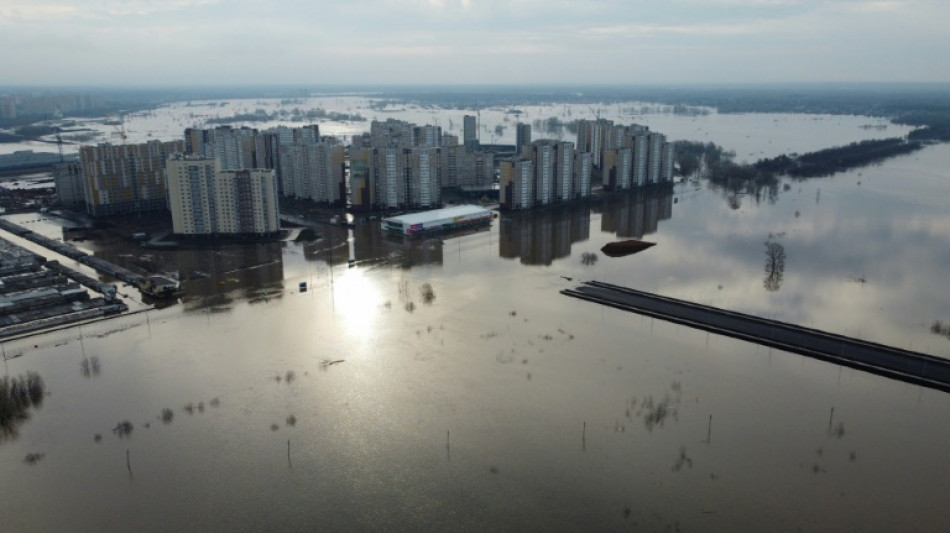
'The water is coming': Russians flee flooded homes / Photo: Andrey BORODULIN - AFP

Alexander Budargin, 25, stood outside his block of flats in the Russian city of Orenburg with knee-deep water lapping in the courtyard, wondering whether it was time to leave.
In this city in the southern Urals about a hundred kilometres from the border with Kazakhstan, Budargin was one of many residents watching anxiously as water levels in the Ural River continued to rise inexorably.
This is one of several major rivers flowing through Russia and Kazakhstan that have breached their banks this month, causing widespread flooding.
Thousands have had to flee their homes and further evacuations are continuing, carried out by rescue services and police.
"The situation is difficult right now. My parents' house was almost completely flooded yesterday," said Budargin, who works in logistics.
"The neighbours sent a video showing that the house was underwater, almost up to the level of the roof."
His parents had packed some belongings and come to stay with him. But the Ural River levels continued to rise and are now threatening Budargin's home, too.
His flat is on an upper floor but the whole building is now surrounded by water that in places is knee-high.
Now officials have announced evacuation of the new residential complex where he lives.
"Unfortunately the water is coming closer to us too," he said.
"The situation is difficult right now... I don't know how the situation will develop further."
His area of the city has also been cut off by flooding and he can safely reach dry areas of the city only by boat or in a specialised rescue vehicle.
In some parts of the city, only the stop signs sticking out of the water show the routes of roads.
Valery, 64, was evacuated Saturday morning, and like most residents, appeared calm and stoical.
"The most important thing is that (my house) does not get looted. That is what I am worried about. Other than that, it is fine! We will survive," he said.
Police were rescuing residents like him in trucks with high wheel bases that can drive through water.
In some areas, locals were able to wade through the water in rubber boots, loaded with children, suitcases and pet carriers.
Meanwhile in other areas of the city, public transport continued to operate and some shops were open.
Some residents not affected personally had come to gaze at the flood waters and at the rescue operation.
- 'Not since 1942' -
"There's been nothing like this since 1942," said Dmitry Surnachev, a 62-year-old designer who came to see the flooding.
"Of course I feel sorry for people," he said. But he said the situation was made worse by building homes on the flood plain, which "is not allowed, and has never been allowed".
Anatoly, a 65-year-old retiree, was busy measuring the water level, finding that according to his calculations, it had risen 15 cm overnight.
"I've lived here for 42 years", he said, witnessing three major floods.
"But this is the biggest."
Fast-rising temperatures have swiftly melted snow and ice floating on rivers, which have also been swelled by heavy rain.
On Saturday afternoon, the river level in Orenburg reached almost 12 metres (39 feet), more than 2.5 metres above the level considered critical.
In neighbouring Kazakhstan, more than 100,000 residents have been evacuated. Russia has not given a total figure for all the affected regions, but at least 20,000 have had to flee homes in the Orenburg and Kurgan regions.
A.Tucciarone--PV