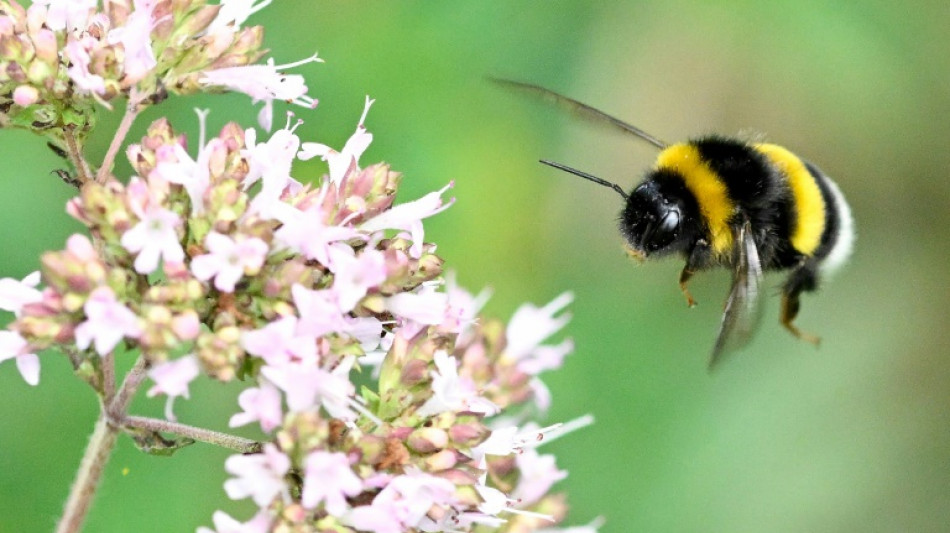
Queen bumblebees surprise scientists by surviving underwater / Photo: Damien MEYER - AFP

Bumblebees can surprisingly withstand days underwater, according to a study published Wednesday, suggesting they could withstand increased floods brought on by climate change that threaten their winter hibernation burrows.
The survival of these pollinators that are crucial to ecosystems is "encouraging" amid worrying global trends of their declining populations, the study's lead author Sabrina Rondeau told AFP.
With global warming prompting more frequent and extreme floods in regions around the world, it poses "an unpredictable challenge for soil-dwelling species, particularly bees nesting or overwintering underground", co-author Nigel Raine of the University of Guelph said in a statement.
Rondeau said she first discovered queen bumblebees could withstand drowning by accident.
She had been studying the effect of pesticide residues in soil on queen bumblebees that burrow underground for the winter when water accidentally entered the tubes housing a few of the bees.
"I freaked out," said Rondeau, who had been conducting the experiment for her doctoral studies. "It was only a small proportion... so it was not that big of a deal, but I didn't want to lose those bees."
To her "shock", she said, they survived.
"I've been studying bumblebees for a very long time. I've talked about it to a lot of people and no one knew that this was a possibility," she said.
She launched another experiment to better understand what happened.
Researchers placed 143 hibernating queen bumblebees in tubes -- some with no water as a comparative group, some floating in water and some fully submerged using a plunger for a period ranging from eight hours to seven days, according to the study published in the journal Biology Letters.
Remarkably, 81 percent of the hibernating queens that were submerged not only survived seven days, but once returned to dry conditions remained alive eight weeks later.
The long-term impact on the bees' health and the effects it could have on a colony still needs further research, Rondeau noted.
The common eastern bumblebees used in the study are found in North America and are particularly hardy, not showing the same degree of population declines as other bee species, she said.
"So we are also wondering whether this resistance to flooding can be part of why they're doing so well," said Rondeau, now a postdoctoral fellow at the University of Ottawa.
The study would have to be replicated on other species of bumblebees to determine how common the trait is.
"But it's encouraging to know that at least (flooding) is not another big threat that we have to consider," she said.
C.Conti--PV