Pallade Veneta - Snake on a train delays Japanese bullet service

Snake on a train delays Japanese bullet service


Snake on a train delays Japanese bullet service
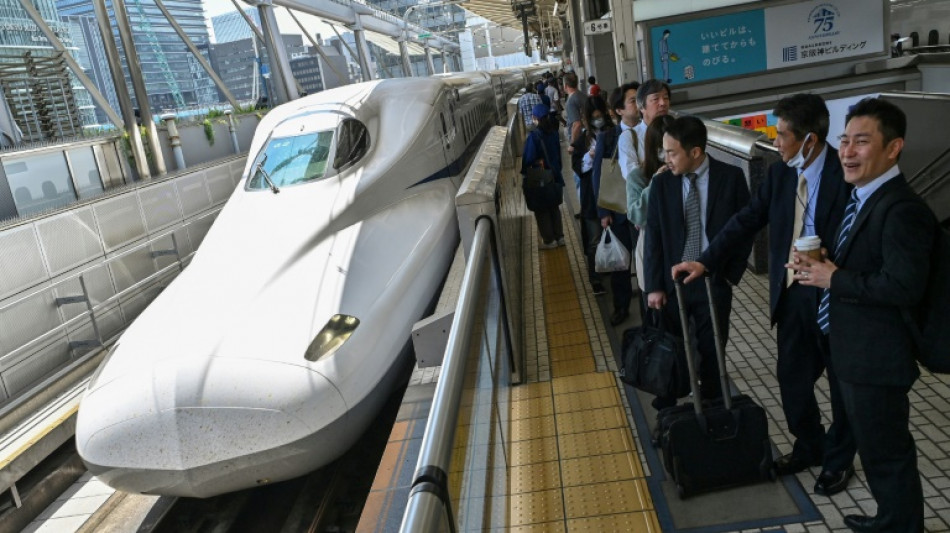
Snake on a train delays Japanese bullet service / Photo: Richard A. Brooks - AFP

Even small delays in Japan's much-vaunted bullet trains are rare, and more unusual still are snakes on board holding up the speedy "shinkansen" services.

Change text size:

On Tuesday evening, a passenger alerted security to a 40-centimetre (nearly 16-inch) serpent lurking on a train between Nagoya and Tokyo, resulting in a 17-minute hold-up.

It was unclear whether the cold-blooded commuter was venomous or how it ended up on the train, and there was no injury or panic among passengers, a spokesman for Central Japan Railway Company told AFP

Shinkansen customers can bring small dogs, cats and other animals, including pigeons on board -- but not snakes.

"It's difficult to imagine wild snakes somehow climbing onto the train at one of the stations. We have rules against bringing snakes into the shinkansen," the spokesman told AFP.

"But we don't check passengers' baggage," he said.

The train was originally scheduled to go on to Osaka, but the company decided to use a different train for the trip, causing a delay of about 17 minutes, he said.

Patrols by uniformed security guards onboard bullet trains were scaled up after a fatal stabbing in 2018 on a shinkansen that shocked normally ultra-safe Japan.

Additional security was added for the Summer Olympics in 2021 and Group of Seven meetings last year.

First launched in 1964, the shinkansen network has never suffered an accident resulting in any passenger fatalities or injuries, according to Japan Railways.

The trains can travel at 285 kilometres (177 miles) per hour, with an average delay of 0.2 minutes.

Y.Destro--PV

Featured

US Buildings Threatened by Wildfires Could Triple by 2060

A new study published in Nature Communications projects that the number of buildings across the contiguous United States threatened by wildfires could almost triple by 2060. Researchers attribute this escalating risk to a combination of climate change, forest mismanagement, and continued development in fire-prone areas, warning that socioeconomically vulnerable communities face disproportionate dangers.

Researchers Warn 'Bookkeeping Trick' Masks Beef Industry's Methane Emissions

Two new analyses warn that a specialized accounting method known as GWP* enables major beef-producing countries to significantly understate their methane emissions. Researchers from Greenpeace and the University of California, Los Angeles, argue that this metric creates a misleading picture of climate progress, allowing nations to claim neutrality while actual warming continues.

Climate Change Intensified Atlantic Hurricanes, Study Finds

Human-caused climate change significantly intensified Atlantic hurricanes over the past five years, according to a new analysis by Climate Central. The study found that elevated sea surface temperatures increased maximum wind speeds for most storms between 2019 and 2023, as well as every recorded storm in the 2024 season.

UAE oil spill raises questions for desalination operations

An oil spill off the United Arab Emirates that has prompted temporary restrictions on fishing and on access to several beaches has raised concerns over the risk of environmental contamination and the potential impact on desalination plants. The spill is from a vessel that shipping sources have identified as crude oil tanker Gem No.

Change text size: