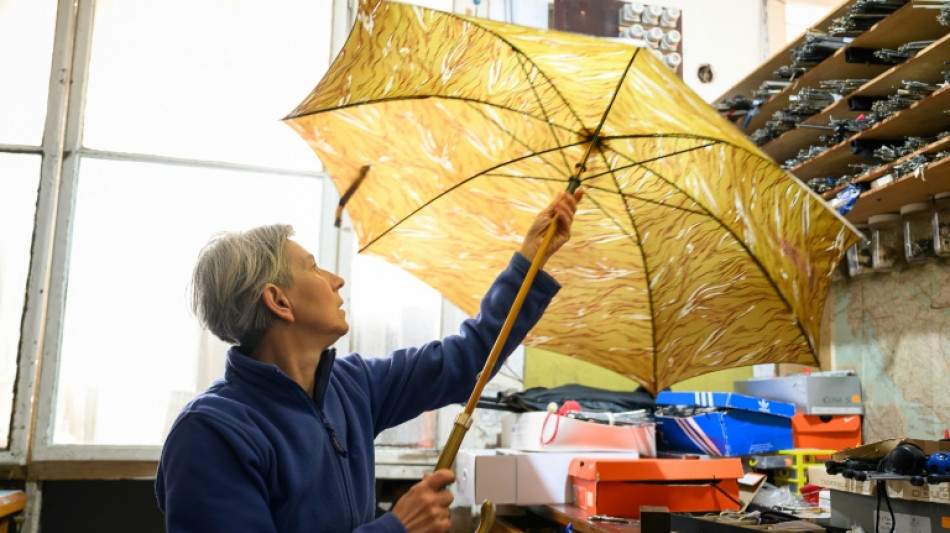
Slovenia's umbrella doctor weathers the economic storm / Photo: Jure Makovec - AFP

While most people believe a malfunctioning umbrella means you have to buy a new one, Slovenian Marija Lah -- one of Europe's last umbrella repairers -- has spent her life proving them wrong.
"Everything can be repaired! I believe I can repair 98 percent of all the umbrellas I get," the 56-year-old laughs, waving around a 50-year-old model to demonstrate its quality.
While most umbrella repairers have closed shop as millions of broken, cheap umbrellas are tossed out each year around the world, Lah is catering to a growing base of new customers who try to throw away less due to environmental concerns.
"It is a fashionable thing now," she told AFP in her shop packed with umbrellas, an old sewing machine and thousands of different spare parts, including ribs, caps and wires piled on shelves.
- Reluctant apprentice -
Founded almost 60 years ago by Lah's father, the tiny shop in a stone-paved Ljubljana street is one of the oldest in Slovenia.
Lah, who used to work as a kindergarten teacher, never thought of working there until her father -- then struggling with an advanced cataract condition -- asked her to join as an apprentice.
Reluctantly, she agreed, to save the shop, working alongside him from 1991 for 14 years. And after his death, customers encouraged her to keep going.
"I told myself: 'Marija, you can't just throw away a knowledge that nobody else has in Ljubljana!'" she recalls.
Lah explains that to make or repair an umbrella you need to master the craft of sewing and fine mechanics.
Some umbrellas take just minutes to repair, sewing the rib to the canopy for example; others, with complex mechanisms or plastic parts, can take weeks to disassemble and put back together.
Mass production of umbrellas by thousands of different factories -- and with customers constantly demanding new models -- also makes repairs difficult.
"You have to learn constantly," Lah said.
She is unsure whether her children want to take over the shop one day, saying it was up to them as she does "not intend to force them".
- 'Saviour' -
Lah believes besides satisfied customers, rain is her "best advertisement" though she does not fear dry summers, which gives her time to clean up her shop.
As scientists warn that extreme weather is becoming more intense as a result of climate change, the Alpine nation of two million last year suffered its worst flooding since 1991 independence, hitting two-thirds of the country.
Refusing to reveal business figures, Lah insists she can make a living as customers from all over Slovenia bring their and often their friends' umbrellas for repair.
"I like to repair my umbrellas," customer Danica Tercon, a pensioner in her early 70s from Ljubljana, told AFP, adding those who throw away their old umbrellas "are not aware what we are doing to our planet".
Another customer, Katja Buda, who brought her grandmother's umbrella for repair, described "Mrs Marija" as "a saviour" and regretted the vanishing profession.
"We throw away old things that were of much better quality instead of repairing them," the philologist in her late 30s said.
"I love umbrellas. They can make the rainy days much nicer."
T.Galgano--PV