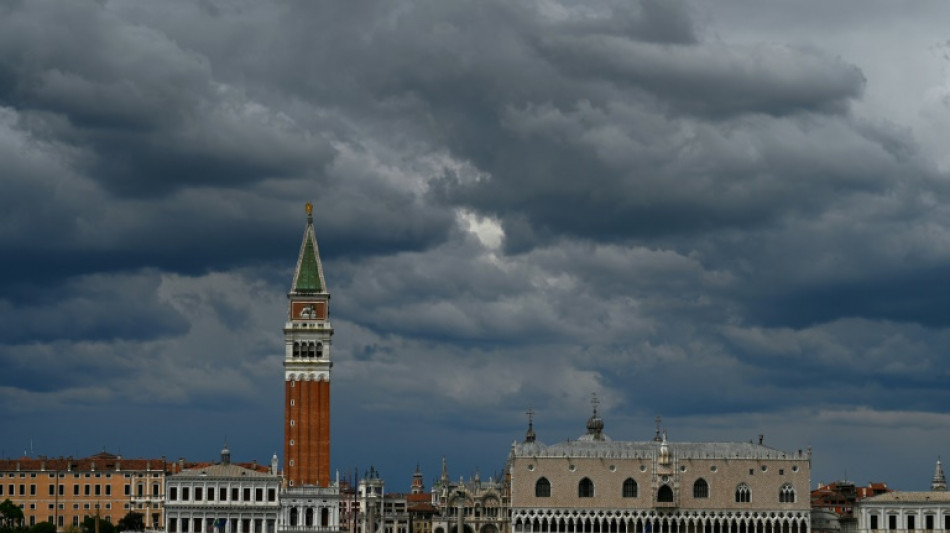
Venice's 60th Biennale opens on humanity and the fragile planet / Photo: GABRIEL BOUYS - AFP

Venice's 60th Biennale international art show has opened its doors, exploring humankind's relationship with the fragile planet, from Greenland's icecaps to deforestation in the Amazon.
The exhibition showcases artists from across the globe, including pavilions from Japan, Denmark, Brazil and the Czech Republic.
The Biennale Arte 2024, one of the world's leading international art exhibitions, runs until November 24.
- Makeshift solutions -
Japanese artist Yuko Mohri's work focussed on makeshift attempts to limit water leaks in Tokyo's underground stations, caused by frequent floods and earthquakes.
In a tribute to human invention, Mohri featured objects used to collect water in vain, including plastic bottles, buckets and pipes.
Decomposed fruits were linked to electrode wires, which control sound by adjusting the degree of humidity, appealing to all the visitor's senses.
The artist aimed to show how "human creativity can really bring about some hopes and solutions when a lot of things are critical", said Sook-Kyung Lee, curator of the Japan pavilion.
To highlight the universality of the climate threat, the artist collected her materials from flea markets in Venice, which has also suffered from flooding.
- Melting ice -
Denmark's pavilion displayed the work of photographer Inuuteq Storch in six series, including "Soon Will Summer Be Over", which documents the effects of climate change, colonisation, Inuit hunting and fishing traditions in the far north of Greenland.
Visitors find nostalgic everyday scenes of the remote land where the sun never sets in the Summer.
Both colour and black-and-white photographs of land, skies and icecaps take visitors through the seasonal cycle in a reminder of the vulnerability of the poles.
"Climate change definitely has a presence," said Louise Wolthers, art historian and curator.
"He (Storch) tells us that hunters cannot practise so much the traditional hunting methods anymore because of climate change and the melting of ice and the more extreme weather conditions."
- 'Unscrupulous men' -
At the entrance to Brazil's pavilion, roots and seeds flowed from an imposing mound of earth to evoke different life forms: human veins, tree sap and Brazilian rivers seen from the sky.
Atop the installation, an old television showed a woman saying: "You have not learned from your mistakes and the forests continue to be torn down to serve unscrupulous men."
"I like to establish a contact between human beings to talk about the importance of an environmental issue, to think about it in a global way," said artist and Indigenous activist Olinda Tupinamba.
- Life and death of a giraffe -
A collaborative project from the Czech Republic, entitled "The heart of a giraffe in captivity weighs 12 kilos less", looks back at the tragic fate of Lenka, captured in Kenya in 1954 and transported to Prague Zoo, where she survived for just two years.
With this installation, Czech artist Eva Kotatkova wanted to recreate the giraffe's insides and skeleton to attract public attention to the human relationship with nature and the violence inflicted on animals.
The exhibit is also mean to provoke reflection, asking "what is my role in this story?", Kotatkova said.
The project resonates with the central theme of this year's event, "Stranieri ovunque-Foreigners Everywhere", in which some 90 countries are represented.
Artist Ruth Patir's video installation had been due to open at Israel's national pavilion, but she said last week that her exhibit would remain closed until a ceasefire was in place and the hostages held captive by Hamas had been released.
N.Tartaglione--PV