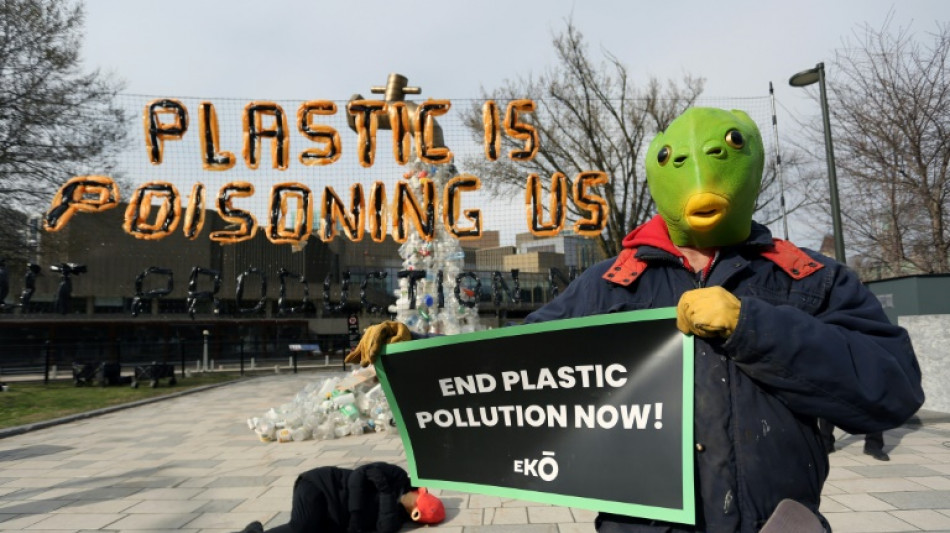
Talks on global plastic treaty begin in Canada / Photo: Dave Chan - AFP

Negotiators from 175 nations began talks Tuesday to agree a global treaty to reduce plastic pollution, which is found everywhere from mountain tops to ocean depths, and within human blood and breast milk.
"The world is counting on us to deliver a new treaty that will catalyze and guide the actions and international cooperation needed to deliver a future free of plastic pollution," said Luis Valdivieso, chair of the negotiations at the UN-led talks in Ottawa, Canada.
"Let's not fail," Valdivieso added as he opened the session that will run to April 29.
Nations agreed in 2022 to finalize a world-first treaty by the end of 2024, with concrete measures to battle plastic pollution around the world.
The meeting in Ottawa is considered crucial as it is the penultimate session before a final round of negotiations in South Korea later this year.
Plastics have created a reliance on "disposable consumer culture," Canadian environment minister Steven Guilbeault said, adding: "We're here today because we recognize that we must throw away this throwaway generation."
In an interview with AFP ahead of the talks, Guilbeault said the goal was to achieve "60 to 70 percent of the elements endorsed" by delegates.
- 'Time is against us' -
Although there is a broad consensus on the need for a treaty, environmental activists pleading for a 75 percent cut in plastic production by 2040 are at odds with oil-producing nations and the plastics industry.
The stakes are high, with widespread plastic pollution having potentially grave impacts on oceans and climate.
Annual plastics production has more than doubled in 20 years to 460 million tonnes, and is on track to triple within four decades.
Only nine percent is recycled, and according to the OECD, its contribution to global warming could more than double by 2060 -- having accounted for 3.4 percent of global emissions in 2019.
"Time is against us both in terms of finalizing the instrument, but also how much more the planet can take as we deliberate," said Inger Andersen, executive director of the UN Environment Program.
During talks in Kenya in November, a draft agreement leapt from 30 to 70 pages, with oil-producing nations such as Saudi Arabia recording their objections to limiting plastic production, instead emphasizing recycling.
For the plastic and chemical industries, recycling is the "most effective way" to end plastic pollution with the "least environmental and economic costs," said Chris Jahn, of the International Council of Chemical Associations, a global trade association.
Meanwhile, 65 members of the so-called "high ambition" coalition, chaired by Rwanda and Norway and including the majority of European Union countries, are calling for more ambitious measures.
"We are at a crossroads," Eirik Lindebjerg, of World Wildlife Fund International, said ahead of the negotiations starting.
He noted that "an overwhelming majority of countries have already called for the adoption of the necessary binding global rules -- our leaders must now transform these calls into action."
L.Guglielmino--PV