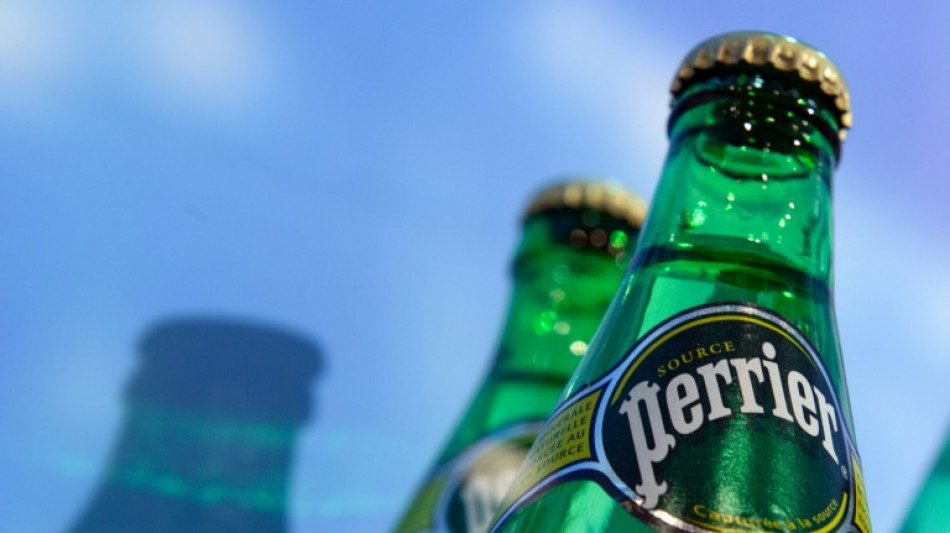
2 million bottles of Perrier ordered destroyed by French agency / Photo: Fabrice COFFRINI - AFP/File

Perrier destroyed two million bottles of its famous sparkling water suspected of being contaminated with "faecal" bacteria under government orders, the public health agency said Thursday.
The announcement of the destruction was the latest blow for Swiss food giant Nestle, whose French water subsidiary is under a criminal investigation for allegedly using illegal means to purify its mineral water.
Health authorities in the Occitanie region of southern France told Nestle Waters France to destroy all Perrier production from March 10 to 14 from one of its sources near Nimes, the DGS health agency said in a document shared with AFP.
Nestle has said about two million bottles were destroyed "out of precaution". The company said that Perrier bottles in stores are safe.
Earlier this month, regional authorities ordered Nestle Waters France to "immediately suspend" production at one of its sources near Nimes, according to a copy of the order seen by AFP.
The order said that "faecal" contamination had been registered from March 10.
Nestle is also the owner of the Vittel, Contrex and Hepar brands and French prosecutors in January opened an investigation in January into its purification methods.
The company has admitted that it disinfected water using UV lamps, carbon filtering and other means that are not allowed for "natural" mineral waters.
The sources for Vittel, Contrex and Hepar brands are in eastern France.
The DGS said that after new checks some water sources in eastern and southern France had been closed or re-classified as "water made drinkable through treatment".
"Before these closures, these catchments were treated fraudulently by the operator," the French health agency said.
The investigation has shaken the whole of France's water industry.
Antoine de Saint-Affrique, director general of French food company Danone, told the company's annual shareholders meeting Thursday that its natural mineral water sources now face "extremely rigorous" monitoring.
Shareholders had raised questions about what steps were being taken at Danone, whose mineral water brands include Evian, Volvic and Badoit.
Saint-Affrique said the company works closely with local farmers and industry to prevent contamination near its water sources.
R.Zarlengo--PV