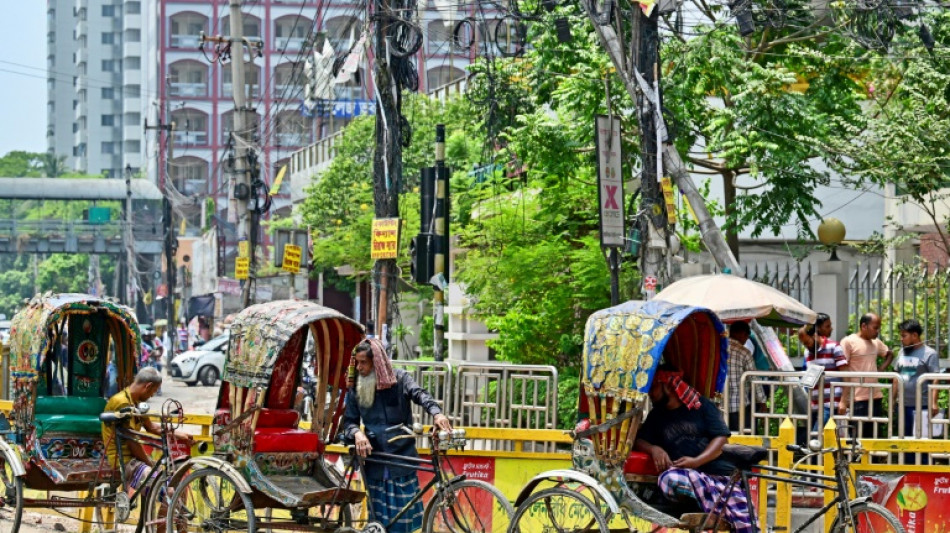
Bangladesh children sweat at home as heatwave shuts schools / Photo: MUNIR UZ ZAMAN - AFP

Classes are cancelled across Bangladesh due to searing heat, but high school student Mohua Akter Nur found the soaring temperatures at home left her in no state for homework.
Millions of pupils were told to stay home this week as the South Asian nation swelters through one of its worst heatwaves on record, with temperatures 4-5 degrees Celsius (7.2-9 degrees Fahrenheit) above the long-term average.
Few schools in the capital Dhaka have air conditioning, and trying to conduct classes would have been futile.
But the government's decision to shutter schools was no relief to 13-year-old Nur.
Her cramped one-room home in the megacity, shared with her younger brother and parents, feels almost as suffocating as the streets outside.
"The heat is intolerable. Our school is shut, but I can't study at home. The electric fan does not cool us," she told AFP.
"When the power went out for an hour or two, it felt terrible."
- 'Unbearable' -
Nur's mother Rumana Islam was laying down in a corner of their home after a sleepless night, coated in sweat after cooking for her family.
"Last year was hot, but this year is too hot -- more than ever. Just unbearable," she said.
"In villages, you can step out and cool yourself under the shade of trees.
"There is some breeze coming from the farmland. But here in Dhaka, all you can do is sit at home."
Temperatures across the country have reached more than 42C (108F) in the past week.
The heat prompted thousands of Bangladeshis to gather in city mosques and rural fields, praying for relief from the scorching heat that forecasters expect to continue through the weekend.
Bangladesh authorities expect to reopen schools from April 28, before temperatures are expected to recede.
Extensive scientific research has found climate change is causing heat waves to become longer, more frequent and more intense.
The United Nations said this week Asia was the region most affected by climate and weather hazards in 2023, with floods and storms the chief causes of casualties and economic losses.
Millions of people across South and Southeast Asia have again sweltered through unusually hot weather this week.
Bangladesh and its 171 million people are already at the forefront of the global climate crisis, regularly battered by powerful cyclones and floods of increasing frequency and severity.
- 'Like you are burning' -
The latest bout of extreme weather has spurred an outbreak of diarrhoea in the country's south, due to higher temperatures and the resulting increased salinity of local water sources.
Around the tenement building where Nur's family lives, alongside dozens of other low-income families, adults tried to block out the worst of the heat by dozing fitfully in their homes through the afternoon.
"The heat is so intense that it's tough to be out driving in these conditions," said 40-year-old Mohammad Yusuf, who like Nur's father and many of their neighbours, makes ends meet as a driver.
"You can get some respite when the air conditioner is on," he said. "But when you are outside, it feels like you are burning".
O.Mucciarone--PV