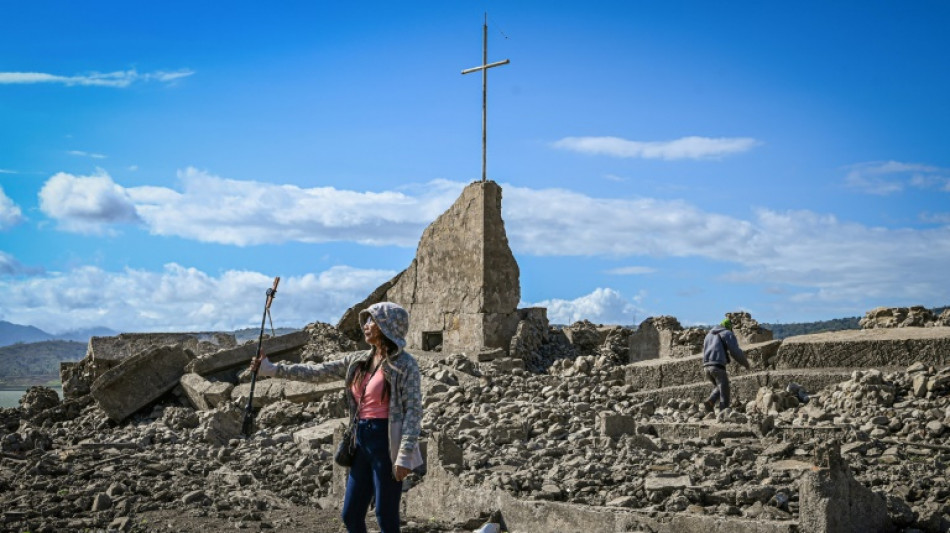
Philippine settlement submerged by dam reappears due to drought / Photo: JAM STA ROSA - AFP

A centuries-old settlement submerged by the construction of a dam in the northern Philippines in the 1970s has reappeared as water levels drop due to a drought affecting swathes of the country.
The ruins in the middle of Pantabangan Dam in Nueva Ecija province are a tourist draw, even as the region swelters in extreme heat.
Parts of a church, municipal hall marker and tombstones began to resurface in March after several months of "almost no rain", said Marlon Paladin, a supervising engineer for the National Irrigation Administration.
It is the sixth time the nearly 300-year-old settlement has resurfaced since the reservoir was created to provide irrigation water for local farmers and generate hydro-power.
"This is the longest time (it was visible) based on my experience," Paladin told AFP.
The reservoir's water level has fallen nearly 50 metres (164 feet) from its normal high level of 221 metres, figures from the state weather forecaster show.
The months of March, April and May are typically the hottest and driest in the archipelago nation, but conditions this year have been exacerbated by the El Nino weather phenomenon.
About half of the country's provinces, including Nueva Ecija, are officially in drought.
Tourists wanting a close-up of the ruins pay around 300 pesos ($5.00) to fishermen for a short boat ride out to the temporary island in the middle of the reservoir.
Nely Villena, who lives in Pantabangan municipality, regularly visits a viewing platform overlooking the dam to see the ruins.
"The view is better when the water level is low. If the water is too high... all I can see is water," Villena, 48, told AFP, as a strong wind whipped across the water, providing relief from the scorching heat.
- 'Badly need water' -
The actual air temperature in Nueva Ecija has reached around 37 degrees Celsius (99 degrees Fahrenheit) most days this week, with the heat index hovering above the "danger" level of 42C.
The heat index measures what a temperature feels like, taking into account humidity.
Hundreds of residents of the submerged villages and farms where the dam is located were moved by the government to higher ground.
Melanie Dela Cruz, 68, was a teenager when her family was forced to leave their home. This year she returned for the first time.
"I got emotional because I got to recall my old life there," Dela Cruz told AFP.
"My heart was overwhelmed because I studied there, I was even born there."
The receding water level forced two hydropower plants near the dam to stop operating earlier this month, ahead of the normal shutdown on May 1.
It also deprived many rice farmers of much-needed irrigation water, forcing some to switch to growing vegetables, which require less water.
Dela Cruz said she prays for rain even though it means her old home will again disappear from view.
"Our farmers badly need water for their fields," she said.
E.Magrini--PV