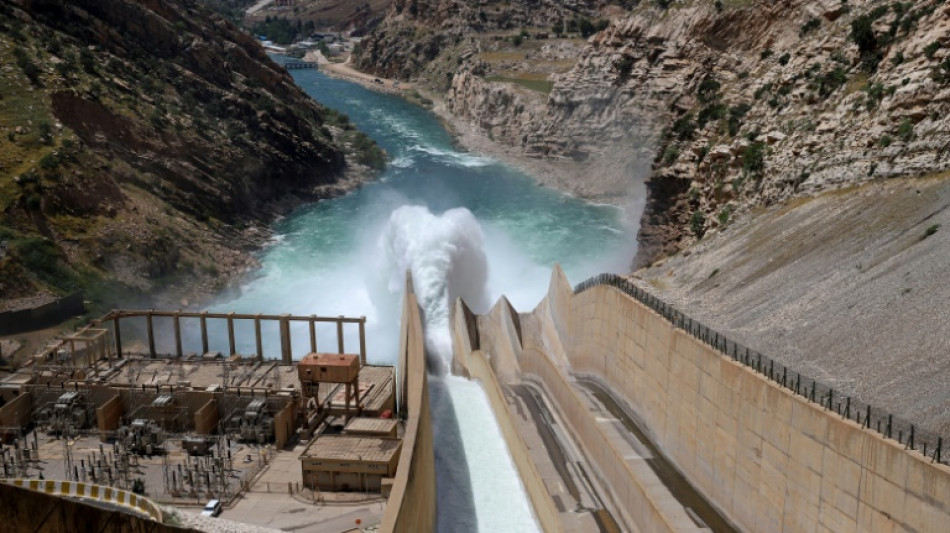
'A blessing': Rains refill Iraq's drought-hit reservoirs / Photo: Shwan MOHAMMED - AFP

The reservoir behind the massive Darbandikhan dam, tucked between the rolling mountains of northeastern Iraq, is almost full again after four successive years of drought and severe water shortages.
Iraqi officials say recent rainfall has refilled some of the water-scarce country's main reservoirs, taking levels to a record since 2019.
"The dam's storage capacity is three million cubic metres (106 million cubic feet). Today, with the available reserves, the dam is only missing 25 centimetres (10 inches) of water to be considered full," Saman Ismail, director of the Darbandikhan facility, told AFP on Sunday.
Built on the River Sirwan, the dam is located south of the city of Sulaimaniyah in Iraq's autonomous Kurdistan region.
"In the coming days, we will be able to say that it's full," said Ismail, with the water just a few metres below the road running along the edge of the basin.
The last time Darbandikhan was full was in 2019, and since then "we've only had years of drought and shortages," said Ismail.
He cited "climate change in the region" as a reason, "but also dam construction beyond Kurdistan's borders".
The central government in Baghdad says upstream dams built in neighbouring Iran and Turkey have heavily reduced water flow in Iraq's rivers, on top of rising temperatures and irregular rainfall.
This winter, however, bountiful rains have helped to ease shortages in Iraq, considered by the United Nations to be one of the five countries most vulnerable to some impacts of climate change.
In Iraq, rich in oil but where infrastructure is often run-down, torrential rains have also flooded the streets of Kurdistan's regional capital Arbil.
Four hikers died last week in floods in Kurdistan, and in Diyala, a rural province in central Iraq, houses were destroyed.
- 'Positive effects' -
Ali Radi Thamer, director of the dam authority at Iraq's water resources ministry, said that most of the country's six biggest dams have experienced a rise in water levels.
At the Mosul dam, the largest reservoir with a capacity of about 11 billion cubic metres, "the storage level is very good, we have benefitted from the rains and the floods," said Thamer.
Last summer, he added, Iraq's "water reserves... reached a historic low".
"The reserves available today will have positive effects for all sectors", Thamer said, including agriculture and treatment plants that produce potable water, as well as watering southern Iraq's fabled marshes that have dried up in recent years.
He cautioned that while 2019 saw "a sharp increase in water reserves", it was followed by "four successive dry seasons".
Water has been a major issue in Iraq, a country of 43 million people that faces a serious environmental crisis from worsening climate change, with temperatures frequently hitting 50 degrees Celsius (122 degrees Fahrenheit) in summer.
About five kilometres (three miles) south of Darbandikhan, terraces near a small riverside tourist establishment are submerged in water.
But owner Aland Salah prefers to see the glass half full.
"The water of the Sirwan river is a blessing," he told AFP.
"When the flow increases, the area grows in beauty.
"We have some damage, but we will keep working."
C.Grillo--PV