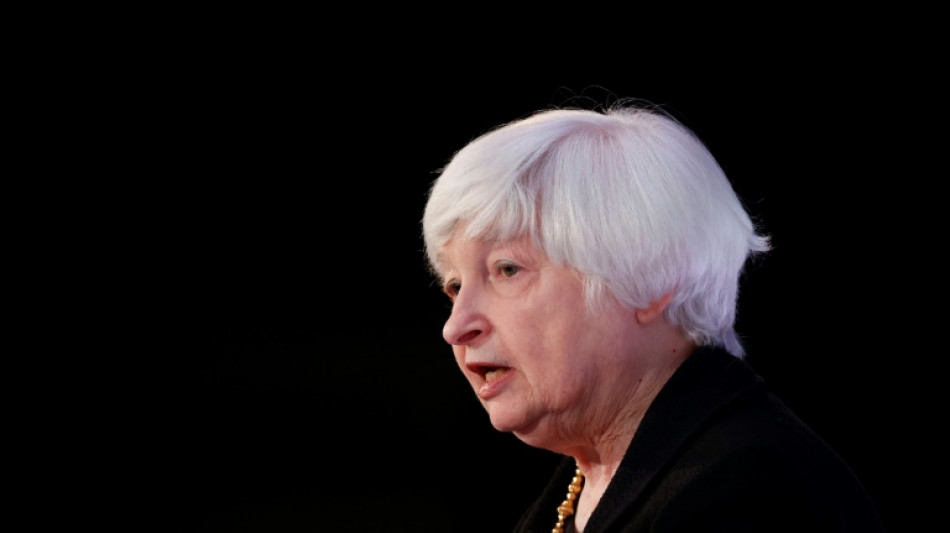
US to unveil 'guardrails' needed for carbon markets to succeed / Photo: KAMIL KRZACZYNSKI - AFP/File

President Joe Biden's administration is set Tuesday to unveil "guardrails" it says will ensure that carbon offset markets effectively reduce greenhouse gas emissions, a significant win for advocates of the contentious schemes.
Treasury Secretary Janet Yellen will lay out the government's first broad guidelines for "high-integrity" carbon markets, aimed at boosting confidence in a system that critics have panned as greenwashing.
To transition to a low-carbon economy, "We need to use all the tools at our disposal -- creatively, thoughtfully, and at scale," she will declare in an event with other senior officials, including White House senior climate adviser John Podesta.
"I believe that harnessing the power of markets and private capital is critical. This includes efforts to grow high-integrity voluntary carbon markets."
Carbon credits enable corporations and countries to offset their greenhouse gas emissions, with each credit representing the reduction or removal of one tonne of CO2, often in developing countries through projects combating deforestation.
The carbon offsets market is currently worth around $2 billion, but has come under intense fire recently after research has shown that claims of reduced emissions under the schemes are often hugely overestimated -- or simply non-existent.
Yellen will outline principles emphasizing integrity in three key areas: supply-side credits tied to genuine emissions reductions or removals; demand-side corporate accountability that prioritizes emission reduction; and market integrity through greater transparency and reduced complexity.
- US imprimatur -
The release of the guidelines signal the US government is throwing its weight behind the controversial climate financing mechanisms.
Prominent advocates of carbon markets, including former US climate envoy John Kerry, argue that government funding alone is insufficient to meet the Paris accord's goal of limiting warming to 1.5 degrees Celsius.
Kenya's President William Ruto has hailed Africa's carbon sinks as an "unparalleled economic goldmine" with the potential to generate billions annually.
The UN special envoy on climate ambition and solutions, business tycoon Michael Bloomberg, welcomed the announcement.
"These will help increase investment in projects that reduce emissions and help more businesses grow while reducing their carbon footprints," he said in a statement with UN special envoy on climate action and finance Mark Carney, and Mary Schapiro, former chair of the US securities and exchange commission.
But scientists emphasize that offsetting should not be used as a license to continue polluting, as emissions must fall by nearly half this decade to meet global warming goals.
A recent global scientific review found that market-based approaches to forest conservation, including carbon offsets and deforestation-free certification schemes, have largely failed to protect trees or alleviate poverty.
Earlier this month, the United Nations introduced rules allowing individuals harmed by carbon credit projects, mostly in the developing world, to file formal appeals.
Activities linked to carbon markets include renewable energy generation, protecting carbon-absorbing environments like forests or peatlands, and replacing coal-fired cookstoves with cleaner alternatives.
But as these schemes have proliferated, allegations of local communities being exploited or displaced have also grown.
A.dCosmo--PV