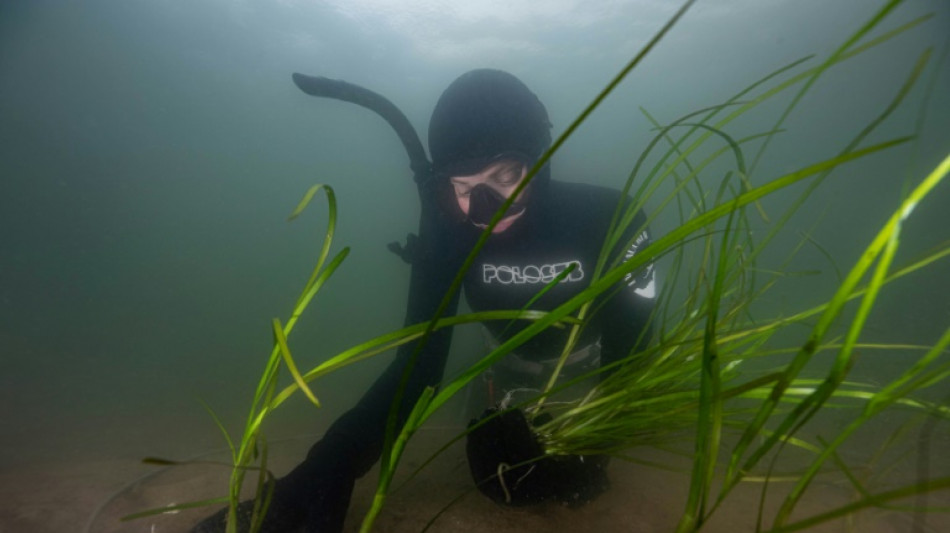
Underwater gardeners plant eelgrass to save 'dead' Danish fjord / Photo: Helene-Julie Zofia PAAMAND - Underwater Ambassador/AFP

Under a white tent on the shores of a polluted Danish fjord, volunteers and researchers prepare slender green shoots of eelgrass to be planted on the seabed to help restore the site's damaged ecosystem.
Denmark generally has a strong track record on environmental issues, but only five of its 109 coastal zones are considered healthy, according to the Danish Environmental Agency.
Like other coastal areas in Denmark, the Vejle fjord is suffering from eutrophication -- a process in which nutrients, often from land run-off, accumulate in a body of water and lead to increased growth of microorganisms and algae.
The algae cover water surfaces, blocking light and cutting off oxygen, killing plants and wildlife.
An underwater surveillance camera installed in the Vejle fjord by the municipality last year detected just one fish in 70 hours.
- 'Completely collapsed' -
In Denmark, a major pork producer, more than 60 percent of the country's land is used for agriculture -- one of the highest concentrations in the world -- sparking frequent warnings in recent years about the risk of run-off.
A 2022 report by the University of Southern Denmark (USD) concluded the 22-kilometre (14-mile) Vejle fjord was in "poor environmental condition" because of high levels of nitrogen run-off from fertiliser use on farms.
And when the mercury rises, so does the problem.
"We had a very warm summer in 2023, and that resulted in a huge oxygen depletion," a biologist who works for Vejle municipality, Mads Fjeldsoe Christensen, told AFP.
"That was quite severe. We witnessed a lot of dead fish."
He noted that excess nutrients had been emitted into the fjord for "the last 30, maybe 40 years."
"For a long time, the fjord has been able to recover. But for the last maybe three, four years, we have witnessed a fjord that has completely collapsed."
Scientists and the municipality decided in 2018 to reintroduce the slender green eelgrass in the busy inlet in the hopes of restoring its once lush seabed, and the wildlife that thrived among them.
In Vejle, some 50 volunteers turned out on a recent weekend to help the scientists.
Braving gloomy, blustery weather, they crowded around tables with buckets full of eelgrass shoots that scientists had picked from zones where it is thriving.
The volunteers rolled the individual shoots around biodegradable nails, which divers then took and transplanted into the seabed.
"Eelgrass is where all the fish grow up, so they're like kindergarten for fish life," Fjeldsoe Christensen said.
"If you do not have eelgrass, there's simply no space for the fish population to grow up."
- Vejle fjord 'funeral' -
Six hectares of seabed and more than 100,000 eelgrass shoots have been planted on the seabed since the transplants began in 2020.
In some places, divers have observed a return of aquatic life, such as crabs and fish.
"We do see effects of the nature restoration," said SDU biologist Timi Banke, who is taking part in the project.
In April, Greenpeace organised an open-air "funeral" for the Vejle fjord to draw attention to the dire state of Danish coastal waters.
"It is in bad condition and that's why we're doing something, but it's not dead," Banke told AFP, hailing the efforts undertaken by environmentalists and locals.
On World Oceans Day on June 8, the Danish think-tank Ocean Institute organised eelgrass transplant operations at 32 sites across the country.
"By planting eelgrass, we are putting the emphasis on restoring nature, but that doesn't mean we should forget that we also have to reduce the emission of nutrients in Danish waters under pressure," the think tank's director Liselotte Hohwy Stokholm wrote on the organisation's website.
A.Fallone--PV